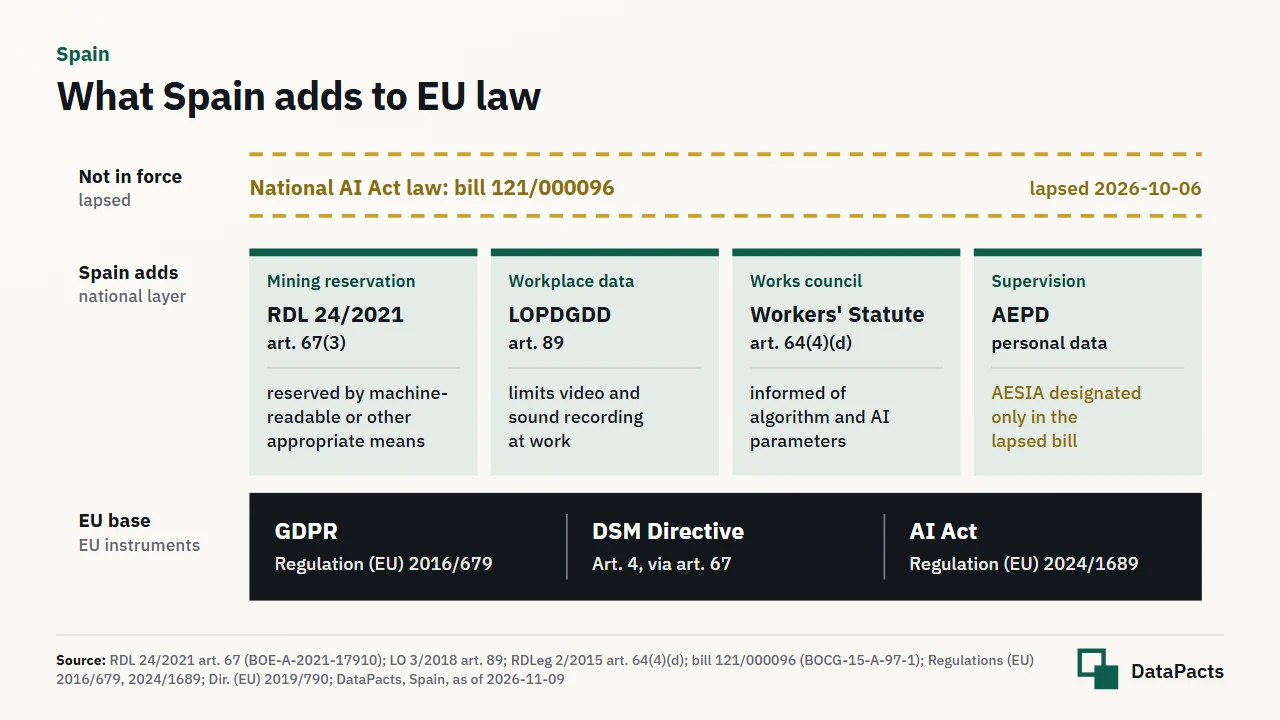
Article 67 has been in force since 2021-11-04, and the Spanish AI governance bill 121/000096 lapsed on 2026-10-06.
This page sets out the instruments, dated changes and Spanish-content deals as of 2026-11-09, for the data holder and for the AI developer.
It is a free-to-read part of the wider reference on AI training data licensing, covers EU rules only where Spain implements or differs from them, and cites the Boletín Oficial del Estado (BOE) and the Congreso record.
Each figure is dated and checked against the official text, as described in the method for sourcing and dating every figure.
What Spanish Law Adds to EU Rules Before a Company Licenses Data for Training
Spanish law decides four things on top of the EU instruments: how a reservation against mining is expressed and what it covers, which workplace data may be recorded and passed on, who must be informed inside the company, and which authority supervises AI systems.
- Reservation: Real Decreto-ley 24/2021, art. 67(3), (6) and (7).
- Workplace data: LOPDGDD art. 89.
- Information: Estatuto de los Trabajadores art. 64(4)(d).
- Supervision: the AEPD for personal data, and AESIA as designated by the lapsed bill.
The GDPR (Regulation (EU) 2016/679, applies from 2018-05-25) applies directly in Spain. The AI Act applies in general from 2026-08-02 without a Spanish implementing law in force.
Spanish Instruments and Authorities That Apply to a Training Data Deal
Ten Spanish instruments, authorities and record gaps shape a training-data license, and the table gives each citation, its date and whether it is final, lapsed or not stated. The label "not stated" means no primary source was verified on 2026-11-09, not that no rule exists.
| Instrument | Citation | Dates | What it decides in a data deal | Final, lapsed or not stated | Source |
|---|---|---|---|---|---|
| Real Decreto-ley 24/2021, art. 67 | BOE-A-2021-17910, art. 67 (Libro cuarto; not the TRLPI) | in force 2021-11-04; consolidated 2023-06-29 | TDM exception; reservation by machine-readable or other appropriate means (67(3)); reaches programs and databases (67(6), (7)) | final | boe.es |
| LOPDGDD | LO 3/2018, BOE-A-2018-16673 | in force 2018-12-07; consolidated 2025-12-27 | art. 7 consent age 14; art. 89 workplace video and sound | final | boe.es |
| Estatuto de los Trabajadores, art. 64(4)(d) | RDLeg 2/2015, BOE-A-2015-11430 | in force | works council informed of algorithm and AI system parameters | final | boe.es |
| GDPR | Regulation (EU) 2016/679 | applies from 2018-05-25 | legal basis, notices and transfers for personal data in the set | final | eur-lex.europa.eu |
| AEPD | Agencia Española de Protección de Datos | n/a | Spanish data protection authority; its AI guidance is not stated on this page | authority | aepd.es |
| AESIA | Agencia Española de Supervisión de Inteligencia Artificial | n/a | designated in the lapsed bill for most prohibited practices and Annex III areas; founding statute not stated | designation lapsed | aesia.digital.gob.es; congreso.es |
| AI bill 121/000096 | BOCG-15-A-97-1 | published 2026-06-12; lapsed 2026-10-06 | AI Act governance and sanctions; no training-data provision found | lapsed | congreso.es; boe.es |
| US-Spain treaty rates on royalties | IRS Tax Treaty Table 1, Rev. May 2023, income codes 10 and 12 | as of 2026-11-09 | 0% US withholding for Spanish residents, subject to limitation on benefits | final | irs.gov |
| Spanish withholding on royalties paid abroad | not stated | not stated | not stated | not stated | n/a |
| Recording of calls and meetings outside the workplace | not stated | not stated | not stated | not stated | n/a |
How Each Spanish Rule Reaches the Seller and the Buyer
The table lists each instrument; the sections below show what each one asks of the data holder and of the AI developer.
Reserving Content Under Article 67 of Real Decreto-ley 24/2021
Article 67 of Real Decreto-ley 24/2021 (BOE-A-2021-17910), in force since 2021-11-04, is Spain's single text and data mining article, and it sits in the decree itself, not in the consolidated intellectual property law (TRLPI). It implements Articles 3 and 4 of Directive (EU) 2019/790, whose transposition deadline was 2021-06-07, so Spain transposed after the deadline.
Under art. 67(3) the exception does not apply where rightsholders have expressly reserved use "a medios de lectura mecánica u otros medios que resulten adecuados", that is, by machine-readable or other appropriate means. Spain sits with Germany, the Netherlands, France and Austria in naming machine-readable means.
Art. 67(6) and (7) extend the exception to computer programs and to the extraction and reuse of substantial parts of databases, so a code or database holder who wants license value records a reservation.
The conditions of the research paragraphs of art. 67 are not stated here. The Directive's rule and its court questions sit on the page about the EU text and data mining exception.
Personal Data in the Set: What the LOPDGDD and the AEPD Add
The GDPR decides whether personal data in a dataset may be licensed for training, and Ley Orgánica 3/2018 (LOPDGDD, BOE-A-2018-16673, in force 2018-12-07) adds Spanish rules on top, enforced by the Agencia Española de Protección de Datos (AEPD).
Art. 7 sets the age of digital consent at 14, and the consolidated text was last updated on 2025-12-27. The AEPD is among the 16 co-signatories of the concluding joint statement on data scraping of October 2024.
The AEPD's own guidance on AI is not stated on this page. The legal-basis analysis sits in the page on GDPR and AI training data.
Employee Records and Recordings: LOPDGDD Article 89 and the Works Council's Right to Information
Two Spanish rules reach staff data before it enters a training set: LOPDGDD article 89 limits what may be recorded at work, and article 64(4)(d) of the Estatuto de los Trabajadores gives the works council information on algorithms.
- Art. 89: video surveillance needs prior express information; sound recording is admitted only where relevant security risks exist, and never in rest areas.
- ET art. 64(4)(d) (RDLeg 2/2015, BOE-A-2015-11430): the works council is informed of the parameters, rules and instructions of algorithms or AI systems that affect working conditions, access to and retention of employment, including profiling.
Recordings made outside art. 89 are a weak base for a license, and information to the works council is not consent.
The LOPDGDD's other digital rights at work, checked on boe.es on 2026-11-10, are art. 87 (privacy in the use of digital devices), art. 88 (digital disconnection), art. 90 (geolocation) and art. 91 (collective agreements); what each requires of a licensor is not stated here.
Spanish rules on recording calls outside the workplace are not stated either. The steps for staff are in employee notice and consent before a license.
AESIA, the AEPD and the AI Bill That Lapsed in October 2026
Spain has no national AI Act implementing law in force: bill 121/000096 lapsed (caducado) on 2026-10-06 when Real Decreto 806/2026 dissolved the Cortes Generales, with a general election set for 2026-11-29. The Council of Ministers approved the anteproyecto on 2025-03-11, the bill was presented on 2026-05-28 and published in the BOCG on 2026-06-12, and the amendment period ran to 2026-10-06 with no committee report.
The bill designated AESIA (art. 5(2)) for most prohibited practices and most Annex III high-risk areas and the AEPD (art. 5(3)) for Art. 5(1)(e) and (g) practices and certain biometric systems, and no training-data or copyright provision was found in it.
A new government must reintroduce it, and AESIA's founding statute and its current AI Act role are not stated here.
Royalty Payments Between Spain and the United States
A US buyer paying a royalty to a Spanish-resident seller withholds 0% on copyright royalties (income code 12) and on other industrial royalties (income code 10) under IRS Table 1, Rev.
May 2023, subject to the treaty's limitation-on-benefits test. Spanish withholding on royalties paid by a Spanish buyer to a non-resident is not stated here. The withholding page compares rates for other countries in its table.
Enacted, Lapsed and Open: Spanish Changes as of November 2026
Nine dated items changed how Spanish law treats training data, and the table keeps enacted law, lapsed bills and EU dates apart.
| Date | Item | Citation or actor | Status as of 2026-11-09 | Source |
|---|---|---|---|---|
| 2026-10-06 | AI bill 121/000096 lapses on dissolution of the Cortes | Real Decreto 806/2026, BOE-A-2026-20742; election 2026-11-29 | lapsed | congreso.es; boe.es |
| 2026-08-02 | AI Act general application | Regulation (EU) 2024/1689, Art. 113 | applies | eur-lex.europa.eu |
| 2026-06-12 | AI bill published, amendment period opens | BOCG-15-A-97-1 | ran to 2026-10-06, no committee report | congreso.es |
| 2025-12-27 | LOPDGDD consolidated text last updated | LO 3/2018 | current text | boe.es |
| 2025-08-02 | AI Act Chapter V (general-purpose models, incl. Art. 53) applies | Regulation (EU) 2024/1689 | applies | eur-lex.europa.eu |
| 2025-03-11 | Council of Ministers approves the AI anteproyecto | Referencia del Consejo de Ministros | approved as draft | lamoncloa.gob.es |
| 2024-10 | AEPD co-signs the concluding joint statement on data scraping | 16 authorities | published | priv.gc.ca |
| 2021-11-04 | RDL 24/2021 in force, including art. 67 | BOE-A-2021-17910 | in force | boe.es |
| 2021-06-07 | DSM Directive transposition deadline | Directive (EU) 2019/790, Art. 29(1) | passed before Spain transposed | eur-lex.europa.eu |
A lapsed bill has no effect and does not carry over to the next legislature. The AI Act's EU dates apply in Spain regardless, and a consolidated text date is the last BOE update, not a new rule.
Spanish News Content Licensed to AI Developers: Prisa Media's Agreements
Prisa Media, the Spanish publisher of El País, Cinco Días, As and El Huffpost, holds three dated agreements with AI developers, and only the OpenAI agreement states that the content will train models. Each row below is the named party's own statement, as of 2026-11-09.
| Date | Agreement | Content and use | Value | Source |
|---|---|---|---|---|
| 2024-03-13 | OpenAI and Prisa Media | El País, Cinco Días, As, El Huffpost in ChatGPT; will also contribute to "la formación y mejora continua de los modelos" | not disclosed | elpais.com |
| 2025-12-10 | Google News AI pilot: El País | enhanced content for AI features in Google News; Google "pay[s] participating news publications" | not disclosed | blog.google |
| 2026-07 (listed 2026-07-27) | Meta AI news partners: PRISA | real-time news with links in Meta AI answers; training not mentioned | not disclosed | about.fb.com |
No value is disclosed in any of the three. Google says it pays participating publications for enhanced content without naming amounts, and Meta's post does not mention training.
Spanish law does not change these terms, but art. 67(3) is why a reservation precedes a license. Every dated deal is listed in the AI data licensing deal tracker.
Benefits, Risks, Downsides and Alternatives of Licensing Data Under Spanish Law, Including Not Selling
Spanish law lets a company license data it holds the rights to, and the art. 67 reservation gives content license value, but workplace rules, the database and software reach of the exception and open national items add conditions, and not licensing remains a valid choice.
Benefits
- A reservation by machine-readable or other appropriate means is accepted under art. 67(3).
- The US treaty rate on royalties to Spanish residents is 0%, subject to limitation on benefits.
- A dated precedent exists of Spanish content licensed for training (OpenAI and Prisa Media, 2024-03-13).
Risks
- Code and databases are minable under art. 67(6) and (7) unless reserved.
- Recordings made outside the limits of LOPDGDD art. 89 are a weak base for a license.
- Consent-based processing of data of minors under 14 needs parental consent under LOPDGDD art. 7.
Downsides
- The works council must be informed before AI systems that affect staff, under ET art. 64(4)(d).
- No national AI law is in force and several items are not stated, so advice per deal is needed.
Alternatives
- License only content without personal data.
- Keep the data and record an art. 67(3) reservation.
- License de-identified data.
- Not selling or licensing at all, among the alternatives, including not selling.
Beyond the Spanish Layer: EU Instruments, Neighboring Countries and the Sale
Spanish law stops at the EU layer above it and at the contract; the pages below cover the EU instruments, neighboring countries, cross-jurisdiction comparisons and the sale.
- The EU layer above Spanish law, the parent page.
- AI training data law in every jurisdiction.
- What the AI Act asks of model providers.
- French rules next door.
- Italian rules.
- Portuguese rules.
- How copyright exceptions compare.
- Employee data rules by jurisdiction.
- Recording consent compared.
- Scraping law, where the AEPD's joint statement belongs.
- Machine-readable signals in robots.txt.
- Programs that accept EU company data.
- Selling from outside the US.
- The steps to sell or license company data.
How This Page Is Sourced and Dated
Every rule here cites the Boletín Oficial del Estado, the Congreso record, the Council of Ministers reference or the IRS treaty table, with the date it was checked.
The rules for dating and checking are set out in the method for sourcing and dating every figure. This page is general information about Spanish law, not legal advice for any specific deal.
Frequently Asked Questions
How does a rightsholder in Spain reserve content from AI mining?
By an express reservation by machine-readable or other appropriate means. Art. 67(3) of Real Decreto-ley 24/2021 excludes the exception where use is reserved "a medios de lectura mecánica u otros medios que resulten adecuados".
Is Spain's AI law in force?
No national AI bill is in force. Bill 121/000096 lapsed on 2026-10-06, while the AI Act applies directly in Spain, in general from 2026-08-02.
Can a Spanish company license workplace recordings for AI training?
Only if they were lawfully made. LOPDGDD art. 89 admits sound recording only for relevant security risks and never in rest areas, and ET art. 64(4)(d) requires information to the works council.
At what age can a minor in Spain consent to data processing online?
At 14. LOPDGDD art. 7 sets the age of digital consent at 14 years.