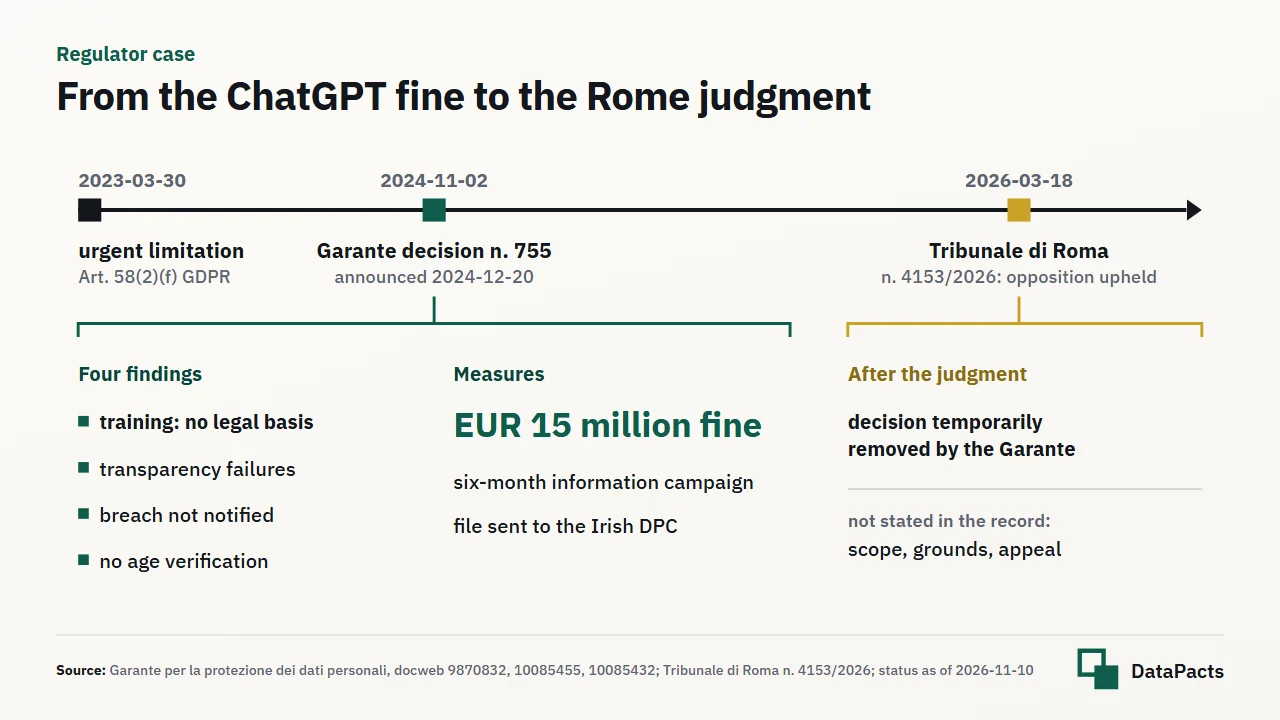
As of November 10, 2026 the Garante has temporarily removed decision n. 755 from its website, and its notice does not say whether the decision was set aside in whole or in part.
This page is part of the independent reference on AI training data licensing, it is not legal advice, and DataPacts is not affiliated with either party. Figures and dates come from the Garante's own pages, and how figures are sourced and dated is explained on the methodology page.
Garante v. OpenAI at a Glance: Authority, Court, Numbers and Status
The Garante's decision n. 755 is off its website after the Tribunale di Roma upheld OpenAI's opposition on March 18, 2026, and no primary source states a later step.
The table lists the record as of 2026-11-10, with the authority, the court, the party, the decision, the measures and the present status, each tied to a Garante page. The decision page (docweb 10085455) now shows only the notice on the court judgment.
| Field | Value | Source |
|---|---|---|
| Proceeding | Garante per la protezione dei dati personali v. OpenAI (ChatGPT); OpenAI v. Garante (opposition) | garanteprivacy.it docweb 10085432 |
| Authority | Garante per la protezione dei dati personali (Italian data protection authority) | garanteprivacy.it |
| Court | Tribunale di Roma (opposition) | garanteprivacy.it docweb 10085455 |
| Party | OpenAI L.L.C. | garanteprivacy.it docweb 9870832 |
| Decision | provvedimento n. 755 of 2024-11-02 (docweb 10085455), announced 2024-12-20 | garanteprivacy.it docweb 10085432 |
| Measures | EUR 15,000,000 fine; six-month information campaign (Art. 166(7) Privacy Code); file sent to the Irish DPC | garanteprivacy.it docweb 10085432 |
| Judgment | Tribunale di Roma n. 4153/2026, published 2026-03-18: opposition upheld | garanteprivacy.it docweb 10085455 |
| Status | decision temporarily removed from the Garante website; scope of the judgment and any appeal not stated (checked 2026-11-10) | garanteprivacy.it docweb 10085455 |
What the Garante Found About ChatGPT's Processing of Personal Data
The Garante found four breaches in OpenAI's handling of ChatGPT: training on users' personal data without first identifying an appropriate legal basis, transparency and information failures toward users, a March 2023 data breach not notified to the authority, and no age verification.
- Legal basis: training on users' personal data without first identifying an appropriate legal basis.
- Transparency: failures to inform users.
- Breach notification: a March 2023 data breach not notified to the authority.
- Age: no age-verification mechanism.
These are the Garante's findings as announced on December 20, 2024, not findings of a court. The reasoning of the Rome judgment is not stated in any primary source, so the page does not give it.
The four findings concern different parts of one service. The first goes to the step before any model is trained, the choice of a legal basis, and the second to what users are told.
The third concerns a security incident of March 2023 and whether it was reported to the authority, and the fourth the absence of a mechanism to check users' age. Only the first is about training data as such, and it is the reason the case is tracked on a site about AI training data licensing.
The general rules on how a seller and a buyer rely on a legal basis for personal data in a training set sit on the page on GDPR and AI training data, framed as how the GDPR's legal-basis rules apply to a licensed dataset.
Garante v. OpenAI Timeline, 2023 to 2026
Four dated steps make up the public record: an urgent limitation in 2023, the fine decision in 2024, its announcement seven weeks later, and the Rome judgment in 2026.
The table gives each step with its number and source, as of 2026-11-10. About 19 months pass between the 2023 limitation and the decision of 2024-11-02, 48 days between the decision and its announcement, and about 15 months between the announcement and the judgment published on 2026-03-18.
| Date | Body | Act | Number | Effect | Source |
|---|---|---|---|---|---|
| 2023-03-30 | Garante | urgent temporary limitation, Art. 58(2)(f) GDPR | registro n. 112 | processing of personal data through ChatGPT limited | docweb 9870832 |
| 2024-11-02 | Garante | corrective and sanctioning decision | provvedimento n. 755 | EUR 15 million; six-month campaign (Art. 166(7) Privacy Code) | docweb 10085455 |
| 2024-12-20 | Garante | press release | docweb 10085432 | decision announced; file sent to the Irish DPC | docweb 10085432 |
| 2026-03-18 | Tribunale di Roma | judgment published | n. 4153/2026 | OpenAI's opposition upheld; decision temporarily removed by the Garante | docweb 10085455 |
The Urgent Limitation of March 30, 2023
On March 30, 2023 the Garante ordered an urgent temporary limitation of OpenAI's processing of personal data through ChatGPT (registro dei provvedimenti n. 112), using its power under Art. 58(2)(f) GDPR.
That order started the inquiry that closed with decision n. 755 on November 2, 2024. The Garante names OpenAI L.L.C. as the party in the 2023 order, and the order is the first of the four steps in the timeline.
The order is a measure of a different kind from the later decision. Art. 58(2)(f) GDPR is the power to impose a limitation on processing, and the 2023 order used it as an urgent, temporary step, while the 2024 decision is the sanctioning decision that closed the inquiry.
The page names Art. 58(2)(f) as the basis of the order and does not paraphrase the article.
Decision n. 755 of November 2, 2024: Fine, Six-Month Campaign and the File Sent to Ireland
Decision n. 755 of November 2, 2024 fined OpenAI EUR 15 million and ordered a six-month information campaign, the first use of the Garante's power under Art. 166(7) of the Italian Privacy Code. The Garante announced it on December 20, 2024 in a press release (docweb 10085432), and the decision page is docweb 10085455.
The campaign order runs for six months and sits next to the fine of EUR 15 million announced on December 20, 2024. The fine is stated in euros only, as the Garante states it, and no conversion into another currency is given here.
The Garante also sent the file to the Irish Data Protection Commission, as it announced on December 20, 2024. The Irish side of the record is covered on the page on Ireland's rules for licensing data for AI training.
Tribunale di Roma Judgment n. 4153/2026: OpenAI's Opposition Upheld
The Tribunale di Roma upheld OpenAI's opposition against decision n. 755 in judgment n. 4153/2026, published on March 18, 2026, and the Garante then temporarily removed the decision from its website.
The Garante's notice reads "è stata accolta l'opposizione proposta avverso il provvedimento del Garante" in Italian and "upheld the appeal lodged against the Authority's decision" in its English version (checked 2026-11-10).
The notice does not say whether the decision was set aside in whole or in part, what the court's grounds were, or whether the Garante appealed. Press and commentary describe the outcome in their own words and give grounds; this page does not repeat them.
The court is named only as the issuer of the judgment, cited through the Garante's notice. The page uses the notice's own wording, "upheld", and the Garante's own description of the decision as temporarily removed, because those are the two statements the primary source makes. The status is dated 2026-11-10.
What the Rome Record Means for Sellers and Licensors of Personal Data
For a company that licenses records containing personal data, the Garante record shows that an EU authority treated training on personal data without a legal basis identified in advance as a breach, while the Rome judgment shows that such a decision can be opposed in court with the outcome published only as a one-line notice.
The balancing test that a seller documents before disclosure is covered under legitimate interest for AI training data.
The record decides nothing about a licensing contract. The findings of 2024-11-02 concern OpenAI as the controller of ChatGPT, not a seller of data, and the court outcome rests on grounds that no primary source states, so it gives no general rule.
A seller who relies on a buyer's legal basis still needs its own basis to disclose the records. An enforcement record can change after a court challenge, so dated checks of the source matter. This page is information, not legal advice.
The seller's own documents answer which legal basis it relies on to disclose the records and what the people in them were told. The case answers neither.
Where Garante v. OpenAI Sits Among Regulator Actions on Training Data
Garante v. OpenAI is the tracked proceeding in which a data protection authority fined an AI developer over training on personal data, and other regulators and courts have reached different results on the same question. Every tracked proceeding with its docket and status is on the case tracker of AI copyright lawsuits over training data.
The table compares four related actions on personal data and AI, as of 2026-11-09. Each row differs from Garante v. OpenAI in the authority, the country or the stage reached, and the GEDI row is a separate Garante step against a news archive licensed to OpenAI, with no fine recorded.
| Proceeding | Body and number | Question | Status | Source |
|---|---|---|---|---|
| Meta AI training on EU user data | Oberlandesgericht Köln, 15 UKl 2/25 | interim injunction against Meta's training on EU user data | interim application rejected 2025-05-23; main proceedings not found | nrwe.justiz.nrw.de |
| Canadian privacy commissioners' OpenAI investigation | OPC with Quebec CAI, OIPC BC, OIPC Alberta, PIPEDA Findings #2026-002 | consent for training ChatGPT on personal information | concluded 2026-05-06: training-data complaint well-founded and conditionally resolved | priv.gc.ca |
| ANPD v Meta | ANPD, Voto n. 11/2024/DIR-MW/CD | Meta's use of user content for AI training | preventive measure 2024-07-02; later lifting not checked | gov.br/anpd |
| GEDI and OpenAI | Garante, provvedimento n. 741 of 2024-11-27 (avvertimento, Art. 58(2)(a) GDPR) | a news archive licensed to OpenAI (deal of 2024-09-24) | formal warning issued | garanteprivacy.it docweb 10076913 |
For the national rules behind the case, see Italy's rules for licensing data for AI training.
More About Garante v. OpenAI
What the Record States and What Stays Open
The Garante's own pages settle the decision, the fine, the campaign order and the court's acceptance of the opposition, and leave the scope and grounds of the judgment open. The two lists below separate the two groups.
- Stated in a primary source: decision n. 755 of 2024-11-02 with EUR 15 million and a six-month campaign; judgment n. 4153/2026 published 2026-03-18 upholding the opposition; the decision temporarily removed from the Garante website.
- Not stated in a primary source: whether the decision was set aside in whole or in part; the grounds of the judgment; any appeal.
Frequently Asked Questions About the Italian OpenAI Fine
The answers below state the record as of 2026-11-10.
Did the Rome court cancel the EUR 15 million fine?
The Garante's notice says the Tribunale di Roma upheld OpenAI's opposition and that decision n. 755 was temporarily removed. It does not say whether the decision fell in whole or in part, and the grounds are not stated in a primary source.
Why did the Garante fine OpenAI?
The Garante found four breaches: training without an identified legal basis, transparency failures, an unnotified March 2023 breach and no age verification. These are its findings of 2024-11-02, announced on 2024-12-20.
Did the Garante appeal the Rome judgment?
The Garante's notice does not say, and no primary source states an appeal. The page records the status as of 2026-11-10 only, and a later step would be added with its source.
Does the case change licensing data to OpenAI?
No primary source links the case to OpenAI's licensing terms. The case record is separate from them. Buyer terms, with their dates, are on OpenAI's data buyer profile.
What else has the Garante said about AI training data?
The Garante published a note on web scraping for generative AI on 2024-05-20. That note is separate from this case. Its decisions and guidance are collected under Garante Privacy and AI training data. This page is information, not legal advice.