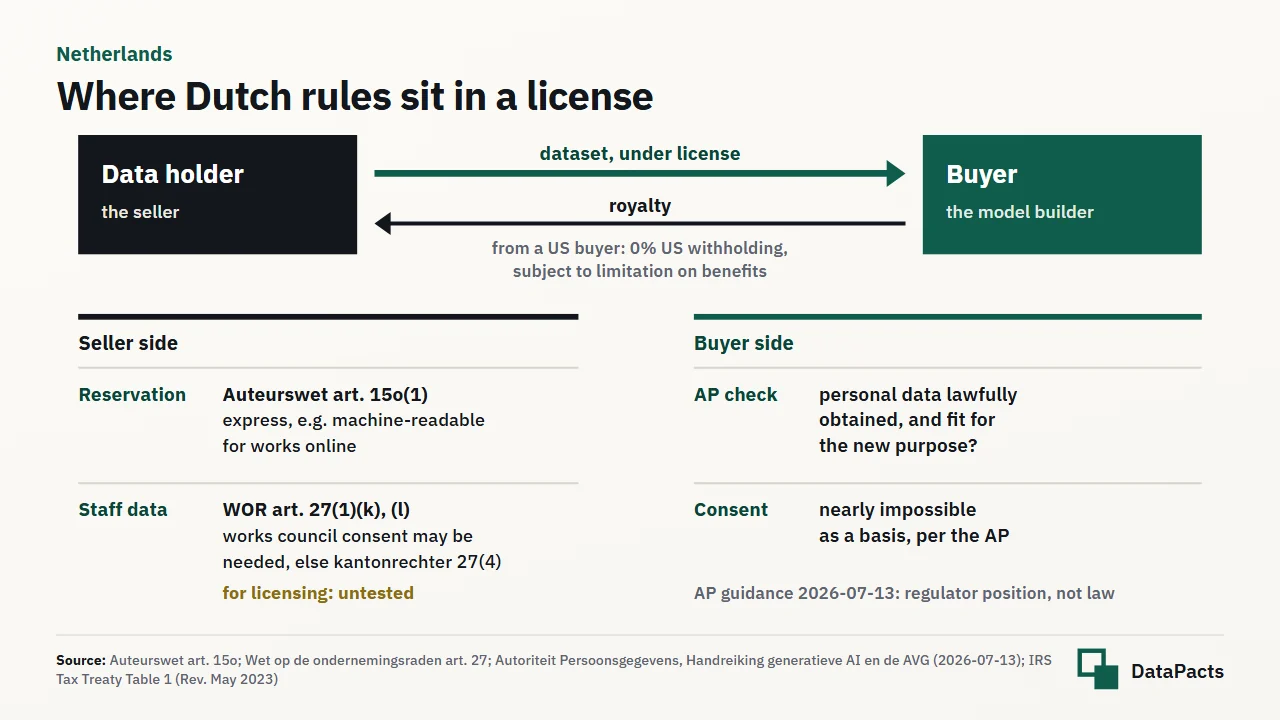
The Autoriteit Persoonsgegevens, the Dutch data protection authority, published its guidance on generative AI and the GDPR on 2026-07-13.
This page sets out the instruments, dated changes and seller-side programs as of 2026-11-09, for the data holder and for the AI developer.
It is a free-to-read part of the wider reference on AI training data licensing, covers EU rules only where the Netherlands differs from or implements them, and cites wetten.overheid.nl and the regulator's own publications.
The Netherlands is a consent country for staff data, and the Dutch regulator expects the buyer of a dataset to check how it was collected.
Each figure is dated and checked against the official text, as described in the method for sourcing and dating every figure.
What Dutch Law Adds to EU Rules Before a Company Licenses Data for Training
Dutch law decides four things on top of the EU instruments: how a reservation against mining must be expressed, what the Dutch regulator expects from the buyer and the seller of personal data, whether staff representatives must agree, and how royalties to and from the Netherlands are taxed.
- Reservation: Auteurswet art. 15o(1).
- Regulator positions: the Autoriteit Persoonsgegevens guidance of 2026-07-13.
- Staff: Wet op de ondernemingsraden art. 27(1)(k) and (l).
- Tax: the US treaty rate on royalties paid to Dutch residents.
The GDPR (Regulation (EU) 2016/679, applies from 2018-05-25) applies directly in the Netherlands. The Dutch act implementing the GDPR and the Dutch rules on recording calls and meetings are not recorded on this page.
Dutch Instruments and Regulator Positions That Apply to a Training Data Deal
Nine Dutch instruments, regulator positions and record gaps shape a training-data license, and the table gives each citation, its date and whether it is final, pending or not stated. Rows with a page of their own link to it, and "not stated" means no primary source was verified on 2026-11-09, not that no rule exists.
| Instrument | Citation | Dates | What it decides in a data deal | Final, pending or not stated | Source |
|---|---|---|---|---|---|
| Auteurswet, art. 15o | Auteurswet art. 15o(1), (2) | in force, commencement date not stated | commercial TDM exception; express reservation in an appropriate way, such as machine-readable means for works made available online; copies kept as long as necessary | final | wetten.overheid.nl |
| Wet op de ondernemingsraden, art. 27 | WOR art. 27(1)(k), (l), (4) | in force (version from 2023-02-18) | works council consent for staff data rules and monitoring systems; kantonrechter route | final; application to licensing untested | wetten.overheid.nl |
| GDPR | Regulation (EU) 2016/679 | applies from 2018-05-25 | legal basis, notices and transfers for personal data in the set | final | eur-lex.europa.eu |
| AP guidance on generative AI and the GDPR | Handreiking generatieve AI en de AVG | published 2026-07-13 | buyer checks lawful collection and purpose fit; consent nearly impossible as a basis | regulator position, not law | autoriteitpersoonsgegevens.nl |
| AI Act market surveillance | Regulation (EU) 2024/1689; Uitvoeringswet AI-verordening | AP not yet designated as of 2026-10-09 | which Dutch authority supervises AI systems | pending | autoriteitpersoonsgegevens.nl |
| US-Netherlands treaty rates on royalties | IRS Tax Treaty Table 1, Rev. May 2023, income codes 10 and 12 | as of 2026-11-09 | 0% US withholding for Dutch residents, subject to limitation on benefits | final | irs.gov |
| Dutch withholding on royalties paid abroad | not stated | not stated | not stated | not stated | n/a |
| Dutch GDPR implementation act | not stated | not stated | not stated | not stated | n/a |
| Recording of calls and meetings | not stated | not stated | not stated | not stated | n/a |
How Each Dutch Rule Reaches the Seller and the Buyer
The table lists each instrument; the sections below show what each one asks of the data holder and of the AI developer.
Reserving Works Under Article 15o of the Auteurswet
Article 15o of the Auteurswet is the Dutch commercial text and data mining exception: anyone with lawful access may reproduce works for mining unless the rightholder has expressly reserved that use in an appropriate way, such as machine-readable means for works made available online.
Under article 15o(2) copies may be kept as long as necessary for the mining. The date the article came into force and any Dutch provision for research mining are not stated on this page.
For a seller, a Dutch publisher with no express reservation has no license to sell against commercial mining of its online works, so the reservation is what turns access into a license.
The Dutch wording names machine-readable means, like the German, French, Spanish and Austrian texts, while Sweden, Denmark, Finland and Slovakia require only an express, appropriate reservation. The Directive's rule and the opt-out practice sit on the page about the EU text and data mining exception.
What the Autoriteit Persoonsgegevens Expects From Data Buyers and Sellers
The Autoriteit Persoonsgegevens (AP), the Dutch data protection authority, published guidance on generative AI and the GDPR on 2026-07-13 that puts a checking duty on the buyer of training data.
In the AP's Dutch text, paraphrased here, the model builder, as buyer of the data, must check whether any personal data was lawfully obtained and may be used for the new purposes. The guidance calls consent as a basis for training difficult and nearly impossible to meet as informed and specific.
For both sides, the buyer will ask the seller for evidence of lawful collection and purpose fit, so a seller keeps notices and records ready. On 2026-08-20 the AP advised Twitch users that the "Training for Generative AI" setting is on by default, a platform training case and not a sale.
Under the AI Act the AP is the intended market surveillance authority but not yet designated as of 2026-10-09, and its powers start when the Uitvoeringswet AI-verordening is in force.
Its fine of EUR 525,000 on the tennis federation KNLTB (decision of 2019-12-20) led to the Court of Justice ruling of 2024-10-04 in C-621/22 on disclosure for consideration, explained under legitimate interest (Article 6(1)(f)) for AI training data.
Scraped Data Under Dutch Supervision: What Is on Record
No Dutch statute or AP decision on scraping for AI training is recorded on this page as of 2026-11-09, so scraped personal data is assessed under the GDPR and the AP's generative AI guidance.
- Recorded: the AP reported on 2026-07-15 that the EDPB put its web scraping and anonymisation guidelines to consultation until 2026-10-30.
- Not stated: any AP guidance or decision on scraping for AI training.
Whether scraping is lawful at all is answered on the page that asks is web scraping for AI training legal.
Staff Records in the Set: The Ondernemingsraad's Say Under the WOR
A Dutch employer that licenses staff emails, chats or other employee-generated records may first need its works council's consent, because article 27 of the Wet op de ondernemingsraden gives the ondernemingsraad a consent right over two kinds of arrangement.
- Article 27(1)(k): rules on processing and protecting personnel personal data.
- Article 27(1)(l): systems for monitoring attendance, behavior or performance.
- Article 27(4): without consent, the employer may ask the kantonrechter for permission.
Whether a licensing policy triggers article 27 is analysis and untested in court. The Netherlands is a consent country, unlike France, where the works council is informed and consulted. The step-by-step route sits on the child page on works council consent under WOR Article 27.
Call and Meeting Recordings: Not Yet Recorded for the Netherlands
No Dutch rule on recording calls and meetings is recorded on this page as of 2026-11-09, so recordings are assessed under the GDPR alone here. The comparison page in the last section holds the jurisdictions that are recorded.
Dutch Companies on Both Sides of Training Data Deals
Dutch-incorporated companies sit on both sides of the market: one buys and collects training data, another licenses its catalog to AI developers.
- Toloka AI BV, Amsterdam, founded 2014 per its own about page, runs a Physical AI Data Partner Program for companies and capture teams that collect egocentric video, UMI three-camera capture and teleoperation data, with pay set per statement of work (checked 2026-11-09).
- Universal Music Group N.V. licensed recorded music and publishing to Udio on 2025-10-29 as part of a litigation settlement and signed a multi-year agreement with ElevenLabs on 2026-09-10, both values not disclosed, per UMG's statements.
Toloka's terms and reputation are set out in the Toloka data buyer profile.
Royalty Payments Between the Netherlands and the United States
A US buyer paying a royalty to a Dutch-resident seller withholds 0% on copyright royalties (income code 12) and on other industrial royalties (income code 10) under IRS Table 1, Rev.
May 2023, subject to the treaty's limitation-on-benefits test. Dutch withholding on royalties paid by a Dutch buyer to a non-resident is not stated here. Rates for other countries are compared on the withholding page for royalties.
Enacted, Pending and Proposed: Dutch Changes as of November 2026
Nine dated items changed how Dutch law and the Dutch regulator treat training data, and the table keeps statutes, regulator positions, court rulings and complaints apart.
| Date | Item | Citation or actor | Status as of 2026-11-09 | Source |
|---|---|---|---|---|
| 2026-10-27 | Five GDPR complaints against Scale AI (Outlier) filed across France, Italy, the Netherlands and Austria, per noyb's statement | noyb with three partner groups | filed; no decision or reference number published | noyb.eu |
| 2026-10-09 | AP states it is the intended AI Act market surveillance authority, not yet designated | Autoriteit Persoonsgegevens | pending on the Uitvoeringswet AI-verordening | autoriteitpersoonsgegevens.nl |
| 2026-08-20 | AP advises Twitch users that the "Training for Generative AI" setting is on by default | Autoriteit Persoonsgegevens | advice to users; platform training, not a sale | autoriteitpersoonsgegevens.nl |
| 2026-08-02 | AI Act general application | Regulation (EU) 2024/1689 | applies | eur-lex.europa.eu |
| 2026-07-15 | AP reports EDPB web scraping and anonymisation guidelines in consultation until 2026-10-30 | EDPB, reported by the AP | consultation, not final | autoriteitpersoonsgegevens.nl |
| 2026-07-13 | AP guidance on generative AI and the GDPR published | Autoriteit Persoonsgegevens | published | autoriteitpersoonsgegevens.nl |
| 2024-10-04 | Court of Justice ruling in KNLTB v Autoriteit Persoonsgegevens | C-621/22, Ninth Chamber | decided | publications.europa.eu |
| 2023-02-18 | Current version of the Wet op de ondernemingsraden in force | WOR | in force | wetten.overheid.nl |
| 2019-12-20 | AP fines KNLTB EUR 525,000 for disclosing members' data for consideration | Autoriteit Persoonsgegevens, as recounted in C-621/22 | decision recounted by the Court | publications.europa.eu |
Guidance and consultation drafts are not law, and the AP's AI Act powers are pending on the implementing act. The five noyb complaints are allegations with no published decision. The Dutch national authorities under Article 77 of the AI Act are not stated on this page.
Programs That Accept EU Company Data From Dutch Holders
Seven programs either run from a Dutch company or state on their own pages that they accept company data from the EU or Europe, each as a claim checked 2026-11-09, none names the Netherlands as a country, and none changes what Dutch law requires of the seller.
| Program | Role | What it acquires or handles | What its own pages say about EU, European or Dutch companies (checked 2026-11-09) | Source |
|---|---|---|---|---|
| Collinear AI, paid data licensing | buyer program | repositories with PRs and tickets, Slack, Gmail, Jira and similar company records | English data; US, CA, UK, EU, AU, NZ; teams of about 50+; several years of human-written history | collinear.ai |
| Handshake AI, Data Partnerships | buyer program | workflow and documentation data | estimator country input: USA, Canada, Europe, Other | joinhandshake.com |
| Mode, data partnership program | buyer program | email, documents, chat, calls and transcripts | agreement names US, EU, Canada, Australia; home page calls the US the strongest fit | data.mode.inc |
| Nyne, data partnerships | buyer program | operational workflow data | country selector offers Europe, yet requires 20+ full-time U.S. W-2 employees | nyne.ai |
| Ooak Data, data partner program | buyer program | Slack, Gmail, Notion, Jira and similar records | EU partner data processed and stored in the EU via Ooak Data SAS; company must own its records | ooakdata.com |
| Toloka, Physical AI Data Partner Program | buyer program (Dutch company, Toloka AI BV) | egocentric video, UMI three-camera capture, teleoperation | eligibility: companies and capture teams; individuals directed to Mindrift; pay set in the statement of work | toloka.ai |
| Turing, Project Lazarus | buyer program | records of active and shut-down companies | most regions; strongest demand US, UK, Canada, EU | lazarus.turing.com |
Two contradictions stay visible: Mode's agreement names the EU while its home page calls the US the strongest fit, and Nyne offers Europe in its selector but asks for 20+ U.S. W-2 employees. Terms across all programs are compared in the company data partnership programs page.
Benefits, Risks, Downsides and Alternatives of Licensing Data Under Dutch Law, Including Not Selling
Dutch law lets a company license data it holds the rights to, and an express article 15o reservation gives online works license value, but the GDPR, the AP's checking duty on buyers and the works council step add conditions, and not licensing remains a valid choice.
Benefits
- A machine-readable reservation is recognized under article 15o(1).
- A 0% US treaty rate applies to royalties paid to Dutch residents, subject to limitation on benefits.
- The AP's published guidance shows what buyers will ask for.
Risks
- Consent is called nearly impossible to meet as a basis for training.
- The buyer's check can expose gaps in the seller's records.
- The AP's AI Act status is pending and no AP position on scraping is recorded.
Downsides
- Works council consent or a kantonrechter procedure costs time before any income.
- Unrecorded national items on recordings, the GDPR act and withholding mean advice per deal.
Alternatives
- License only works without personal data.
- Keep the data and record an express article 15o reservation.
- License de-identified data.
- Not selling or licensing at all, among the alternatives to selling data to AI labs.
Beyond the Dutch Layer: EU Instruments, Topic Comparisons and the Sale
Dutch law stops at the EU layer above it and at the contract; the pages below cover the EU instruments, compare topics across jurisdictions and apply the rules to a sale.
- European Union rules for AI training data, the parent and the EU layer above Dutch law.
- AI training data law by jurisdiction, every jurisdiction compared.
- GDPR and AI training data: legal basis, notices and transfers in full.
- EU AI Act Article 53, what the AI Act asks of model providers.
- copyright and AI training across jurisdictions, how copyright exceptions compare.
- employee data and AI training rules by jurisdiction.
- employee notice and consent in a sale.
- call and meeting recording consent rules compared.
- robots.txt for AI crawlers, machine-readable signals.
- ethics and risk of selling data, what the people in the data are owed.
- Germany rules for licensing data, the German layer next door.
- Ireland rules for licensing data, the Irish layer and its regulator.
- selling data to AI companies from outside the US.
- sell or license company data to AI companies, the steps of a sale.
How This Page Is Sourced and Dated
Every rule here cites wetten.overheid.nl, the Autoriteit Persoonsgegevens' own publications, EUR-Lex, the Court of Justice or the IRS treaty table, with the date it was checked.
The rules for dating and checking are set out in the method for sourcing and dating every figure. This page is general information about Dutch law, not legal advice for any specific deal.
Frequently Asked Questions
How does a rightholder in the Netherlands reserve works from AI mining?
By an express reservation made in an appropriate way. Article 15o(1) of the Auteurswet names machine-readable means for works made available online as an example.
What does the Dutch data protection authority expect from a buyer of training data?
The buyer must check that personal data was lawfully obtained and may be used for the new purposes. This is in the AP's guidance of 2026-07-13.
Who supervises AI systems in the Netherlands under the AI Act?
The AP is the intended market surveillance authority, not yet designated as of 2026-10-09. Its powers start when the Uitvoeringswet AI-verordening is in force.
Does a Dutch works council have to agree before staff data is licensed?
It may, under article 27(1)(k) and (l) of the Wet op de ondernemingsraden. Without consent the employer may ask the kantonrechter (art. 27(4)); application to licensing is untested.