No program on record asks for meeting recordings by that name, no price for them is on record, and the one note-taker case in the sources is an allegation that a vendor trained on meetings it captured (N.D. Cal. No. 5:25-cv-06911-EKL, filed August 2025).
Within AI training data licensing, the page covers Zoom, Microsoft Teams and Google Meet recordings, note-taker apps and their transcripts, the usual unit of a deal. Not licensing is a valid outcome, and phone and call-center recordings have their own page.
The DataPacts Editorial Team explains how we source, date and check every figure; everything below was checked on November 9, 2026 unless another date is shown.
Can a Company License Its Meeting Recordings for AI Training?
Yes in principle, but meeting archives are among the hardest workplace records to license, because every recording carries the voices of people who never agreed to an AI license.
No program on record asks for meeting recordings as such, and the closest asks are listed under the programs heading below.
Zoom states in its Terms of Service s.10.2 (effective August 11, 2023) that it does not use audio, video, chat or similar Customer Content to train Zoom or third-party AI models, and Google states that Workspace does not use customer data to train models without the customer's prior permission or instruction. Both describe the platform's own training, not a customer's license of its own archive.
One-to-one, customer and call-center conversations sit on the page about selling call recordings and sales calls.
Where a Meeting Archive Sits and What Each Platform's Terms Say
A meeting archive is spread across the meeting platform's cloud, the organizer's account and any note-taker app that joined, and each place has its own export route, retention clock and training statement.
The table compares the training statement and export route of each place, as of November 10, 2026, with values checked on November 9, 2026.
| Where recordings sit | Training statement on record | Export route and retention on record | Source |
|---|---|---|---|
| Google Workspace (Meet) | Workspace does not use customer data to train models without the customer's prior permission or instruction | Organization-wide Data Export by a super admin (account at least 30 days old); data available no earlier than 48 hours, typically 72, up to 14 days; Google-provided bucket deleted 60 days after start; core service data excluded after cancellation or suspension; where Meet stores recordings: not stated | knowledge.workspace.google.com |
| Microsoft Teams | not stated | Export APIs return recordings and transcripts for private scheduled meetings only, by organizer; Microsoft states about 350 MB per recording and about 300 KB per transcript for a 30 to 60 minute meeting; active Teams license required; user-deleted messages retrievable 21 days, deleted users and channels 30 days | learn.microsoft.com |
| Note-taker apps (example: Otter.ai, Inc.) | vendor terms not stated; Otter's own training is alleged in litigation | not stated | otter.ai terms; govinfo.gov |
| Zoom (Zoom Communications, Inc.) | ToS s.10.2: Zoom does not use audio, video, chat or other communications-like Customer Content to train Zoom or third-party AI models | Cloud recordings deleted 30 days after a downgrade to the free plan unless the account resubscribes | zoom.com/en/trust/terms; support.zoom.com |
Retention clocks matter before a sale, because a recording that expires cannot be licensed: Zoom's runs 30 days after a downgrade, Teams' 21 and 30 days, and a Workspace export bucket's 60 days. Teams export routes and eDiscovery are covered under Microsoft Teams data export and licensing.
Who Holds the Rights to a Recorded Meeting: Account Holder, Host or Note-Taker Vendor
The company can license only the recordings that sit in accounts it controls, which usually means meetings its own staff organized on company accounts.
Teams exports by organizer, so a meeting hosted by a customer or partner sits in that party's account, and a recording on a staff member's personal account sits outside the company archive.
Note-taker bots keep their own copy under the vendor's terms, which this page does not record. Otter.ai, Inc. is the named operator in its Terms of Service (effective September 19, 2025).
Holding a recording is not the same as holding the right to license the people in it, and this page does not address who owns copyright in a recording. A rights audit before licensing lists the accounts and contracts behind the archive.
Consent From Every Speaker Before a Meeting Recording Leaves the Company
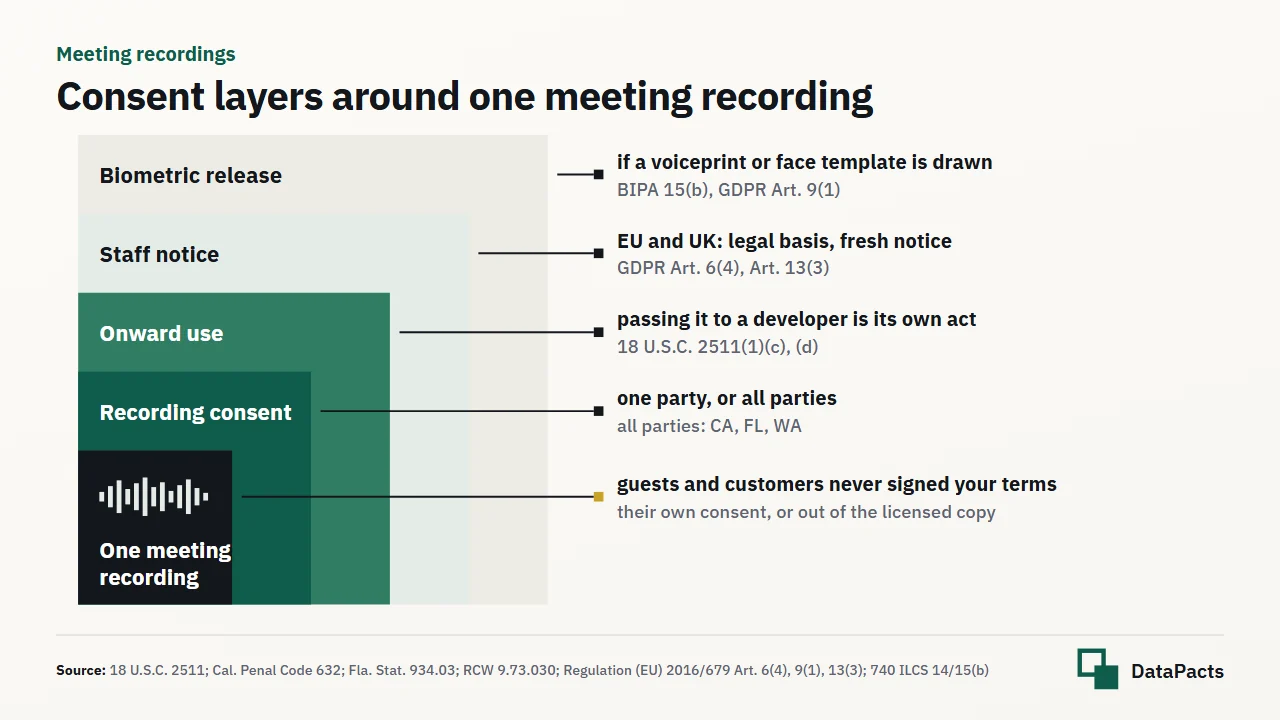
A meeting recording needs a lawful basis for every person in it twice: once when it was recorded and again when it is passed to an AI developer.
Under federal law, 18 U.S.C. 2511(2)(d) lets a party, or anyone with one party's prior consent, record a conversation unless the purpose is criminal or tortious. California (Penal Code 632, confidential communications), Florida (Fla. Stat. 934.03) and Washington (RCW 9.73.030(1)) require the consent of all parties.
Passing a recording on is its own act: 18 U.S.C. 2511(1)(c) and (d) make disclosing or using contents known to come from an unlawful interception a violation (up to 5 years under 2511(4)(a)), and § 201 StGB separately penalizes making an unauthorized recording available to a third party. The comparison sits under call and meeting recording consent rules by jurisdiction.
Staff on the Call: Notice, Legal Basis and Works Councils
Staff are the largest group in most archives, and in the EU and UK their words are personal data that need a legal basis and fresh notice before the company licenses them.
Regulation (EU) 2016/679 applies from May 25, 2018: Art. 6(4) sets the test for reuse for a new purpose, and Art. 13(3) requires notice before further processing.
Under Art. 88, the CJEU held in C-34/21 (March 30, 2023) that national employment rules failing Art. 88(2) are disregarded unless an Art. 6(3) basis applies, and the Bundesarbeitsgericht (8 AZR 209/21, May 8, 2025) left § 26(1) BDSG unapplied.
In Germany a works council also has a say over technical monitoring devices (BetrVG § 87(1) Nr. 6). The Irish DPC (AI Insights Report, September 2026) calls it "unlikely" that a controller can show data subjects expect "private messages or other private data" to be used for AI training.
In the US, the CCPA employee exemption has been inoperative since January 1, 2023, and licensing personal information for money is a sale. Notice is mapped under employee data and AI training rules by jurisdiction.
Guests, Customers and Candidates Who Never Signed Your Terms
External participants agreed to none of the company's employment terms, so their voices need their own consent or must come out of the licensed copy. Customers, partners, candidates and patients are protected by the all-party rules as much as staff, and Mercor's listings name "Recordings made without consent" as not a fit.
A customer contract with a confidentiality clause can also bar licensing a meeting held under it.
Voiceprints and Faces: When a Recording Becomes Biometric Data
A plain recording is usually not biometric data, but a voiceprint or face template drawn from it is, and that triggers written-release rules. Va.
Code 59.1-575 (in force January 1, 2023) excludes recordings "or data generated therefrom" from its biometric definition, and Washington's RCW 19.375 excludes recordings from its definition; Illinois BIPA section 15(b) (740 ILCS 14) bars collecting biometric identifiers without written notice and release, and GDPR Art. 9(1) makes biometric data used to identify a person special-category data.
micro1's Data License Master Terms s.5.7 (updated November 8, 2026) list biometric identifiers among excluded categories, and the Otter plaintiffs plead BIPA. The statute is covered at Illinois BIPA and AI training data.
What the Otter.ai Note-Taker Case Alleges About Training on Meetings
One consolidated US case tests whether a note-taker that joins meetings may use what it records to train its own models: In re Otter.AI Privacy Litigation, N.D. Cal. No. 5:25-cv-06911-EKL, filed in August 2025.
The plaintiffs, from California, Illinois and Washington, allege that the notetaker recorded meetings without all-party consent and used conversations and voiceprints to train speech-recognition and machine-learning models.
The claims include ECPA, CIPA 631 and 632, BIPA 15(a) and (b), unjust enrichment and the California UCL, among others. All of this is allegation, and the case is pending as of November 9, 2026.
The case concerns a vendor training on meetings it captured, not a company licensing its own archive, but it shows the claims a licensed archive could draw. The filings are summarized in In re Otter.AI Privacy Litigation.
Programs That Ask for Recorded Conversations and Transcripts
No program on record asks for meeting recordings by that name; the closest asks are for call recordings, call transcripts, sales conversations, Teams data and recorded clinical visits.
Pangea.ai and Data Licensing Advisors are intermediaries: Pangea licenses on the company's behalf and Data Licensing Advisors handles the sale, with the seller signing directly with the buyer.
The table lists each program in alphabetical order with its own wording, as of November 10, 2026, every value being the program's statement checked on November 9, 2026.
| Program (role) | What it acquires or handles, in its own words | Stated terms (claims) | Source | Target | Status |
|---|---|---|---|---|---|
| Aba Compute (program; operator's legal name not published) | "call transcripts" among emails, chats, tickets | illustrative USD 300K to 800K, "not an offer" | abacompute.com | none | n/a |
| Centific (data vendor) | "email, calendar, Teams, Slack, Google Chat" | owner chooses applications, teams and periods; "You license your data. You never hand it over." | centific.com | Centific | not yet published |
| Data Licensing Advisors (broker, handles the sale on the seller's behalf) | "call recordings" among email, chat, tickets | seller signs directly with the buyer; never takes custody; success fee not published | datalicensingadvisors.com | Data Licensing Advisors | not yet published |
| Mercor, Digital Health Company listing (program) | "Recorded patient-clinician visits with consent that covers secondary use"; tools named Zoom for Healthcare, Doxy.me | USD 100,000 to 900,000 deal range to the company | Mercor listing feed | Mercor | live |
| Mode (data vendor) | "calls and transcripts" among email, documents, chat | "Mode buys the filtered copy"; "could be worth $100K–$5M", "Indicative only" | data.mode.inc | Mode | not yet published |
| Pangea.ai (marketplace, licenses on the company's behalf) | "call recordings" among chat, email, documents | non-exclusive license for a set use and term; company keeps ownership | pangea.ai | Pangea.ai | not yet published |
| Polyshares (data vendor) | "call recordings", "Slack and Teams" | "Typically $100K to $2M"; "Defined material for a defined term" vs "Perpetual exclusive license to the operational record" | polyshares.com | Polyshares | not yet published |
| Replay (data vendor) | "sales conversations" among records | only de-identified data licensed; upfront payment plus perpetual revenue share | replay.ai | Replay | not yet published |
Each figure is the program's headline for a whole company archive, not a price for meetings, and none is averaged or converted to an hour.
Polyshares shows two license wordings side by side, a defined term on its home page and a perpetual exclusive license in its track record. Aba Compute is named without a legal entity because its operator publishes none.
Preparing a Meeting Archive: Transcripts First, Exclusions and De-identification
Most companies that license meeting data start from transcripts, not recordings, because a transcript drops the voice and the face and can be redacted line by line.
Microsoft states about 300 KB per Teams transcript against about 350 MB per recording, and Mercor's digital-health listing accepts "Transcripts, or audio clear enough to transcribe" and asks for "the ability to de-identify audio and text".
Exclusions come next: meetings with external participants who have not consented, HR, legal and board meetings, and recorded visits outside a health program; Centific states that such exclusions are enforced in its extraction code.
De-identification covers names, speaker labels and on-screen content, as set out under PII removal and de-identification before licensing.
Licensing Meeting Recordings: Benefits, Risks, Downsides and Alternatives, Including Not Licensing
Meeting archives record how decisions are actually made, which is why they interest AI developers, and why they carry more consent risk than any other workplace record.
Benefits:
- Revenue from an archive the company already holds.
- Transcripts can be licensed without voices.
- The owner chooses teams and periods, as Centific states.
Risks:
- All-party recording statutes and the onward-use rules in 18 U.S.C. 2511(1)(c) and (d) and § 201 StGB.
- Biometric claims where voiceprints are drawn.
- Litigation of the kind alleged against Otter.ai.
Downsides:
- Consent and notice work for every speaker in scope.
- Models already trained cannot be untrained.
Alternatives:
- License transcripts only, after redaction.
- License chat or email instead.
- Delete the recordings or let them expire under the platform clock.
- Not license at all: the decision is covered under whether to sell or license your data at all.
Meetings Next to Calls, Chat and Voice, and the Seller Steps
Meeting records sit beside phone calls, chat, speech corpora and individual voices, each with its own page, as do the systems that store recordings.
Neighboring pages:
- Every data type AI companies buy: the parent page
- Meeting chat and channel messages
- Speech corpora and audio
- An individual's own voice
- Recorded patient visits
- Workspace Data Export, including Meet
- Zoom cloud recordings
- Call recorder exports
- How staff see their meetings licensed
Seller steps for meetings:
- Read the complete guide on how to sell or license company data.
- Build a data inventory listing recordings, transcripts and accounts.
- Give staff employee notice and consent before recordings leave.
- Agree the license using AI data licensing agreements, covering scope, term and deletion.
- Check when AI data buyers pay: upfront, milestones and revenue share.
The law above is information, not legal advice; the wider picture is under AI training data law by jurisdiction.
Frequently Asked Questions
Can I sell recordings of my Zoom or Teams meetings to AI companies?
Only recordings in company accounts, with notice to staff and consent where the law requires it. Zoom states it does not train on such content itself.
Do AI note-takers train on meeting recordings?
Vendor terms differ and are not recorded on this page. The Otter.ai plaintiffs allege that the vendor trained on meetings and voiceprints, in a case pending as of November 9, 2026.
How much are meeting recordings worth to AI companies?
No price for meeting recordings is on record. Programs state archive-wide ranges, for example Polyshares USD 100K to 2M (checked November 9, 2026). Valuation methods are under what company data is worth to AI companies.
Do all participants have to agree before a recording is licensed?
In all-party states and in Germany, effectively yes. The federal one-party rule carries a criminal or tortious purpose proviso.
Advisers and liquidators can use the introducer form.