Gradient publishes one worked example of that share, a 20 % "typical" partner share that yields USD 240,000 on a USD 3 million deal, and no rate, term or timing beyond it.
Gradient handles and licenses partners' data rather than buying it outright. Every Gradient figure on this page is Gradient's own statement with its check date. The page belongs to an independent reference on AI training data licensing that covers Gradient Health.
Fact-check note: each figure below carries its source and check date, and the method is described in how DataPacts sources and dates every figure.
What Gradient Health Does With Hospital Data
Gradient Health sits between data holders and AI developers: partners give it access to their records, Gradient de-identifies them and offers them to developers through its Atlas platform.
The company wants medical imaging, EHR data, pathology reports, clinical records and multimodal patient-level data, and it names research organizations and specialty care providers next to hospitals as eligible partners.
Gradient's home page makes three claims about the platform, checked 2026-11-09:
- It offers "millions of patient journeys".
- It names HIPAA and SOC 2. This is what the home page states, not a DataPacts finding of compliance.
- It delivers data "in as little as 48 hours".
All three are marketing statements from Gradient. The page gives no study counts per modality, no developer names and no delivery terms that a data holder could hold Gradient to.
Gradient Health Company Identity
Gradient Health trades under its brand at gradienthealth.io; its legal entity, registry entry and headquarters are not stated here because they could not be confirmed against the sources DataPacts relies on. The table lists what is established as of 2026-11-09.
| Attribute | Value | Source |
|---|---|---|
| Brand | Gradient Health | gradienthealth.io |
| Website | gradienthealth.io | gradienthealth.io |
| Legal entity | not confirmed | n/a |
| Registry entry | not confirmed | n/a |
| Headquarters | not confirmed | n/a |
| Founded | not recorded | n/a |
| Type | health data platform connecting data partners with AI developers | gradienthealth.io/data-partners |
A holder that signs with Gradient should ask for the contracting entity in writing, because the public pages do not settle it.
Gradient Health Data Partners: Program Terms
Gradient Health's data partners program, as its own page described it on 2026-11-09, pays a recurring revenue share and publishes no other license term. The table lists each term Gradient states on its data partners page as of 2026-11-09, and the terms it leaves out.
| Term | What Gradient Health states | Checked | Source |
|---|---|---|---|
| Program name | Gradient Health data partners | 2026-11-09 | gradienthealth.io/data-partners |
| Who can join | hospitals, health systems, imaging centers, research organizations, specialty care providers | 2026-11-09 | gradienthealth.io/data-partners |
| Data wanted | medical imaging, EHR, pathology reports, clinical records, multimodal patient-level data | 2026-11-09 | gradienthealth.io/data-partners |
| How data is shared | cloud access to EHR, PACS or RIS | 2026-11-09 | gradienthealth.io/data-partners |
| De-identification | DICOM PS3.15 2023a metadata redaction, pixel scanning; its Ethics Board reviews research projects | 2026-11-16 | gradienthealth.io/data-partners |
| Payment model | revenue share each time data is used, recurring | 2026-11-09 | gradienthealth.io/data-partners |
| Worked example | USD 3M deal x 40 % x "typical" 20 % = USD 240,000, Gradient's illustration | 2026-11-09 | gradienthealth.io/data-partners |
| License terms | not published beyond the revenue share; the share depends on data type, scale and usability | 2026-11-09 | gradienthealth.io/data-partners |
| Payment timing, term, exclusivity, deletion | not published | 2026-11-09 | n/a |
| Referral fee | none recorded | 2026-11-09 | n/a |
The table leaves the contract terms empty: no license length, no exclusivity rule, no deletion duty and no payment date appear on the page. Other programs that publish rates and clauses appear in program terms compared, dated, so a holder can set Gradient's single illustration next to published ranges.
How Gradient's Revenue Share Works: The 20 % Worked Example
Gradient Health illustrates its revenue share, as checked on 2026-11-09, with a worked example: a USD 3 million deal, 40 % of the studies coming from the partner, and a "typical" 20 % partner share give the partner USD 240,000.
On its page as re-read on 2026-11-10, Gradient labels the 40 % a "share of studies", and the arithmetic is unchanged.
The table shows each step of Gradient's illustration as of 2026-11-09, with the label re-read on 2026-11-10.
| Step | Value | Who states it | Source |
|---|---|---|---|
| Deal value with an AI developer | USD 3,000,000 | Gradient Health (illustration) | gradienthealth.io/data-partners |
| Partner's share of the studies in the deal | 40 % | Gradient Health (illustration) | gradienthealth.io/data-partners |
| "Typical" partner revenue share | 20 % | Gradient Health (illustration) | gradienthealth.io/data-partners |
| Partner receives | USD 240,000 (USD 3,000,000 x 0.40 x 0.20) | Gradient Health (illustration) | gradienthealth.io/data-partners |
The USD 240,000 is Gradient's illustration, not a payout DataPacts has observed, an average or a guarantee.
Gradient says the actual share depends on data type, scale and usability, and the page does not say how those three factors move the percentage. Payment follows each use of the data, so a partner whose studies are never licensed receives nothing.
Other programs name the same model with different disclosure. Protege states revenue share payouts to data partners with each use and does not publish the percentage, and Turing's Project Lazarus pays a revenue share with nothing upfront and an unpublished split (both checked 2026-11-09).
The revenue share and other ways AI data buyers pay, such as upfront fees and milestones, are compared on revenue share and other ways AI data buyers pay.
How a Hospital Shares Data Through Gradient: Five Steps
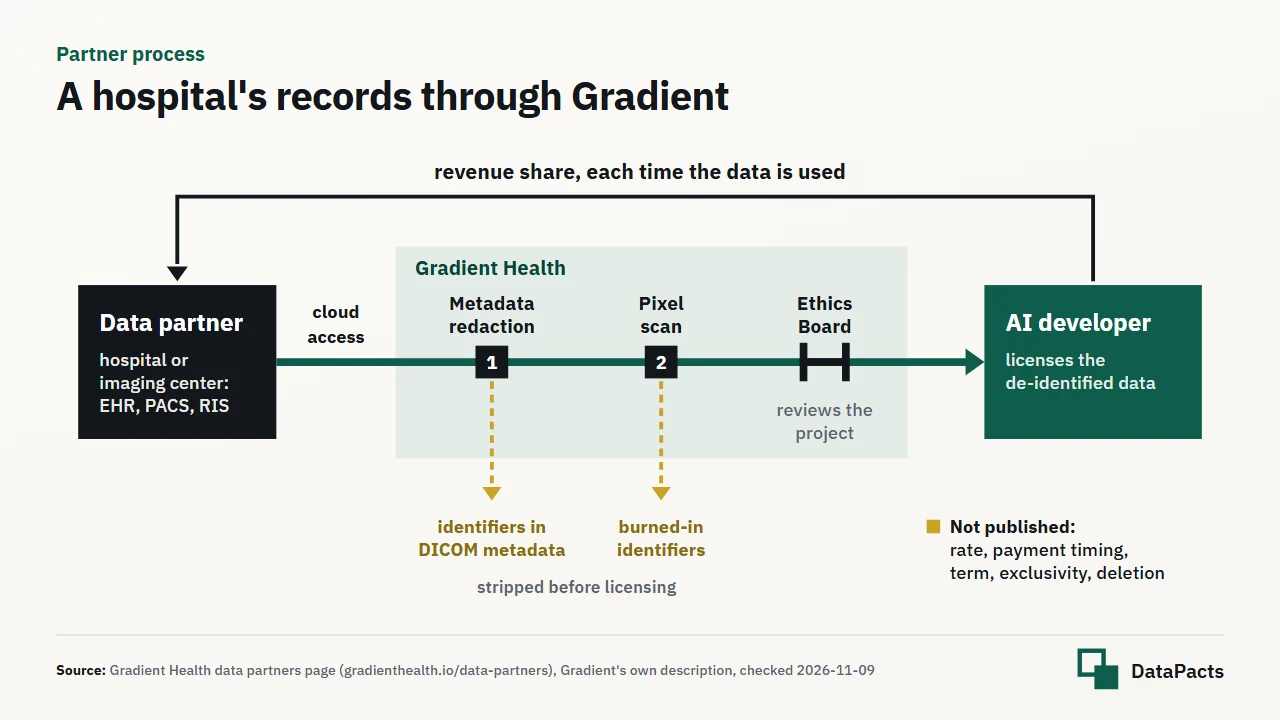
Gradient Health describes five steps from first access to payment, and the data holder's own work is mainly granting cloud access to the source systems. The steps below follow its data partners page, checked 2026-11-09.
- The partner gives Gradient cloud access to its EHR, PACS or RIS.
- Gradient de-identifies the data.
- Gradient's Ethics Board reviews the research project.
- The partner earns a revenue share when the data is licensed and used.
- Final checks complete the process.
For de-identification, Gradient states that it redacts DICOM metadata under DICOM PS3.15 2023a and scans pixels for burned-in identifiers, meaning identifying text drawn into the image itself.
The page does not report the outcome of either step. Other data types face their own version of this work, described in de-identification before licensing data for AI training.
HIPAA sets the legal frame for all of it.
Under 45 CFR 164.514(a) and (b), properly de-identified data is outside the Privacy Rule (45 CFR 164.502(d)(2)), while a sale of protected health information needs patient authorization under 45 CFR 164.502(a)(5)(ii), except narrow cases such as a cost-based research fee.
Gradient's page as checked does not say whether Safe Harbor or Expert Determination applies, so the method behind its de-identification is unstated. The two routes and the sale rule are set out under HIPAA de-identification.
Is Gradient Health Reliable? Record, Complaints and What Is Not Public
DataPacts holds no complaint, incident, lawsuit or regulator action involving Gradient Health, and no Gradient agreement appears in the deal tracker, as of 2026-11-10. This is an absence of records, not an endorsement, and it does not mean none exist.
What stays unconfirmed is the company's legal entity, registry entry and headquarters, and the terms a partner would sign: license length, exclusivity, deletion and payment timing. Gradient also names no HIPAA method and gives no data volumes to check its home-page claims against.
Before signing, a data holder can ask Gradient for the contracting entity, the written revenue share and how it is calculated, the audit rights over reported uses, the payment date after each use, what happens to the data when the agreement ends, which HIPAA de-identification method applies, and what its Ethics Board reviews.
Benefits, Risks, Downsides and Alternatives to Licensing Health Data Through Gradient Health
Gradient Health offers a recurring share of each use and handles de-identification itself, but it publishes no license term, exclusivity rule or payment timing. The lists below separate what Gradient states from what is missing.
Benefits (Gradient's claims)
- Recurring income: a revenue share each time the data is used.
- Gradient performs the de-identification, with DICOM metadata redaction and pixel scanning, and its Ethics Board reviews research projects.
- The partner's work is cloud access to its systems.
- It lists hospitals, health systems, imaging centers, research organizations and specialty care providers as eligible.
Risks
- Terms are not published: payment timing, term, exclusivity and deletion.
- The HIPAA method behind the de-identification is not stated.
- The legal entity is not confirmed, so the counterparty to an agreement is unclear.
Downsides
- The share depends on data type, scale and usability, factors Gradient sets.
- The worked example is an illustration only, and payment arises only when data is used.
- Income cannot be forecast from the published pages.
Alternatives
- Protege pays a revenue share with each use, with no public percentage (checked 2026-11-09).
- Mercor pays by wire after delivery of the anonymized dataset, with no published amount, "typically within 2-4 weeks of the signed agreement" (checked 2026-11-09).
- Shfa.ai lets the client approve every deal and set its terms.
- HistAI sells its own slides under a perpetual commercial license, with no partner route.
- Not licensing at all: keeping the records unshared is a valid outcome.
Whether a revenue share beats a payment on delivery depends on volume that no page discloses.
The full range of options is set out in alternatives to selling data to AI, including keeping the data.
Gradient Health Among Dataset Vendors and Health Data Routes
Gradient Health is the only healthcare platform among the 23 dataset vendors and data labs DataPacts profiles, and it is one of several routes a health data holder can compare.
The other dataset vendors and data labs collect or license other data types, and the full answer to who buys AI training data covers every buyer type.
HistAI sells its own pathology slides, and Mercor pays by wire after delivery of an anonymized dataset. Rules and prices for medical and clinical data for AI training sit on their own page, as does how healthcare providers licensing data to AI choose a route.
Medical imaging and pathology data has its own page, and choosing a buyer for your data shows where an intermediary fits. Clauses to ask for in an AI data licensing agreement are listed there.
More About Gradient Health
Gradient Health and Contributor Work
Gradient Health's data partners program is for organizations holding records, and DataPacts holds no Gradient program for individual contributors or annotators. Individuals looking for paid work compare AI training jobs and platforms.
Frequently Asked Questions About Gradient Health
Does Gradient Health buy medical data?
No outright purchase is described: partners grant access, Gradient de-identifies the data and offers it to AI developers, and the partner receives a revenue share each time it is used (checked 2026-11-09).
How much does Gradient Health pay data partners?
As checked on 2026-11-09, Gradient publishes no rate; its own worked example gives a partner USD 240,000 from a USD 3 million deal at a "typical" 20 % share, and the share depends on data type, scale and usability.
Which organizations can become Gradient Health data partners?
Gradient names hospitals, health systems, imaging centers, research organizations and specialty care providers.
How does Gradient Health de-identify imaging data?
Gradient states it redacts DICOM metadata under DICOM PS3.15 2023a, and scans pixels for burned-in identifiers; its Ethics Board reviews research projects.