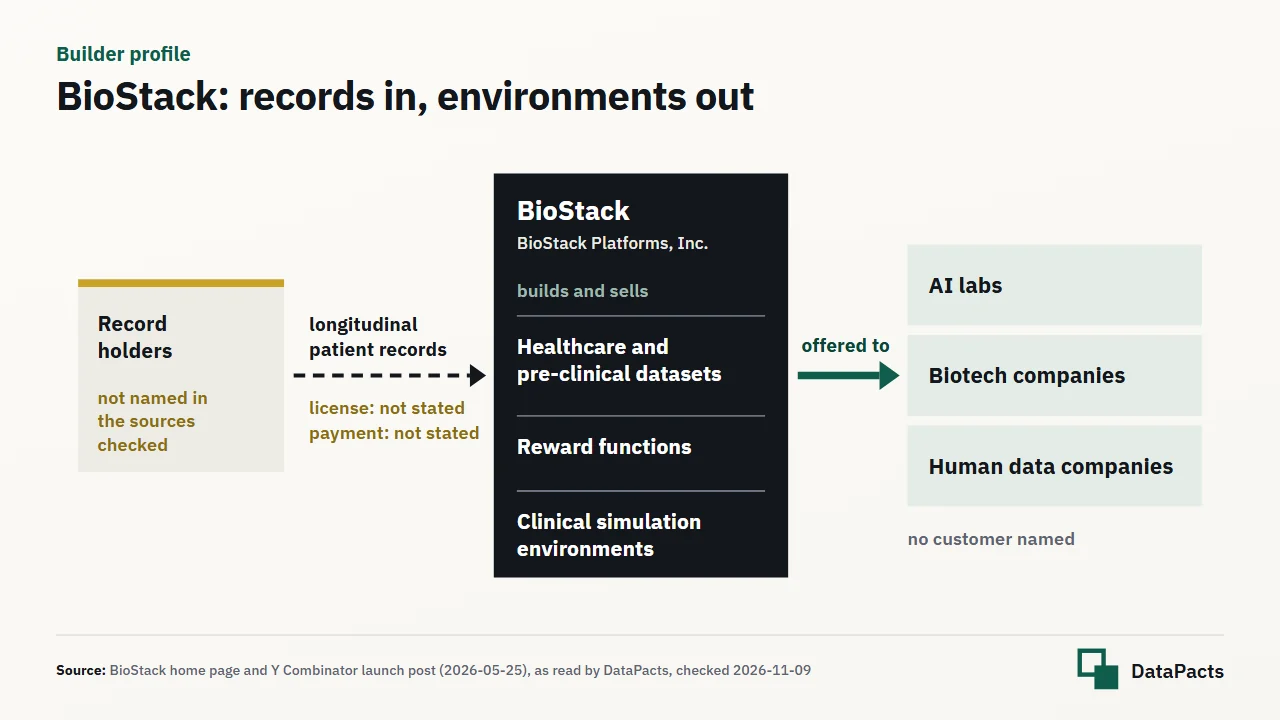
Its own pages state the products and a customer count, and no source checked states a price, a funding amount or the providers that supply its records.
Every BioStack figure on this page is BioStack's own statement or Y Combinator's listing, with its date, read in the context of AI training data licensing, where clinical environments are one form of data acquired for AI training. DataPacts states no amount or deal that BioStack or a filing has not published.
Each value below names its source and check date, and how DataPacts sources and dates every figure is set out in the methodology.
What BioStack Sells to AI Labs and Biotech
BioStack's home page, checked 2026-11-09, offers healthcare and pre-clinical datasets and RL environments to three kinds of customers: AI labs, biotech companies and human data companies.
The company describes its output as datasets, reward functions and clinical simulation environments, all built from longitudinal patient records, which are records that follow the same patients across visits over time.
BioStack's launch post on Y Combinator, dated 2026-05-25, gives its own account of the start. The work began in October 2025, and BioStack says it grew out of a six-figure request from a human data company, which the post does not name.
This page does not name one either, and BioStack's account is the only source for the origin.
An RL environment is the task, the tools and the grader a model trains against, and the reward function is the part that scores the model's output. How environments are built and bought is explained under RL environments, which this profile does not repeat. BioStack is the only healthcare builder in that page's type table.
BioStack Company Identity
BioStack's legal name is BioStack Platforms, Inc., as the footer of its own website gives it, and Y Combinator's company profile places it in San Francisco. The table lists each attribute with its source, as of 2026-11-09.
| Attribute | Value | Source |
|---|---|---|
| Legal name | BioStack Platforms, Inc. | getbiostack.com (footer) |
| Website | https://www.getbiostack.com | getbiostack.com |
| Registry number | none found on primary pages, checked 2026-11-09 | n/a |
| Country | United States | ycombinator.com/companies/biostack-platforms |
| City | San Francisco, per YC's profile | ycombinator.com/companies/biostack-platforms |
| Founded | 2025, per YC's profile | ycombinator.com/companies/biostack-platforms |
| Y Combinator batch | Spring 2026 (P26) | ycombinator.com/companies/biostack-platforms |
| Founders listed by YC | Sanat Mishra (Founder/CEO), Parth Patwa (Founder/CTO), checked 2026-11-10 | ycombinator.com/companies/biostack-platforms |
| Type | RL environment builder and healthcare dataset seller | getbiostack.com |
| Customers and prospects | 17, including "top AI labs" (BioStack's claim, 2026-05-25) | ycombinator.com/launches |
YC's profile, checked 2026-11-10, lists Sanat Mishra as Founder/CEO and Parth Patwa as Founder/CTO. No registry number appears on the primary pages checked, and one is added when BioStack or a filing states it.
Where BioStack's Patient Records Come From: What the Record Shows
BioStack states that its datasets and environments are built from longitudinal patient records, but none of the sources checked on November 9, 2026 names the providers that supply them or the terms on which they do.
The company's own pages describe the product and its customers, and they stop there. A reader weighing a request to supply records therefore has the product description but no sourcing statement to test it against.
What no source checked shows is which hospitals, clinics or data holders supply the records, whether and how they are paid, under what license the records reach BioStack, and whether BioStack runs a program for providers. No program for providers is on record, and this page states nothing further about sourcing.
The rule a provider must meet is set out under HIPAA de-identification and the sale of PHI.
Records de-identified under 45 CFR 164.514(a) and (b), by Safe Harbor or Expert Determination, fall outside the Privacy Rule under 164.502(d)(2), and licensing records that are not de-identified for payment needs a patient authorization that states the payment, under 164.508(a)(4); the federal regulations were current on eCFR as of 2026-11-05.
A provider asked to supply records can put four questions to BioStack:
- Who de-identifies the records, and by which HIPAA method?
- Is the provider paid, and on what basis?
- Is the license exclusive, and for how long?
- What happens to the records after the contract ends?
BioStack Funding, Customers and Deals on Record
BioStack has not stated a funding amount on the pages DataPacts checks, and no filing in the record states one, as of November 9, 2026, so this page gives none.
Funding of RL environment builders is written on this site only from the company itself or from a filing, so a figure from an aggregator or a search snippet is not used, however often it is repeated.
BioStack's launch post of 2026-05-25 claims 17 customers and prospects, including "top AI labs", and names no lab. A customer count that names no counterparty is not a deal, and the tracker of AI data licensing deals lists a transaction only with a primary source, none of which names BioStack as of 2026-11-09.
The page is updated when BioStack, a customer or a filing publishes an amount or a deal, and the claim of 17 customers and prospects stays a claim until a named party confirms any of them.
How BioStack Compares With Other Healthcare Dataset Sellers
BioStack sells datasets and environments built from patient records without published prices or terms, which sets it apart from a vendor that lists per-slide prices and from an intermediary that pays providers a revenue share. The table compares three sellers by what each publishes, as of 2026-11-09.
| Company | Role | What it sells or handles | Published price | Published terms | Source |
|---|---|---|---|---|---|
| BioStack | builder and dataset seller | healthcare and pre-clinical datasets, reward functions, clinical simulation environments | none published | none published | getbiostack.com; ycombinator.com |
| Gradient Health | intermediary for providers | imaging, EHR and pathology reports from hospitals, health systems and imaging centers | revenue share each time data is used (Gradient's claim) | not published beyond the revenue share | gradienthealth.io/data-partners |
| HistAI | dataset vendor | pathology whole-slide images | USD 5.00 to USD 2.00 per H&E slide by volume (HistAI's price table) | "full perpetual commercial license" | hist.ai |
Each value is the company's own statement, checked 2026-11-09.
HistAI's table runs from USD 5.00 per H&E slide for 1 to 99 slides to USD 2.00 for 10,000 or more, and it does not describe where its slides come from.
Gradient Health states a revenue share to providers each time data is used. The full list of acquirers and intermediaries sits on the page about clinical data for AI training.
Working With BioStack: Benefits, Risks, Downsides and Alternatives
For a healthcare data holder or an environment builder, BioStack is a named, YC-backed company that publishes what it sells but not how it sources, prices or licenses: its pages state products and customers, and no contract, price or provider program of BioStack is on record.
Benefits
- A stated focus on healthcare and pre-clinical data.
- A named legal entity and a Y Combinator listing.
- A stated customer base that includes AI labs, as BioStack's claim of 2026-05-25.
Risks
- Sourcing and provider terms are not public.
- Records that are not de-identified to the HIPAA standard stay protected health information.
- Builders' terms can keep deliverables: Proximal's MSA states that Proximal owns them (s.8.1, checked 2026-11-09).
- No registry number found on primary pages, checked 2026-11-09.
Downsides
- No published prices.
- No provider program on record.
- The customer claim names no lab.
Alternatives
- An intermediary that states its provider terms, such as Gradient Health, with a revenue share each time data is used.
- A vendor with published prices, such as HistAI.
- A marketplace where the seller sets the price: DataVendor states a 20 % fee on earnings at withdrawal and a USD 1,000 minimum withdrawal, checked 2026-11-09.
- Not licensing or supplying records at all, which is a valid outcome.
BioStack's statements are its own and can change, so its current terms and the contract are the reference before records are supplied.
BioStack Among RL Environment Builders and Health Data Pages
BioStack is the healthcare entry among the companies that build RL environments for labs, listed with every other builder on DataPacts' company list. The list of RL environment companies places it among custom environment builders for labs. Related pages:
- Other builders: Proximal, a coding builder with a published MSA.
- Providers and holders: healthcare providers licensing data and biotech labs licensing data, which covers lab records rather than patient records.
- Neighboring data and vendors: HistAI and medical imaging and pathology data, covering imaging studies and slides.
- Seller steps: de-identification before licensing, how to sell an RL environment and whether to sell or license data at all.
More About BioStack
Frequently Asked Questions About BioStack
What is BioStack?
BioStack is BioStack Platforms, Inc., a US company in Y Combinator's Spring 2026 batch that sells healthcare datasets, reward functions and clinical simulation environments to AI labs and biotech. It builds them from longitudinal patient records.
Who founded BioStack?
Y Combinator's company profile lists Sanat Mishra and Parth Patwa as founders of BioStack. The profile, checked 2026-11-10, gives their titles as Founder/CEO and Founder/CTO.
Where is BioStack based?
BioStack is based in San Francisco, according to Y Combinator's company profile. The same profile gives 2025 as the year it was founded.
How much funding has BioStack raised?
BioStack and the filings checked state no funding amount as of 2026-11-09, so DataPacts gives none. The page is updated when the company or a filing publishes one.
Does BioStack buy patient data from hospitals?
BioStack builds from longitudinal patient records, but the sources checked do not say from whom or on what terms. No provider program is on record as of 2026-11-09.