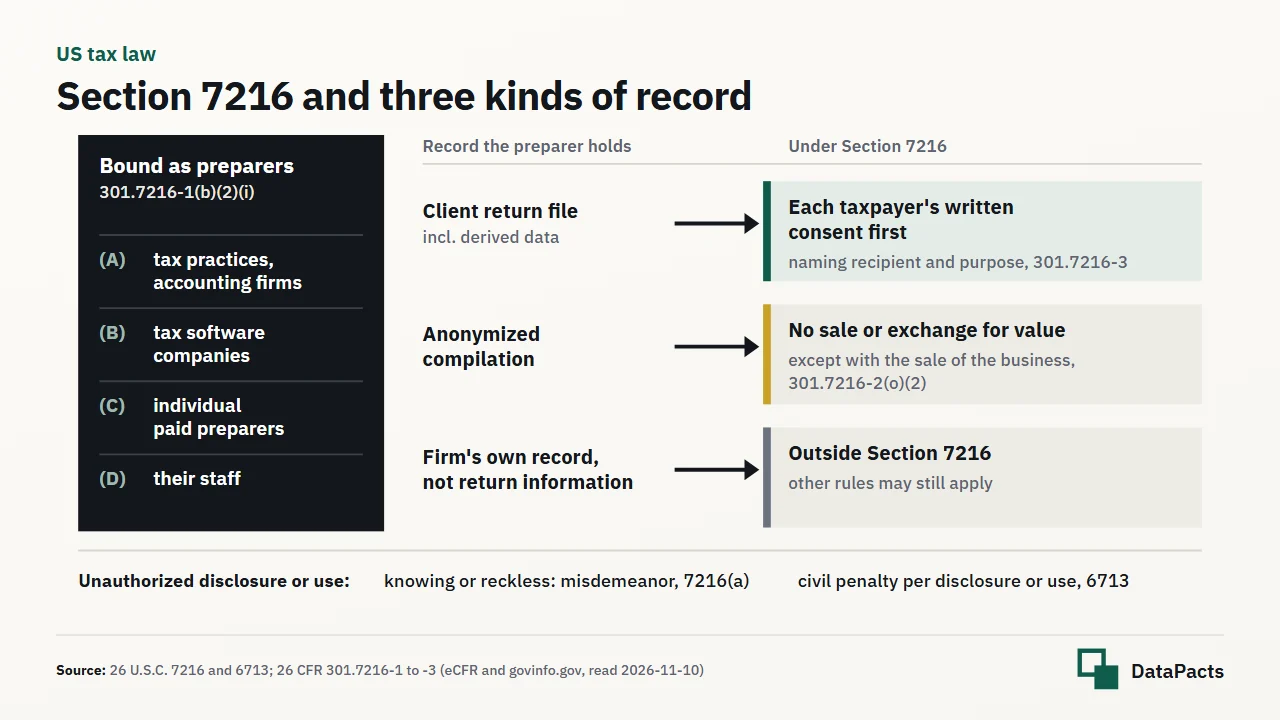
Anonymized compilations of return data may not be sold at all, except with the sale of the preparation business.
The instrument set is 26 U.S.C. 7216 and 6713, 26 CFR 301.7216-1 to -3 and Rev. Proc. 2013-14, all in force as of November 10, 2026. Tax return data is among the most restricted records in AI training data licensing.
Every rule below was read in the primary text on November 10, 2026, and the sourcing and dating method is public.
Can a Tax Return Preparer License Client Data for AI Training Under Section 7216?
Only with each taxpayer's prior written, knowing and voluntary consent that names the recipient and the purpose, and a statistical compilation of return data cannot be sold at all except with the sale of the preparation business.
The consent rule sits in 26 CFR 301.7216-3(a)(1): unless Section 7216 or 26 CFR 301.7216-2 authorizes the act, a preparer may not disclose or use return information before obtaining written consent. The consent must be knowing and voluntary, and making services depend on it makes it involuntary.
For a data deal the result splits three ways. Return files need per-taxpayer consent. Anonymized aggregates fall under the compilation bar in 301.7216-2(o)(2). Records that are not return information, such as a firm's own procedures, sit outside this rule, though other rules may reach them.
Who Section 7216 Binds: Preparers, Their Staff and Tax Software Companies
Section 7216 reaches more than the person who signs a return: 26 CFR 301.7216-1(b)(2)(i) counts four groups as tax return preparers, including companies that develop tax software.
The table lists the four groups as of 2026-11-10.
| Group (301.7216-1(b)(2)(i)) | Who it includes | Example relevant to a data deal | Source |
|---|---|---|---|
| (A) business of preparing returns | anyone holding out as preparing or assisting, fee or not | a tax practice or accounting firm | ecfr.gov 301.7216-1 |
| (B) auxiliary services | includes a person who develops software used to prepare or file a return, and any Authorized IRS e-file Provider | a tax software company | ecfr.gov 301.7216-1 |
| (C) otherwise compensated | paid for preparing a return outside a business, or casually for relatives or friends | an individual paid preparer | ecfr.gov 301.7216-1 |
| (D) employees | individuals whose duties assist groups (A) to (C) | staff who export client files | ecfr.gov 301.7216-1 |
The regulation's Example 1 treats all four employees of a bank's tax unit as preparers, and paragraph (b)(2)(v) lists exclusions. A tax software company licensing its users' data is inside the rule.
What Counts as Tax Return Information, Including Derived Data
Tax return information is any information furnished in any form for, or in connection with, preparing a return, including the taxpayer's name, address and identifying number and information the preparer derives or generates from it.
The information can come from the taxpayer, third parties or the IRS, for example acknowledgments and rejections. Paragraph (b)(3)(i)(D) applies a "but for" test.
Paragraph (b)(3)(i)(B) says statistical compilations are return information "even in a form that cannot be associated with, or otherwise identify, directly or indirectly, a particular taxpayer". Paragraph (b)(3)(i)(C) excludes identical information that the preparer obtained outside return preparation.
A Training License Is Both a Use and a Disclosure
Licensing return data for training is a disclosure, because 301.7216-1(b)(5) defines disclosure as making return information known to any person in any manner, and it is a use where the preparer relies on that information to build or sell a dataset.
A use, under paragraph (b)(4), is any circumstance in which a preparer refers to or relies upon return information as the basis to take or permit an action.
Under 301.7216-3(c)(1) one written document cannot authorize both uses and disclosures, and a consent to use must describe the particular use, so a general "AI" clause does not.
Statistical Compilations: The Sale Bar on Anonymized Return Data
Anonymizing returns does not take them out of Section 7216: a preparer may make a statistical compilation without consent only for limited purposes, and may not sell or exchange it for value.
Under 301.7216-2(o)(1) the preparer may compile and disclose without consent only if:
- the purpose relates directly to internal management or support of the preparation business, or to bona fide research or public policy discussions on state or federal taxation;
- any disclosure is anonymous as to taxpayer identity;
- no aggregate figure uses data from fewer than ten returns.
Paragraph (o)(2) then bars a preparer from selling or exchanging a compilation for value, in whole or in part, except with a transfer of assets on the sale or other disposition of the preparation business.
Paragraphs (n), (o) and (p) apply to disclosures or uses on or after 2012-12-28. The sources read here do not say whether consents from every taxpayer in a set would change the (o)(2) result. For what removing identifiers achieves under other rules, see anonymization of AI training data.
Consent Under 26 CFR 301.7216-3 and Rev. Proc. 2013-14
A valid consent is written, signed and dated before any disclosure or use, and the IRS adds format rules for consents from Form 1040 series filers in Rev. Proc. 2013-14.
The table lists the requirements as of 2026-11-10.
| Requirement | Rule | Applies to | Source |
|---|---|---|---|
| Written, before disclosure or use | no retroactive consent | all | 301.7216-3(a)(1), (b)(1) |
| Knowing and voluntary | conditioning services on consent voids it (except disclosure to another preparer for preparation services) | all | 301.7216-3(a)(1), (a)(2) |
| Names | preparer and taxpayer | all | 301.7216-3(a)(3)(i)(A) |
| Purpose and recipient, or particular use | intended purpose and specific recipients for a disclosure; the particular use for a use | all (descriptive class only for non-1040 filers, limited services) | 301.7216-3(a)(3)(i)(B), (iii) |
| Information covered | the return information to be disclosed or used | all | 301.7216-3(a)(3)(i)(C) |
| Signature and date | signed and dated by the taxpayer; copy to the taxpayer | all | 301.7216-3(a)(3)(i)(E), (c)(3) |
| Separate documents | one document for uses, another for disclosures | Form 1040 series filers | 301.7216-3(c)(1), (a)(3)(iii) |
| Format and statements | mandatory statements in sequence; no opt-out; 12-point type on paper | Form 1040 series filers | Rev. Proc. 2013-14 ss. 5.02, 5.04 |
Mandatory Statements for Form 1040 Filers
For individual filers, Rev. Proc. 2013-14 prescribes statements every consent must carry in a fixed sequence, and it bars opt-out consents.
- A consent to disclose outside return preparation must carry the statements of section 5.04(1)(a), including "If you consent to the disclosure of your tax return information, Federal law may not protect your tax return information from further use or distribution".
- A consent to use carries the statements of section 5.04(1)(c).
- Every consent carries a statement of section 5.04(1)(d) naming the Treasury Inspector General for Tax Administration as the route for complaints.
The taxpayer must opt in, signing a paper consent by hand, and no blank space may be completed after signing. Paper consents use at least 12-point type on 8.5 by 11 inch paper. The procedure (I.R.B. 2013-3) supersedes Rev. Proc. 2008-35 and is effective 2013-01-14.
Business Clients: Engagement Letters and Descriptive Classes
A consent from a taxpayer that does not file in the Form 1040 series may take any format, including an engagement letter, as long as it meets the general elements.
The shortcut of naming a descriptive class of recipients is limited to services for tax returns, audited financial statements or financial information required by a government authority, so it does not name an AI developer as a class. The separate-document rule of 301.7216-3(c)(1) does not apply to these consents.
Timing, Duration and Recipients Outside the United States
Consent must come before the disclosure or use and cannot be given retroactively.
- Duration is as the consent specifies, otherwise one year from signature (301.7216-3(b)(5)).
- The preparer gives the taxpayer a copy of the executed consent (301.7216-3(c)(3)).
- Disclosure to a preparer outside the United States needs prior consent (301.7216-3(a)(3)(i)(D)), and a Form 1040 filer's Social Security number may not be disclosed abroad except through an adequate data protection safeguard defined by the IRS (301.7216-3(b)(4)), which matters where a buyer's annotators sit abroad.
Section 7216 and Section 6713 Penalties
An unauthorized disclosure or use can bring both a criminal penalty under Section 7216(a) and a civil penalty under Section 6713.
The table lists the penalties as of 2026-11-10.
| Provision | Conduct | Penalty | Source |
|---|---|---|---|
| 26 U.S.C. 7216(a) | knowing or reckless disclosure or use other than to prepare the return | misdemeanor: fine up to USD 1,000, or imprisonment up to 1 year, or both, with costs of prosecution | govinfo.gov, 2026-11-10 |
| 26 U.S.C. 7216(a) with 6713(b) | the same, in connection with a crime of taxpayer identity misappropriation | fine up to USD 100,000, or up to 1 year, or both | govinfo.gov, 2026-11-10 |
| 26 U.S.C. 6713(a), (b) | disclosure or use other than to prepare the return | USD 250 per disclosure or use, at most USD 10,000 per calendar year; USD 1,000 and USD 50,000 where 6713(b) applies | govinfo.gov, 2026-11-10 |
Section 7216 requires knowing or reckless conduct, while the text of 6713(a) carries no such words. The civil penalty counts each disclosure or use, so a dataset of many returns multiplies the figure up to the yearly cap.
Exceptions in Section 7216(b) and the Regulations, and Why Training Is Not Among Them
The statute excuses disclosures made under another provision of the Code or a court order, use for state and local returns, and disclosures or uses the regulations permit, and none of these names AI training.
- Section 7216(b)(1): disclosure under any other provision of title 26 or under a court order.
- Section 7216(b)(2): use in preparing the taxpayer's own state and local returns and declarations of estimated tax.
- Section 7216(b)(3): disclosures or uses the regulations permit, which must include quality or peer reviews (301.7216-2(p)).
- 301.7216-2(d)(1): disclosure to another preparer located in the United States for preparation or auxiliary services, but not for substantive determinations or advice.
This page does not claim that any other paragraph of 301.7216-2 authorizes training.
Buyer Requests for Return Files and the IRS Alert on AI, Dated
At least one AI data buyer asks tax firms for return files, while an intermediary that advises sellers keeps them out.
Mercor states that its Accounting & Tax Firm listing seeks tax returns with workpapers across several entity types, several filing seasons and "client documents that can be anonymized for licensing" (checked 2026-11-09).
The listing does not say how it treats consent, and this page draws no conclusion about Mercor from 301.7216-2(o)(2); see the Mercor data buyer profile.
Regulr, a sell-side advisory for businesses licensing records to AI companies, states that it excludes client tax returns (checked 2026-11-09).
The IRS Office of Professional Responsibility issued Alert 2026-19, "Introductory Guidelines for Responsible AI Use in Federal Tax Practice", on 2026-06-24, and it cites IRC 6713 and 7216(a). Which records firms hold and what buyers ask for sits on the page on accounting and tax firms licensing data to AI.
Licensing Under Section 7216: Benefits, Risks, Downsides and Alternatives, Including Not Licensing
A preparer that licenses return data trades a license fee against criminal and civil exposure and client trust, and keeping return data out of any deal is a valid choice.
Benefits
- With compliant, signed consents, a disclosure the taxpayer directs is permitted.
- Records that are not return information stay licensable under other rules.
Risks
- A misdemeanor and a civil penalty per disclosure apply to unauthorized conduct.
- The compilation bar applies even when data is anonymized, and the same ground is covered for company data that cannot be licensed for AI training.
- Once disclosed, federal law may not protect the information from further use or distribution, as the mandatory statement says.
Downsides
- Consent cannot be a condition of service, so coverage of a client base is uneven.
- Consents expire after one year unless they state otherwise.
Alternatives
- Not licensing at all.
- Licensing only the firm's own non-return records.
- Internal compilations for the (o)(1) purposes, without sale.
- Waiting for IRS guidance on AI, with no assurance that any will come.
The wider choice is set out in should you sell or license your data to AI companies.
Beyond Section 7216: Financial Privacy, Foreign Buyers and the Seller Process
Section 7216 is one federal rule for tax data among several that reach a data deal. The page on United States AI training data law sets it beside the other federal and state rules.
- Other countries: AI training data law by jurisdiction.
- Tax preparers as financial institutions under the FTC Safeguards Rule: GLBA and licensing financial customer data.
- Finance records as a data type: accounting, ERP and financial records for AI training.
- Buyers linked to countries of concern: the DOJ bulk sensitive data rule.
- Records outside this rule: PII removal and de-identification before licensing.
- Consent warranties in the contract: AI data licensing agreements.
- Accountants who introduce clients: referral fees for advisers.
- Other paths, including not selling: alternatives to selling data to AI labs.
What This Page Does Not Cover
This page covers licensing client return information as AI training data, not a preparer's use of AI tools in its own practice or how to choose them. It supplies no consent forms or templates and does not summarize AICPA, Circular 230 or state board rules.
How This Page Is Sourced and Dated
Every rule here cites the Code section, regulation paragraph or revenue procedure section, read on the date shown. The approach is described in how we source, date and check every figure. This page is general information about US federal tax law, not legal or tax advice for any specific firm or deal.
Frequently Asked Questions
Does anonymizing tax returns take them outside Section 7216?
No: statistical compilations remain tax return information even when no taxpayer can be identified. They may not be sold except with the sale of the business (301.7216-2(o)(2)).
Can a tax preparer use client returns to train its own AI model?
Training on client returns is a use other than preparing the return, so it needs a written consent to use that describes the particular use. The exception is where a provision of 301.7216-2 authorizes it, and this page identifies none.
Is a tax software company a tax return preparer under Section 7216?
Yes: a person who develops software used to prepare or file a return is a tax return preparer for Section 7216. The rule is in 301.7216-1(b)(2)(i)(B).