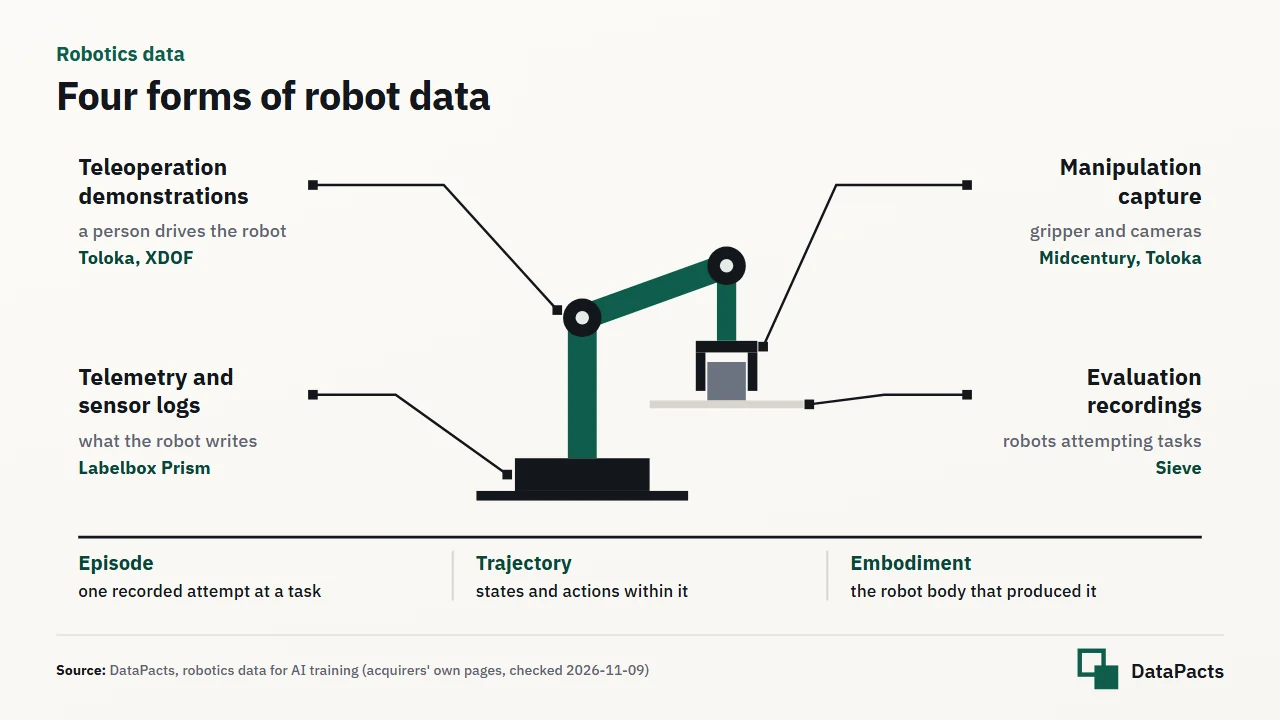
Toloka asks data holders for teleoperation and three-camera gripper capture, XDOF and Midcentury sell datasets they record themselves, and Labelbox Prism lists robotics telemetry among the data it wants (all checked November 9, 2026).
This page sets out, for robot data in AI training data licensing, who collects or pays for it, the dated program terms, the free datasets it competes with and what an operator must clear before licensing. Not licensing is a valid outcome.
The DataPacts Editorial Team explains how we source, date and check every figure.
What Robotics Data Is: Teleoperation Sessions, Manipulation Demonstrations and Robot Logs
Robotics data comes in four forms that acquirers name on their own pages: teleoperation demonstrations, gripper or hand-held capture of manipulation, robot telemetry and sensor logs, and evaluation recordings of robots attempting tasks.
- Teleoperation demonstrations: a person drives a robot and the session is recorded, which Toloka asks for and XDOF produces (its co-founders authored the GELLO teleoperation system).
- Manipulation capture: UMI gripper data and UMI three-camera capture of manipulation tasks, which Midcentury and Toloka name.
- Telemetry and sensor logs: the signals a robot writes while it works, which Labelbox Prism lists as robotics telemetry.
- Evaluation recordings: footage of robots attempting tasks, which Sieve names as robotics evals in its self-description.
Every acquirer on record wants these forms for the same purpose, and the parent page lists all of the data types AI companies buy with the robot entry among them.
In this field an episode is one recorded attempt at a task, a trajectory is the sequence of states and actions within it, and an embodiment is the robot body that produced it. Open datasets count in those units, while no program in the terms table below prices in them.
Footage of a person's own hands and surroundings is a related but separate type. First-person recordings feed robot training too, and they are set out in full under egocentric first-person video for robotics training, so this page does not repeat their buyers, pay or consent rules.
Companies That Acquire or Collect Robot Demonstrations and Logs
Robot data reaches AI developers through five kinds of companies: labs that collect it themselves, capture vendors that record it and sell datasets, programs that pay data holders, intermediaries that license holders' data on their behalf, and services firms that collect it under contract.
The table lists each company's role for robot data as of November 10, 2026 (programs checked November 9, 2026).
| Company | Role for robot data | What it collects, acquires or handles | Source |
|---|---|---|---|
| Figure AI | lab, collects itself | egocentric human video of everyday activities in homes (Project Go-Big); no dataset purchase stated | figure.ai |
| Mecka (Carbon Based Technology Corporation d/b/a Mecka AI) | capture vendor, sells datasets | human demonstration data in homes and commercial environments; sells to robotics labs, frontier model teams and enterprises | mecka.ai |
| Midcentury (Midcentury Labs Inc.) | capture vendor, sells datasets | egocentric vision and UMI gripper data | midcentury.xyz |
| XDOF (xdof, Inc.) | capture vendor, sells datasets | teleoperation demonstrations for robotics labs | xdof.ai |
| Claru (Reka AI Inc. d/b/a Claru AI) | licensee and capture program | robotics manipulation among wanted footage | claru.ai |
| Human Archive (Human Archive, Inc.) | contributor app | depth and motion data with first-person video, licensed to AI and robotics labs | humanarchive.ai |
| Labelbox Prism | licensee, company data program | robotics telemetry among wanted data | prism.labelbox.com |
| Protege (Protege Health, Inc.) | licensee platform | spatial and physical data among provider domains | withprotege.ai |
| Sieve (Sieve, Inc.) | licensee and capture program | recordings of physical work; robotics evals in its self-description | sieve.ai |
| Toloka (Toloka AI BV) | program for companies and capture teams | teleoperation, UMI three-camera capture, egocentric video | toloka.ai |
| Troveo (Troveo AI, Inc.) | intermediary, licenses on the owner's behalf | robotics data among listed categories | troveo.ai |
| TaskUs (TaskUs, Inc.) | services firm | markets AI data services for autonomous vehicles and robotics | taskus.com |
XDOF, Mecka and Midcentury state no seller or contributor program: they collect their own data and sell it to robotics labs, so a robot operator is their customer or supplier of nothing. Figure collects its own footage in Brookfield homes and states no dataset purchase.
Troveo licenses content on the owner's behalf and does not buy it, and TaskUs markets collection services to developers. The companies that collect and license data across every type are compared among the dataset vendors and data labs that collect and license.
Why Robot Data Is Mostly Recorded to Order Rather Than Licensed From Archives
Most acquirers on record collect robot data themselves or commission it, recorded to order by the vendor's own fleets or by outside teams under a statement of work.
Mecka states that it runs capture fleets with its own multi-sensor hardware and an iPhone app, and that buyers can choose dataset access, commissioned task-specific collection, evaluations or a full data program.
Toloka states the same order of work for outside teams: a reply within 3 working days, an intro call, a sample, and then an agreement before any recording (checked November 9, 2026). XDOF's co-founders built the GELLO teleoperation system, which shows how close collection and tooling sit at these firms.
Mecka also publishes dated figures on its own growth. Mecka states a Series B of USD 60,000,000 led by Sequoia Capital, announced October 7, 2026, and run-rate revenue of more than USD 100,000,000 as of June 2026 with a projection of USD 300,000,000 by year-end.
These are the company's own claims, not audited figures, and Mecka publishes no pay or license terms for data holders. Simulation complements recorded data, and it is covered under synthetic data below.
Open Robot Datasets That Set the Free Baseline
Robot developers can already obtain large open demonstration datasets, so paid robot data has to offer new tasks, robots, sites or exclusivity.
The table compares two open robot collections as of November 10, 2026, each size and license as its publisher states it.
| Dataset | Publisher (stating party) | Size as stated | License as stated | Date | Source |
|---|---|---|---|---|---|
| Open X-Embodiment | project page | 1M+ trajectories; 22 embodiments; "21 institutions" and "34 labs" on the same page | not stated here | not stated here | robotics-transformer-x.github.io |
| ABC-130K | XDOF | 130K+ episodes; 200 manipulation tasks | Apache 2.0 | 2026-06-17 | xdof.ai/blog |
The Open X-Embodiment page counts its contributors twice, as 21 institutions in one place and 34 labs in another, so both figures stand above and neither is merged. XDOF states that ABC-130K is released under Apache 2.0, while no license for Open X-Embodiment is stated in the source cited here.
Open sets cap what a generic demonstration is worth. The license and provenance of each major collection are compared among the major AI training datasets and their licenses.
Robotics Data Terms by Program: What Each Wants, Pays and Licenses
Only a handful of programs publish terms for taking robot data from holders, and they differ on three points: the pay unit, the width of the license, and what happens to trained models when the license ends.
The table sets out the stated terms as of November 10, 2026; every value is the program's own statement, checked November 9, 2026.
| Program | Robot data wanted (stated) | Pay unit (stated) | License grant (stated) | After termination or deletion (stated) | Source |
|---|---|---|---|---|---|
| Claru Partnerships | robotics manipulation among footage types | "Typical first deal: $5K–$50K archive license, or $10–$120/hr capture rate by region and modality"; archive net-15, capture weekly | non-exclusive training rights; owner keeps ownership; no republishing | delivered content cannot be recalled from client copies | claru.ai/partnerships; claru.ai/privacy |
| Labelbox Prism | robotics telemetry | targeted datasets "typically start around $50K"; enterprise partnerships "can reach $1M+"; upfront fee at signing plus revenue share | exclusive by default; seller keeps ownership and continued use | kill clause: deletion within 30 days on stated triggers; models already trained "cannot be unlearned" | prism.labelbox.com (telemetry, checked 2026-11-16); prism.labelbox.com/faq |
| Protege data providers | spatial and physical data | revenue share with each use; percentage not public | worldwide, royalty-free, non-exclusive license to Protege (§1.1); provider indemnifies (§4.1); liability cap of 2x fees in 12 months (§6.2) | licensees keep access for 12 months, academic licensees for 3 years (§7.2); Delaware law | withprotege.ai/provider-terms |
| Sieve partners | recordings of physical work | "Checks them, then pays"; no amount or timing | "You keep ownership"; scope in Sieve's agreement | term and exclusivity not published | sieve.ai/partners |
| Toloka Physical AI Data Partner Program | teleoperation; UMI three-camera capture | set in the statement of work by data type, volume and quality | confidentiality and IP terms in the agreement | not stated | toloka.ai/physical-ai-become-a-data-partner |
| Troveo content owner licensing | robotics data listed among categories | royalty each time content is used; no rate published | owner keeps full ownership; Troveo licenses on the owner's behalf under NDA | not stated | troveo.ai; troveo.ai/content-owners |
Prism's exclusive-by-default license and 30-day kill clause contrast with Protege's non-exclusive license and Claru's non-exclusive training rights. The units also differ (archive license, capture hour, revenue share, statement of work), so the figures are not comparable and no average is given.
Prism states that models already trained cannot be unlearned, and Claru states that delivered content cannot be recalled. The same programs appear beside terms for other data types in the program terms compared, dated.
What a Robot Operator Already Holds: Teleoperation Records, Fleet Logs and Telemetry
A company that runs robots, such as a warehouse, factory or service operator, may already hold licensable material: teleoperation records from remote assistance, fleet logs and telemetry, and recordings of robots failing and recovering.
Prism names robotics telemetry among the data it wants and Claru names robotics manipulation, so both kinds of program describe material an operator's fleet produces. Who may license it depends first on the contract between the robot's manufacturer and its user.
An acquirer asks for the robot model, the sensors, the task labels and the number of hours or episodes, and the sample under a statement of work that Toloka describes serves to prove them.
No program in the table states a price per teleoperation hour, per episode or per fleet-log volume, so the value of a log set is set in negotiation. The route for operating companies licensing their data covers how a business that runs equipment approaches this.
Clearing Robot Data: Product Data, Customer Sites and People in Frame
Robot data is cleared on three fronts: the product-data rules around the robot, the confidentiality of the sites it worked in, and the people its cameras recorded. This section is information, not legal advice.
Robot Product Data Under the EU Data Act
In the EU, data generated by a connected robot is product data, and a manufacturer acting as data holder may share non-personal product data with third parties, such as an AI buyer, only under its contract with the user.
Regulation (EU) 2023/2854, Art. 4(13) and (14), applies from September 12, 2025, and Art. 13 makes unfair terms on data access and use, imposed unilaterally by one enterprise on another, non-binding. The Commission's non-binding model terms are Recommendation (EU) 2026/2394, published on November 6, 2026.
The act's reach over AI training is set out under the EU Data Act and AI training data, including the access-by-design duty for products placed on the market after September 12, 2026.
Logs Recorded at Customer Sites and Trade Secrets
A robot working inside a client's facility records the client's layout, processes and products, so its logs may carry the client's trade secrets and confidentiality terms, not only the operator's.
Under the Defend Trade Secrets Act (18 U.S.C. 1839(5), in force since May 11, 2016), misappropriation includes disclosure by a person who acquired a secret under a duty to maintain secrecy.
Directive (EU) 2016/943, Art. 4(4), makes acquisition, use or disclosure unlawful where the person knew or ought to have known that the secret came from someone using or disclosing it unlawfully (transposition deadline June 9, 2018).
A service contract usually decides whether logs from a client's site may be licensed, as set out under customer consent and confidentiality clauses.
Operators and Bystanders Captured by Robot Cameras
Robot cameras record the workers who operate or pass the robot, so EU workplace-monitoring rules, German works council co-determination and US biometric statutes can apply before footage is licensed.
GDPR Art. 88(2) (Regulation (EU) 2016/679, applies from May 25, 2018) requires employee rules to include suitable measures on monitoring systems at the workplace, and BetrVG § 87(1) Nr. 6 gives the German works council co-determination over technical devices that monitor employees.
Illinois BIPA, 740 ILCS 14/15(b), requires written notice and release before biometric identifiers are collected, and 14/15(c) bars selling or profiting from them. GDPR Art. 9(1) treats biometric data that uniquely identifies a person as special-category data.
Notice and works council steps are set out under employee notice and consent when licensing. Wearer and bystander law for head-mounted footage sits on the egocentric page named above.
Licensing Robotics Data: Benefits, Risks, Downsides and Alternatives, Including Not Licensing
Licensing robot data can earn income from recordings a fleet produces anyway, but the stated licenses are often exclusive or irrevocable, trained models stay trained, and the logs can expose customers, staff and the operator's own know-how.
Benefits:
- Claru's archive license leaves ownership with the owner.
- Prism states an upfront fee at signing plus revenue share on downstream use.
- Protege's stated license is non-exclusive, so other licensing stays open.
Risks:
- Prism's exclusive-by-default license and its statement that trained models cannot be unlearned.
- Delivered content is not recalled from client copies, as Claru states.
- Product-data rules and customer confidentiality can bar licensing the logs at all.
Downsides:
- Open sets such as Open X-Embodiment and ABC-130K cap demand for generic demonstrations.
- No program publishes a price per hour or episode for robot logs.
- Capture vendors such as Mecka and XDOF record their own data and state no seller program.
Alternatives:
- License under non-exclusive terms only, as Protege and Claru state.
- Provide a sample under a statement of work first, as Toloka's process allows.
- Release an open dataset under a chosen license, as XDOF did with ABC-130K.
- Not license at all, as set out in the alternatives to selling data to AI labs, including not selling at all.
The contract with the robot's manufacturer and with each customer site decides which of these options exist.
Neighboring Data Types and the Seller Steps for Robot Data
This page covers data recorded by or for robots; first-person human video, other footage, sensor and IoT streams, motion capture, driving footage and simulated data each have their own page. Product data and people at work also fall under the AI training data law by jurisdiction.
Neighboring pages:
- Selling video for AI training: existing footage and archives
- Sensor, IoT and telemetry data: machine and IoT telemetry without a robot
- Motion capture and 3D data: human motion capture
- Driving and dashcam footage: footage from vehicles
- Synthetic data for AI training: simulation and generated data
- Manufacturers licensing industrial data: industrial data from factories
Seller steps for robot data:
- Read how to sell or license company data for the whole process.
- Prove quality with samples and clean rooms before any full delivery.
- Agree the license, clause by clause, using AI data licensing agreements.
- Check payment timing under when AI data buyers pay.
Frequently Asked Questions
What is robotics data collection?
Robotics data collection is recording robots, or people steering them, through tasks to train robot policies. Toloka asks data holders for teleoperation and UMI three-camera capture (checked November 9, 2026).
Who pays for robotics data?
Programs that publish terms for holders include Labelbox Prism, Claru, Protege and Toloka. XDOF, Mecka and Midcentury collect their own data and publish no seller program (checked November 9, 2026).
Are AI robotics data collection jobs real?
Contributor programs for physical tasks exist and publish terms. Human Archive states payouts for approved submissions, which can be reversed, and no robotics-specific rate is on record (checked November 9, 2026). Individuals can compare AI training jobs and platforms compared, and is AI training work legit explains how to check a platform.
What is robotics data annotation?
Robotics data annotation is labeling robot recordings with task, success and object information. The work is a service bought from labeling vendors, not a data sale. Vendors are compared among the data labeling companies.
Advisers and agents can use the introducer form.