Mercor states that its Manufacturing & Industrial Company listing asks for CAM programs with setup sheets, work orders with inspection reports, or machine alarm logs and process data, with several years of history (re-read 2026-11-10).
Mercor states a range of USD 100,000 to 1,500,000 per company, "Depends on record types and history", the highest maximum among its 25 listings (checked 2026-11-09). It is an advertised claim, not a price paid; shop-floor records are sector holdings in AI training data licensing.
DataPacts Editorial Team checked the buyer pages, statutes and rules cited here on 2026-11-09 and 2026-11-10, following how we source, date and check every figure.
What AI Buyers Ask Manufacturers For
Seven programs name manufacturing, industrial records, robot data or factory footage on their own pages, and one more offer aimed at plants is a paid service, not a purchase. The table compares them as of 2026-11-10, in alphabetical order; each value is the party's own statement, checked 2026-11-09 unless marked.
| Program | Role | What it names for manufacturers, or excludes | Source |
|---|---|---|---|
| AfterQuery Data Partnerships | B | CAD designs among processed business data | afterquery.com launch post, 2026-10-23 |
| AIChamp factory studies | S | plant supplies drawings, videos, sensor readings and production data; the plant pays; data not sold or licensed | aichamp.com/terms.html |
| Claru partnerships | B | archive footage (security, QA, training), robotics manipulation; faces scrubbed | claru.ai/partnerships |
| Handshake AI Data Partnerships | B | manufacturing named; production records and quality reports; design documentation, specifications, test reports; AutoCAD named | joinhandshake.com/ai/data-partnerships |
| HUMXN | M | manufacturing and robotics and automation among 24 industries; records not stated | humxn.io/sell-company-data |
| Labelbox Prism | B | robotics telemetry | prism.labelbox.com |
| Mercor Manufacturing & Industrial Company listing | B | owned production or maintenance records; CAM programs with setup sheets, work orders with inspection reports, or alarm logs and process data; several years; not a fit: data restricted by customer contracts, marketing material only; re-read 2026-11-10 | api.data.mercor.com listings /manufacturing |
| Mercor program page | B | manufacturing among 8 target industries | mercor.com/data |
B = buyer or licensee program; M = marketplace; S = paid service for plants that does not acquire data. "Not stated" does not mean allowed.
A named sector is not a stated record list: HUMXN names manufacturing but states no manufacturing records. The AIChamp row is a service the plant pays for, and its terms say it does not sell, license or share the plant's data.
Production, Maintenance and Quality Records Versus Design Files
Buyers want two kinds of manufacturing records: the shop-floor history of production, maintenance and inspection, and the design files behind the parts.
Mercor names CAM programs with setup sheets, work orders with inspection reports, and machine alarm logs and process data, with several years of history and tools such as Mastercam, Maximo, MES and OSIsoft PI. Handshake AI names production records and quality reports next to design documentation, specifications and test reports.
Mercor's separate Hardware Engineering Company listing asks for native CAD with feature trees, from designs the company owns, "not customer IP" (checked 2026-11-09). AfterQuery names CAD designs among the business data it has already processed.
Work instructions and training materials are a separate data type: they follow the rules for SOPs, playbooks and process documentation.
Machine Logs, Robot Telemetry and Factory Video
Machine-generated records reach buyers as alarm logs and process data from historians and MES systems, as telemetry from robot fleets, and as video of work on the floor.
Claru names archive footage from security, QA and training, and states that it scrubs faces, cards and plates. Build AI released Egocentric-10K, 10,000 hours of factory video from 85 factories under Apache 2.0 (dataset card, 2025-08), a free baseline.
Labelbox Prism names robotics telemetry, and Claru names robotics manipulation, which is covered under robotics data for AI training.
Process Know-How as a Trade Secret: What a License Puts at Stake
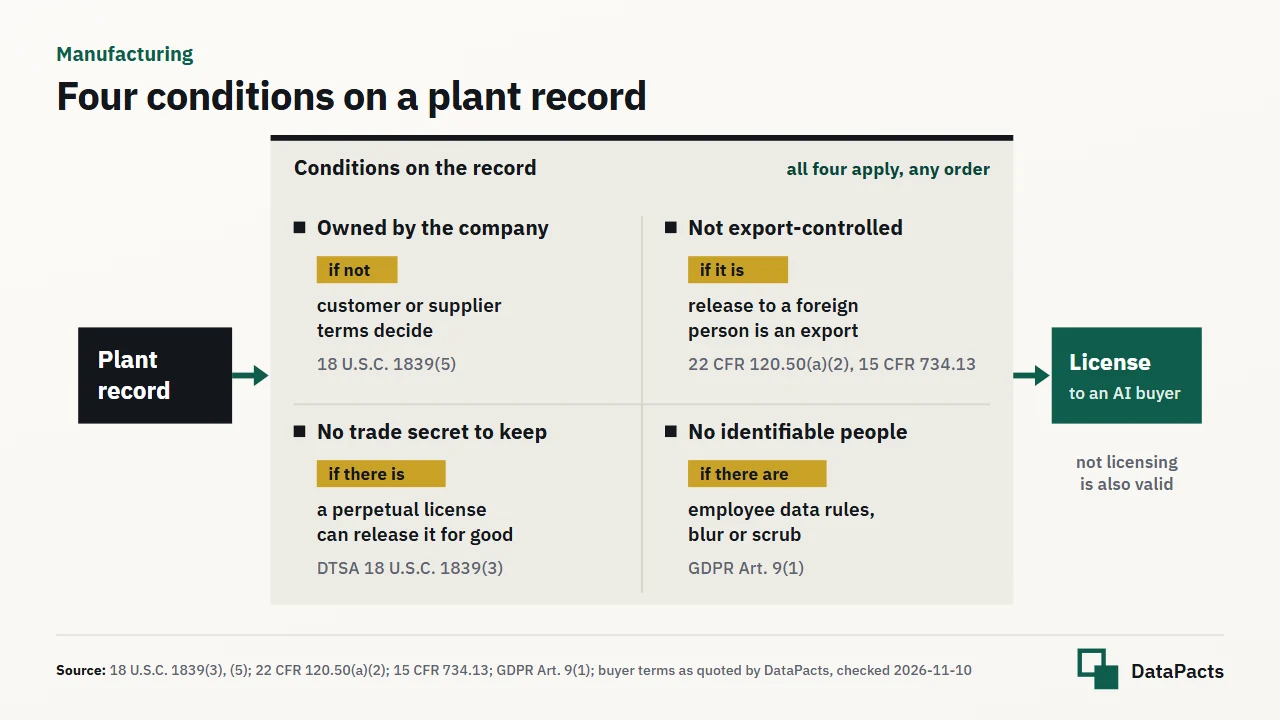
Process parameters, setup sheets and yield histories can be a manufacturer's trade secrets, and they keep that status only while the company takes reasonable steps to keep them secret, including in any license.
US federal law defines a trade secret in 18 U.S.C. 1839(3), and its reasonable measures element dates from Pub. L. 104-294 (1996-10-11); the Defend Trade Secrets Act of 2016 (Pub.
L. 114-153, 18 U.S.C. 1836 and 1839, in force 2016-05-11) amended only part (B) of that definition.
The UK Trade Secrets (Enforcement, etc.) Regulations 2018 (SI 2018/597, in force 2018-06-09) define it in reg. 2 as information that is secret, has commercial value because it is secret, and has been subject to reasonable steps to keep it secret.
micro1's Data License Master Terms s.1.2 state a worldwide, nonexclusive, irrevocable, perpetual license, sublicensable through multiple tiers, and s.4.4 sets no duty to retrain Licensee Materials; confidentiality survives 3 years after termination and indefinitely for trade secrets (last updated 2026-11-08). Labelbox Prism states that "Models already trained on the data cannot be unlearned" (checked 2026-11-09).
How the Defend Trade Secrets Act and licensed AI training data interact is set out on the DTSA page.
Customer and Supplier Records a Manufacturer Does Not Control
A manufacturer licenses only what it controls, and Mercor's manufacturing listing names data restricted by customer contracts as not a fit. Mercor's Hardware Engineering listing also lists "Designs owned by your customers" as not a fit (checked 2026-11-09).
Build-to-print drawings, customer specifications and supplier price files sit under the customer's or supplier's terms, and the company reads its own contracts for the clause.
Under 18 U.S.C. 1839(5), disclosure by a person who acquired a secret under a duty to keep it secret is misappropriation, so passing on a customer's or supplier's confidential material can lead to a claim against the seller.
What the company's own employees create is different: 17 U.S.C. 201(b) makes the employer the owner of a work made for hire unless a signed written instrument says otherwise, and CDPA 1988 s.11(2) gives the UK employer first ownership, subject to any agreement to the contrary.
Read the customer consent and confidentiality clauses before licensing data before any record is scoped.
Connected-Product Data From Machines Sold to Customers (EU)
A manufacturer that collects data from machines it sold in the EU holds connected-product data, which it may make available to a third party only under its contract with the user.
Regulation (EU) 2023/2854, Art. 4(13)-(14), applies from 2025-09-12 and bars a data holder from making non-personal product data available to third parties outside that contract, and Art. 3(1) requires access by design for products placed on the market after 2026-09-12.
The EU Data Act and AI training data page covers the access and sharing rules.
Defense and Dual-Use Drawings: When Release to an Annotator Is an Export
Drawings, plans and instructions required for defense articles are ITAR technical data, and releasing them to a foreign person in the United States counts as an export. The sources are 22 CFR 120.33(a)(1) and 120.50(a)(2); this section gives primary citations only and no classification advice.
Under the Export Administration Regulations, 15 CFR 734.13 treats release of controlled technology or source code to a foreign person as a deemed export, and 734.13(b) sends it to the person's most recent country of citizenship or permanent residency.
Controlled unclassified information is defined in 32 CFR 2002.4(h) as information the Government creates or possesses, or an entity creates or possesses for the Government; data a company creates privately and not for an agency is not CUI.
micro1's s.5.7 excludes export-controlled information unless the Order Form allows it. Whether a given file is controlled is the company's own classification question, set out under export controls and technical data.
Workers on Camera and in Operator Records
Factory video, badge-linked machine logs and maintenance records name or show employees, so licensing them involves employee data rules as well as the company's own rights. Regulation (EU) 2016/679 applies from 2018-05-25, and Art. 9(1) makes biometric data used to identify a person a special category, prohibited unless an Art. 9(2) exception applies.
Claru states that it auto-scrubs faces, cards and plates and that delivered content cannot be recalled, and Toloka states that it blurs faces, palms, fingerprints and tattoos and removes voices (both checked 2026-11-09).
Operator records fall under employee data and AI training rules.
Company Size Gates and Stated Ranges for Manufacturers
Mercor sets a 20 to 2,000 employee band for manufacturers, Handshake AI's own pages disagree on whether a minimum applies, and the other programs state ranges without a size rule. Each party states its own figure, alphabetically:
- AIChamp: the plant pays USD 4,870 for a Second Opinion, under terms effective 2026-10-22 (checked 2026-11-17); the terms page no longer lists the Whole-Plant Study, earlier published at USD 14,610; no money goes to the plant.
- Claru: a typical first deal of USD 5,000 to 50,000 for an archive license (checked 2026-11-09).
- Handshake AI: "Earn $100K to $4M+", while the estimator on the same page reads "Your data could be worth up to $100,000" (re-checked 2026-11-16); the Data Partnerships page states no minimum, while the license and referral pages state 20+ full-time employees and 3+ years (checked 2026-11-09).
- Labelbox Prism: smaller, more targeted datasets "typically start around $50K", and large enterprise partnerships "can reach $1M+" (checked 2026-11-09).
- Mercor: 20 to 2,000 employees, location "Anywhere", and the range stated at the top of this page (re-read 2026-11-10).
Mercor states a referral base of USD 100,000 plus a USD 10,000 fast-signing booster for this listing (checked 2026-11-16; the base read USD 55,000 on 2026-11-10). Every figure is an advertised claim, not an offer. The payouts and program terms compared page sets the programs side by side.
Benefits, Risks, Downsides and Alternatives for a Manufacturer
Licensing gives a manufacturer a new use for years of shop-floor records, but it can release process know-how for good and carries customer, export and security risks a fee does not offset, and not licensing is a valid outcome.
Benefits
- Income from records the plant already keeps, as Mercor's claim and not a promise.
- Records made by the company's own staff need no third-party grant under 17 U.S.C. 201(b), absent a contrary agreement.
Risks
- Misappropriation claims over customer or supplier material (18 U.S.C. 1839(5)).
- Export violations (22 CFR 120.50(a)(2), 15 CFR 734.13).
- Buyer security: Mercor's filing with the California Attorney General gives breach dates of 2026-03-24 and 2026-03-30 after unauthorized access via compromised LiteLLM versions, and In re Mercor.io Corporation Data Breach Litigation, N.D. Cal. Lead Case No. 3:26-cv-02821-WHO, is the lead docket.
Downsides
- Licenses that cannot be withdrawn, such as micro1's s.1.2 and s.4.4.
- Trained models cannot be unlearned, as Labelbox Prism states.
- Exclusivity by default at one program: Labelbox Prism states its datasets are exclusive by default.
Alternatives
- License only records free of customer terms.
- Keep the archive for in-house use or a private model; The General Data Company describes training private models for industrial companies (checked 2026-11-09).
- Not licensing at all, covered under alternatives to selling data, including not selling at all.
Where Manufacturing Licensing Meets the Seller Path, Data Types and Other Industries
Manufacturing shares design files with hardware companies, process records with semiconductor fabs and project imagery with construction firms, and each industry page sets out its own limits.
Manufacturers are one sector in data licensing by industry, next to construction and trades companies licensing data, logistics and transport data, semiconductor companies licensing process data and engineering and architecture firms licensing data.
Worker-worn cameras produce first-person video for AI and robotics training, machine records sit under sensor, IoT and telemetry data, and design files under CAD and engineering files. The full map is AI training data law by jurisdiction.
- Check data sale readiness.
- Run a rights audit on owned versus customer records.
- Sign an NDA before a sample leaves the plant.
- Start evaluating an offer for your data.
- Negotiate the clauses of AI data licensing agreements.
This page is information, not legal advice.
Buyer, Program and Law Pages Named on This Page
Each buyer, service and rule above has or will have its own page with dates and sources.
Buyers, programs and services:
- AfterQuery
- AIChamp
- Build AI
- Claru
- The General Data Company
- Handshake AI data buyer profile
- HUMXN
- Labelbox Prism
- Mercor data buyer profile
- Toloka data buyer profile
Laws:
Frequently Asked Questions
Can a manufacturer sell its production data to AI companies?
Yes, where the company owns the records and no customer contract restricts them; Mercor's manufacturing listing asks for CAM programs, work orders with inspection reports or alarm logs and process data, checked 2026-11-10.
How much do AI companies pay manufacturers for data?
No manufacturer price is published by a seller or a court; Mercor states USD 100,000 to 1,500,000 per company, depending on record types and history, checked 2026-11-10.
See what company data is worth to AI companies.
Can a job shop license its customers' drawings?
Not without the customer's agreement: Mercor lists designs owned by customers as not a fit.
The drawings of product companies are covered with hardware and product engineering companies licensing CAD.