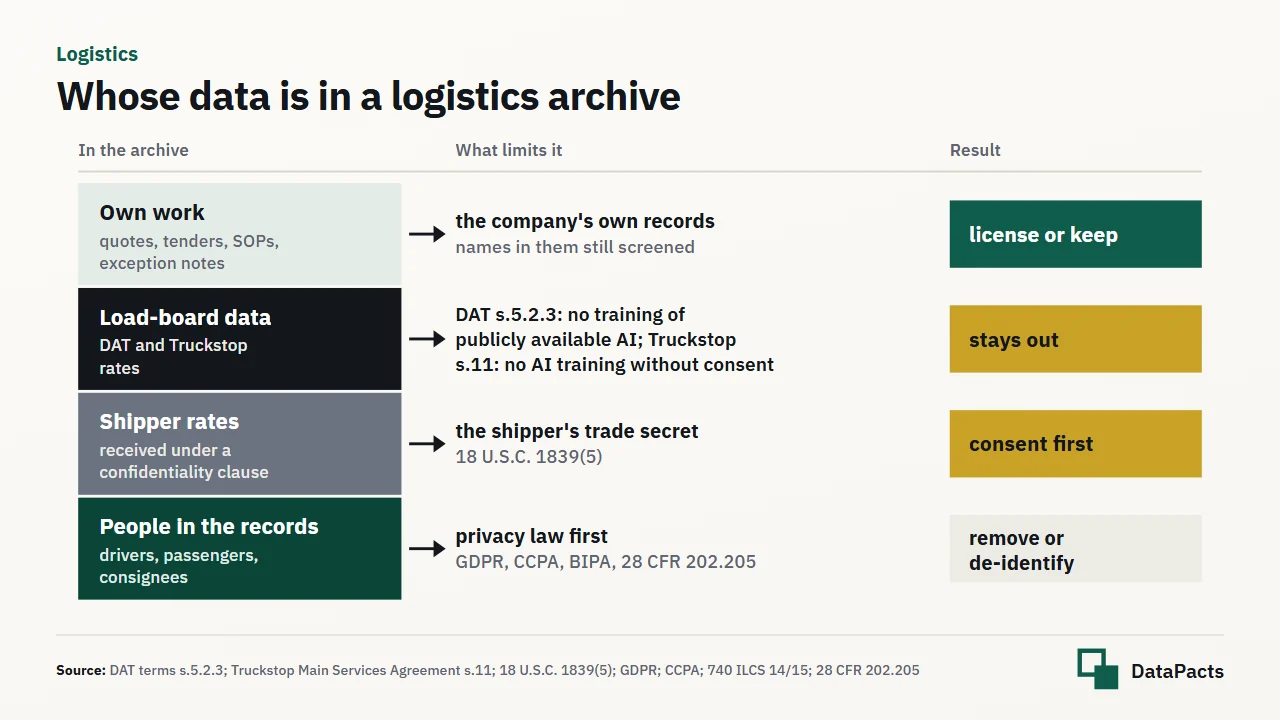
Five programs and intermediaries name logistics records on their own pages, checked 2026-11-09, and none of the buyers publishes a logistics-specific price. DAT's terms bar training publicly available AI on its Product Data and Truckstop's terms bar AI training on Truckstop Data without written consent, both re-read 2026-11-10.
Intermediaries advise sellers and do not acquire data, and every figure below is a dated claim from a named source. The page sits within AI training data licensing, where freight and transport records are one sector among many.
How we checked this page: every clause and figure was compared with its primary source on the date shown, and the method is set out under how we source, date and check every figure.
What Logistics Companies Hold That AI Buyers Ask For
Logistics companies hold four kinds of records that buyers' pages describe: shipment and document records, rate history, telematics and location data, and the dispatch and exception logs that show how staff solve problems.
Shipment Records, Freight Documents and Rate History
A broker or 3PL's core archive is the shipment record: tenders, quotes, rate confirmations, bills of lading and proof-of-delivery documents tied to each load.
Handshake AI states that it wants "procurement, shipping, dispatch logs" together with product catalogs and inventory workflows, and micro1 states that it wants logistics and fulfillment processes, both checked 2026-11-09. Freight documents follow the rules for selling documents for AI training.
Rate data bought from a load board is not the company's own, because the load-board terms below govern it.
Telematics and Location Records From Trucks and Aircraft
Telematics records are the location, speed and engine signals a vehicle or aircraft writes while it moves, and a carrier often holds them only through its device or vehicle maker's platform.
Regulation (EU) 2023/2854 Art. 4(13)-(14) lets a data holder use non-personal product data only under its contract with the user and bars making it available to third parties outside that contract.
The product data rules of the EU Data Act and AI training data apply from 2025-09-12, and access by design under Art. 3(1) covers connected products placed on the market after 2026-09-12.
A location trace tied to a truck can identify its driver, so the personal data rules below apply.
Under 28 CFR 202.205, precise geolocation from more than 1,000 US devices in the preceding 12 months is bulk sensitive data, and the rule has been in force since 2025-04-08. Selling or licensing such data to buyers in or linked to countries of concern is prohibited, even if de-identified, as the thresholds of the DOJ bulk sensitive data rule show.
Dispatch, Exception and Customer-Service Logs
Dispatch messages, check calls, exception notes and customer-service tickets record how a logistics team handles delays, damage and disputes, which is the workflow knowledge buyers describe.
These logs carry shipper, consignee and driver names. Service logs are one case of customer support tickets and chats for AI training, which has its own page.
Buyer and Intermediary Statements That Name Logistics
Five programs and intermediaries name logistics or transport records on their own pages, checked 2026-11-09, and none of the buyer programs publishes a logistics-specific price.
The table compares what each names or excludes, as of 2026-11-09, in alphabetical order. Role B is a buyer or licensee program and I is an intermediary that advises and does not acquire data. "Not stated" does not mean allowed.
| Program | Role | What it names for logistics, or excludes | Source |
|---|---|---|---|
| Handshake AI Data Partnerships | B | "Logistics & supply chain" among 11 industries; procurement, shipping, dispatch logs; product catalogs and inventory workflows; no minimum on the main page, 20+ full-time employees and 3+ years on the license and referral pages | joinhandshake.com/ai/data-partnerships |
| HUMXN | B (marketplace) | "logistics & transport" among 24 industries; records not stated for logistics | humxn.io/sell-company-data |
| Mercor Data | B | Logistics among 8 target industries; no logistics listing among 25 referral listings; covers extraction, anonymization and transfer costs | mercor.com/data; api.data.mercor.com listings |
| micro1 Company Data Partnerships | B | "Operations & logistics" among 6 functional areas; logistics and fulfillment processes; 30+ full-time employees; biometric identifiers excluded unless the Order Form allows them | micro1.ai/data-partnerships; data license master terms |
| Regulr sell-side advisory | I | Freight brokers and 3PLs industry page; excludes third-party licensed data; the buyer pays Regulr a fee when a license closes | regulr.ai |
Mercor names logistics among eight target industries on its program page, yet none of its 25 referral listings is for a logistics company.
Handshake AI's two size statements both stand, as the table shows. HUMXN and Regulr are written about only as far as their own pages go, and Regulr states, checked 2026-11-09, that it has not yet closed a data deal. Each program's terms sit under payouts and program terms compared.
Load-Board Terms and Shipper Confidentiality Come Before Any License
A broker's records mix its own work with data it received under contract, and the load-board and shipper terms on that data bind before any buyer's license does.
The table lists each limit by source, as of 2026-11-10, with the version read.
| Source of limit | Clause | What it says | Version or in force | Source |
|---|---|---|---|---|
| DAT Solutions, LLC (dba DAT Freight & Analytics) | Terms s.5.2.3 | No use of products or Product Data to train or improve any publicly available AI or ML algorithm; no transfer of a privately developed algorithm trained with Product Data to any third party | Updated 2026-07-30; re-read 2026-11-10 | dat.com/terms-and-conditions |
| DAT | Terms s.9 | Freight rates are DAT trade secrets; confidentiality for the term and five years after | Updated 2026-07-30; re-read 2026-11-10 | dat.com/terms-and-conditions |
| Internet Truckstop Group, LLC | Main Services Agreement s.11 | No Truckstop Data into any AI Function and no AI or ML training on it without prior written consent | Updated 2026-09-15; re-read 2026-11-10 | truckstop.com/terms-conditions |
| United States | 18 U.S.C. 1839(5) (DTSA) | Disclosure by one who acquired a secret under a duty to maintain secrecy is misappropriation | In force 2016-05-11 | govinfo.gov |
DAT and Truckstop Terms on AI Training
DAT's terms prohibit using its products or Product Data to train any publicly available AI or machine learning algorithm, and Truckstop's terms bar using Truckstop Data to train any AI or machine learning model without its prior written consent.
DAT s.5.2.3 also bars transferring a privately developed algorithm trained with Product Data to any third party, and Truckstop s.11 also bars inputting Truckstop Data into any AI Function without consent, in agreements updated 2026-07-30 and 2026-09-15.
DAT s.9 treats freight rates in Product Data as DAT's trade secrets, with confidentiality for the term plus five years. Rate history drawn from a load board therefore stays out of the licensed set.
Shipper Rates and Trade Secrets Held Under a Duty of Secrecy
Rates and volumes a shipper discloses under a confidentiality clause are the shipper's secrets in the broker's files, and passing them to an AI buyer can breach both the contract and trade secret law.
Under 18 U.S.C. 1839(5), in force since 2016-05-11, misappropriation includes disclosure by one who acquired the secret under a duty to maintain secrecy, as the Defend Trade Secrets Act and licensed AI training data page sets out.
The practical line runs between lane-level aggregates the company produced itself and customer-identified rates, and Mercor's statement that no AI lab buyer or third-party vendor sees raw data, checked 2026-11-09, does not release a confidentiality duty.
Driver and Passenger Personal Data in Logistics Records
Logistics records name people at every step, from the driver on a load to the passenger on a booking, and each group brings its own privacy rule. The table sets the rules out by jurisdiction, as of 2026-11-09.
| Jurisdiction | Rule | What it requires | In force | Source |
|---|---|---|---|---|
| European Union | Regulation (EU) 2016/679 (GDPR) | Governs personal data of drivers, passengers and consignees | Applies from 2018-05-25 | eur-lex.europa.eu |
| United States | 28 CFR 202.205 | Precise geolocation of more than 1,000 US devices in 12 months is bulk sensitive data | 2025-04-08 | ecfr.gov |
| United States | 11 U.S.C. 363(b)(1) | PII under a debtor's privacy policy is sold only consistent with it, or after an ombudsman and court approval | In force (2005 amendment) | law.cornell.edu |
| California | Cal. Civ. Code 1798.120 (CCPA) | Right to opt out of sale or sharing | 2020-01-01 | cppa.ca.gov |
| Illinois | 740 ILCS 14/15(b), (c) (BIPA) | Written release before collection; no sale or profit from biometric identifiers | In force; amended effective 2024-08-02 (P.A. 103-0769) | ilga.gov |
Driver employment and hours-of-service rules and passenger booking rules are not yet summarized on this page.
Drivers: Biometrics, Location Traces and Employment Records
Driver records include qualification files, hours, location traces and, at some terminals, fingerprint or face scans, and the biometric part carries the strictest US rule.
Under 740 ILCS 14/15(b), no private entity may collect, capture, purchase or receive biometric identifiers without written notice and a written release, and under 14/15(c) none may sell, lease, trade or profit from them.
In Payton v. Union Pacific Railroad, No. 26-1946, the Seventh Circuit decided on 2026-09-30 a BIPA claim over fingerprint scans of truck drivers from 2013 to 2021, and as of 2026-11-09 the case status is affirmed. The release rule is set out under Illinois BIPA and AI training data.
micro1's Data License Master Terms s.5.7 exclude biometric identifiers unless the Order Form allows them, in terms updated 2026-11-08.
Passengers and Consignees: Privacy Law and a Court-Supervised Airline Sale
Passenger bookings and consignee addresses are personal data, so an airline or parcel carrier licenses them only under the privacy law of the people named.
The GDPR applies from 2018-05-25, and the CCPA gives California residents a right to opt out of sale or sharing under Cal. Civ. Code 1798.120, with a business threshold of USD 26,625,000 in annual revenue from 2025-01-01.
In bankruptcy, 11 U.S.C. 363(b)(1) allows personally identifiable information covered by a privacy policy to be sold only consistent with that policy, or after a consumer privacy ombudsman and court approval, as described under US bankruptcy data sales under Section 363(b)(1).
Spirit Airlines' chapter 11 estate has offered a de-identified enterprise data archive with passenger profiles listed as not included, and a sale hearing is set for 2026-11-17 (Bankr. S.D.N.Y. 25-11897, Dkt. 1779).
Benefits, Risks, Downsides and Alternatives for a Logistics Company
Licensing can earn income from shipment and dispatch archives a logistics company keeps anyway, but load-board, shipper and personal-data limits shrink what can go, and not licensing is a valid outcome.
Benefits
- Buyers name logistics records, including dispatch logs and fulfillment processes, in their own words.
- The company's own quotes, SOPs and exception notes need no load-board consent.
Risks
- Breach of load-board terms where DAT or Truckstop data is in the set.
- Shipper trade secret claims where customer-identified rates leave the company.
- Driver biometrics collected without a written release.
Downsides
- micro1's master terms grant a worldwide, nonexclusive, irrevocable, perpetual license in s.1.2, and s.4.4 sets no duty to delete or retrain Licensee Materials.
- Stripping third-party and personal data before delivery takes scoping work.
- Most of the archive may fall outside what can be licensed.
Alternatives
- License only the company's own process documents.
- Keep the archive for in-house use.
- Not licensing at all, among the alternatives to selling data, including not selling at all.
Where Logistics Licensing Meets the Seller Path, the Law and Other Industries
Logistics shares customer-call records with contact centers and machine and product data with manufacturers, and each industry page sets out its own limits.
This page is one entry in data licensing by industry, next to contact centers licensing call and chat data, manufacturers licensing industrial data and construction companies licensing data. Wholesale distributors licensing data and automotive companies licensing data are the nearest pages on stock and vehicle records.
Warehouse robots produce robotics data for AI training, a separate data type from the records above. Vehicle and device signals are covered under sensor, IoT and telemetry data and driving and dashcam footage.
The full map is AI training data law by jurisdiction, with driver records under employee data and AI training and passenger records under privacy law and AI training data. This page is information, not legal advice.
- Run a data sale readiness check on the records.
- Review shipper consent under customer consent and confidentiality clauses.
- Remove driver and passenger data through de-identification before licensing data.
- Work through choosing a buyer for your data.
- Negotiate the clauses of AI data licensing agreements.
Buyer, Intermediary and Law Pages Named on This Page
Each buyer and intermediary above has or will have its own page with dates and sources.
Frequently Asked Questions
Can a freight broker license load-board data to AI companies?
Not without the load board's consent: DAT's terms bar training publicly available AI on its Product Data and Truckstop's terms bar AI training on Truckstop Data without written consent, both re-read 2026-11-10.
How much do AI companies pay logistics companies for data?
No buyer page checked 2026-11-09 publishes a logistics-specific price, and the general ranges buyers state are their own claims.
Valuation methods are set out under what company data is worth to AI companies.
Can a carrier license truck telematics data?
Only data the carrier controls under its device or vehicle contract; in the EU the Data Act ties product data to that contract, and precise geolocation of more than 1,000 US devices falls under 28 CFR Part 202.