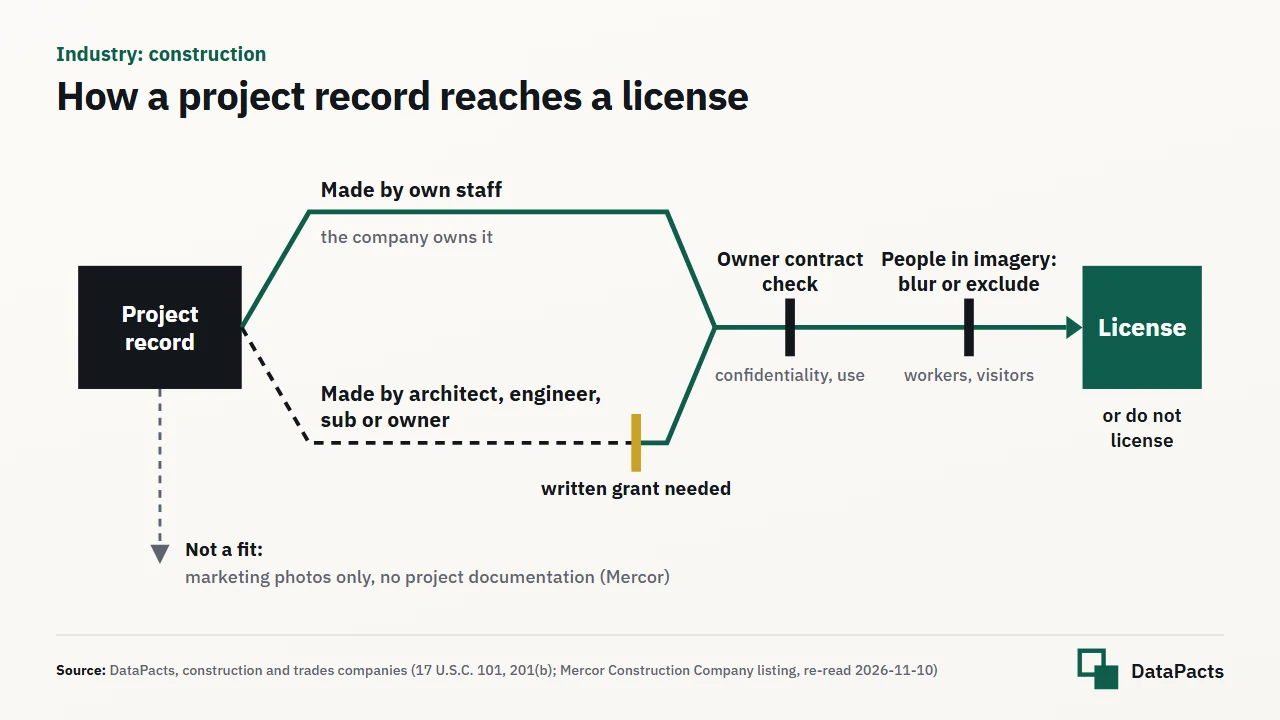
Mercor states that its Construction Company listing asks for drawings, specs, RFIs, submittals, change orders and daily logs, plus site photos, video or drone imagery tied to specific projects, from companies with 50 or more employees (checked 2026-11-09).
Mercor states a range of USD 115,000 to 1,000,000 per company, "Depends on project count and imagery", and HUMXN names bids, estimates, site photos and daily logs for construction and service calls and dispatch for trades (checked 2026-11-09). Project files and service records are sector holdings in AI training data licensing.
DataPacts Editorial Team checked the buyer pages, statutes and rules cited here on 2026-11-09 and 2026-11-10, following how we source, date and check every figure.
What AI Buyers Ask Construction and Trades Companies For
Four programs name construction or trades records, or the tools and footage those companies keep, on their own pages, and each wants something different. The table compares them as of 2026-11-10, in alphabetical order; each value is the party's own statement, checked 2026-11-09 unless marked.
| Program | Role | What it asks construction and trades companies for, or excludes | Source |
|---|---|---|---|
| Claru Partnerships | B | archive footage (security, QA, training, smart glasses); POV capture of hands-on work; drone, dash and body-cam footage; non-exclusive; the partner keeps ownership | claru.ai/partnerships |
| Handshake AI Data Partnerships | B | design documentation, specifications, procurement, shipping and dispatch logs; sources named include AutoCAD and ServiceTitan | joinhandshake.com/ai/data-partnerships |
| HUMXN company data licensing | M | construction: bids, estimates, RFIs, change orders, site photos, daily logs; trades and home services: service calls, quotes, job notes, technician photos, dispatch | humxn.io/sell-company-data |
| Mercor Construction Company listing | B | completed-project drawings, specs, RFIs, submittals, change orders, daily logs; site photos, video or drone imagery tied to projects; not a fit: marketing photos only, small crews without project documentation; tools Procore, Autodesk Construction Cloud, Revit, AutoCAD, Bluebeam, Primavera P6, DroneDeploy; re-read 2026-11-10 | api.data.mercor.com listings /construction |
B = buyer or licensee program; M = marketplace that licenses to buyers. "Not stated" does not mean allowed.
Mercor's program page names eight target industries (legal, healthcare, finance and insurance, professional services, manufacturing, retail and e-commerce, real estate and logistics), and construction is not among them, although its listing feed carries a Construction Company listing published on 2026-10-17.
Completed-Project Records Versus Trades Service Records
Buyers split construction data into two kinds: closed-out project files from builders, and the service-call and dispatch records of trades and home-services firms.
Mercor wants the first kind, drawings, specs, RFIs, submittals, change orders and daily logs, with imagery tied to specific projects, and lists "Marketing photos only" and "Small crews without project documentation" as not a fit.
HUMXN names the second kind for trades and home services: service calls, quotes, job notes, technician photos and dispatch. Handshake AI names ServiceTitan and dispatch logs among its sources.
Programs that pay companies to record first-person video of physical work belong to a separate data type, covered under first-person video for AI and robotics training.
Who Owns the Drawings, Models and Specs a Contractor Holds
A contractor owns the records its own staff create, but drawings, models and specifications prepared by an architect, engineer or subcontractor usually remain someone else's work unless a written agreement transfers them.
A contractor's archive mixes both: its own estimates, daily logs and photos, and design documents, BIM models, specifications and shop drawings that came from others.
Under 17 U.S.C. 201(b), for a work made for hire, the employer or the person for whom the work was prepared is the author and owns all rights unless a signed written instrument says otherwise, and section 101 limits commissioned works to nine listed categories with a signed written agreement.
CDPA 1988 s.11(2) gives the employer first ownership of works made by an employee in the course of employment in the United Kingdom, subject to any agreement to the contrary. The standard design and construction contract clauses are not summarized here, and the company reads its own contracts.
Mercor lists "Designs owned by your customers" and "Client work you can't license" as not a fit on its Hardware Engineering Company and Design & Web Agency listings (checked 2026-11-09). A rights audit separates staff-made records from drawings others authored.
Owner Contracts That Restrict Project Data
Project owners' contracts can bind a contractor's use of project records through confidentiality and use clauses, and those clauses come before any license term. Subcontractor shop drawings and owner-furnished documents carry the same question.
HUMXN states that buyers are bound by confidentiality and that the company is never named (checked 2026-11-09), which does not release an owner clause. How confidentiality clauses before licensing data are read is set out on the consent page.
Drawings That Count as Defense Technical Data
Drawings, photographs and plans required for a defense article are technical data under 22 CFR 120.33(a)(1), and releasing them to a foreign person, even inside the United States, is an export under 120.50(a)(2). Offshore or foreign annotators are the practical exposure.
micro1's Data License Master Terms s.5.7 exclude export-controlled information unless the Order Form allows it (last updated 2026-11-08).
Workers and Bystanders in Site Photos, Video and Safety Reports
Site photos, video and drone imagery show workers, visitors and neighbors, so the imagery buyers ask for is personal data wherever a person can be identified. Mercor wants imagery tied to specific projects, and Claru names drone and body-cam footage (checked 2026-11-09).
In the EU, Regulation (EU) 2016/679 applies from 2018-05-25 (Art. 99(2)), and Art. 9(1) makes biometric data used to uniquely identify a person, and health data, special-category data.
Spain's LOPDGDD art. 89 (LO 3/2018, in force 2018-12-07) allows workplace video only with prior express information, sound only where relevant security risks exist, and never in rest areas. Staff in site footage fall under employee data and AI training rules by jurisdiction.
In the United States the rules differ by state (checked 2026-11-09). Illinois BIPA 740 ILCS 14/15(b) requires written notice and release before biometric identifiers are collected, 15(c) bars selling or profiting from them, and liquidated damages are USD 1,000 for negligent and USD 5,000 for intentional or reckless violations.
Virginia's Code 59.1-575 excludes photographs and audio or video recordings from biometric data (in force 2023-01-01). Texas exempts biometric identifiers used to train AI unless the system uniquely identifies a specific individual, in force 2026-01-01 under HB 149.
Safety and incident reports name injured workers and describe injuries, which is health data under Art. 9(1). US injury recordkeeping rules are not covered on this page.
Programs state their own handling. Claru states that it auto-scrubs faces, cards and plates, Mercor states that it covers extraction, anonymization and transfer costs, and micro1 s.5.7 excludes biometric identifiers unless the Order Form allows them. The methods are set out under de-identification before licensing data.
Company Size Gates and Stated Ranges for Construction Data
Programs set different minimum sizes, from Handshake AI's contradicting statements to Mercor's 50 employees for its construction listing. Each party states its own threshold, alphabetically:
- Handshake AI: the Data Partnerships page states no minimum, while the license and referral pages state 20+ full-time employees and 3+ years (checked 2026-11-09).
- HUMXN: any business running on records, files or footage that owns its data (checked 2026-11-09).
- Mercor: 50 to 2,000 employees, location "Anywhere" (re-read 2026-11-10).
- micro1: "established companies with 30+ full-time employees", data primarily in English (checked 2026-11-09).
Mercor states USD 115,000 to 1,000,000 per company, HUMXN states that "$250K+" is where typical single-company deals start, and Handshake AI states "$100K to $4M+" while the same page's estimator reads "up to $100,000" (all checked 2026-11-09). None is a construction price paid, and the DataPacts deal tracker records no signed construction data deal.
Mercor states a referral base of USD 40,000 plus a USD 10,000 fast-signing booster for the referrer and the company, with a 1-day window (checked 2026-11-09). The referral programs of AI data buyers are compared on one page.
Benefits, Risks, Downsides and Alternatives for a Construction or Trades Company
Licensing gives a builder or trades firm a use for closed-out records it already stores, but it carries ownership, privacy and security risks that a fee does not offset, and not licensing is a valid outcome.
Benefits
- Income from closed project files, as a buyer's claim and not a promise (Mercor's stated range above).
- Records staff create in the course of employment need no third-party grant under 17 U.S.C. 201(b) or CDPA s.11(2), absent a contrary agreement.
Risks
- Drawings the company does not own, which Mercor treats as not a fit on its other listings.
- Biometric or health data of workers in imagery and safety reports.
- Buyer security: Mercor's filing with the California Attorney General gives breach dates of 2026-03-24 and 2026-03-30 after unauthorized access via compromised LiteLLM versions, and In re Mercor.io Corporation Data Breach Litigation, N.D. Cal. Lead Case No. 3:26-cv-02821-WHO, is the lead docket.
Downsides
- A license can be impossible to withdraw: micro1's s.1.2 states a worldwide, nonexclusive, irrevocable, perpetual license, and s.4.4 sets no duty to delete or retrain Licensee Materials.
- Claru states that delivered content cannot be recalled from client copies.
- Reviewing owner contracts and blurring imagery take time.
Alternatives
- License only staff-made records such as daily logs and estimates.
- Use the archive in-house.
- Not licensing at all, covered under alternatives to selling data, including not selling at all.
Where Construction Licensing Meets the Seller Path, Data Types and Other Industries
Construction shares project and production records with manufacturing and logistics, and the industry pages set out what limits each sector. Construction is one sector in data licensing by industry, alongside manufacturers licensing industrial data, logistics and transport data, engineering and architecture firms licensing data and real estate firms licensing data.
Site pictures follow the face rules for photos and images for AI training and the archives of video for AI training. Design files sit under CAD and engineering files, aerial capture under drone imagery for AI training, and export mechanics under Procore data export.
Release rules apply under Illinois BIPA and AI training data and biometric data in AI training, and export-controlled drawings sit among company data that cannot be licensed.
- Check data sale readiness.
- Decide whether you should sell or license your data.
- Begin choosing a buyer for your data.
- Start evaluating an offer for your data.
- Negotiate the clauses of AI data licensing agreements.
This page is information, not legal advice.
Buyer and Program Pages Named on This Page
Each program above has or will have its own page with dates and sources.
- Claru
- Handshake AI data buyer profile
- HUMXN
- Mercor data buyer profile
- micro1 data buyer profile
- Payouts and program terms compared
Frequently Asked Questions
Can a construction company sell its data to AI companies?
Yes, where it owns the records and can clear the people in its imagery; Mercor's construction listing asks for completed-project records and site imagery from companies with 50 or more employees, checked 2026-11-09.
How much do AI companies pay for construction data?
No construction price paid is on the DataPacts record; Mercor states a range of USD 115,000 to 1,000,000 per company, depending on project count and imagery, checked 2026-11-09.
Valuation methods are set out under what company data is worth to AI companies.
Can an HVAC or plumbing business license its job records?
HUMXN names trades and home-services records such as service calls, quotes, job notes, technician photos and dispatch, and Handshake AI names ServiceTitan among its sources, both checked 2026-11-09.
Can construction workers earn money from AI training work?
Individual professionals can do paid expert work for human-data platforms, a separate route from licensing the company's records.
The field is covered under expert contributor work by field.