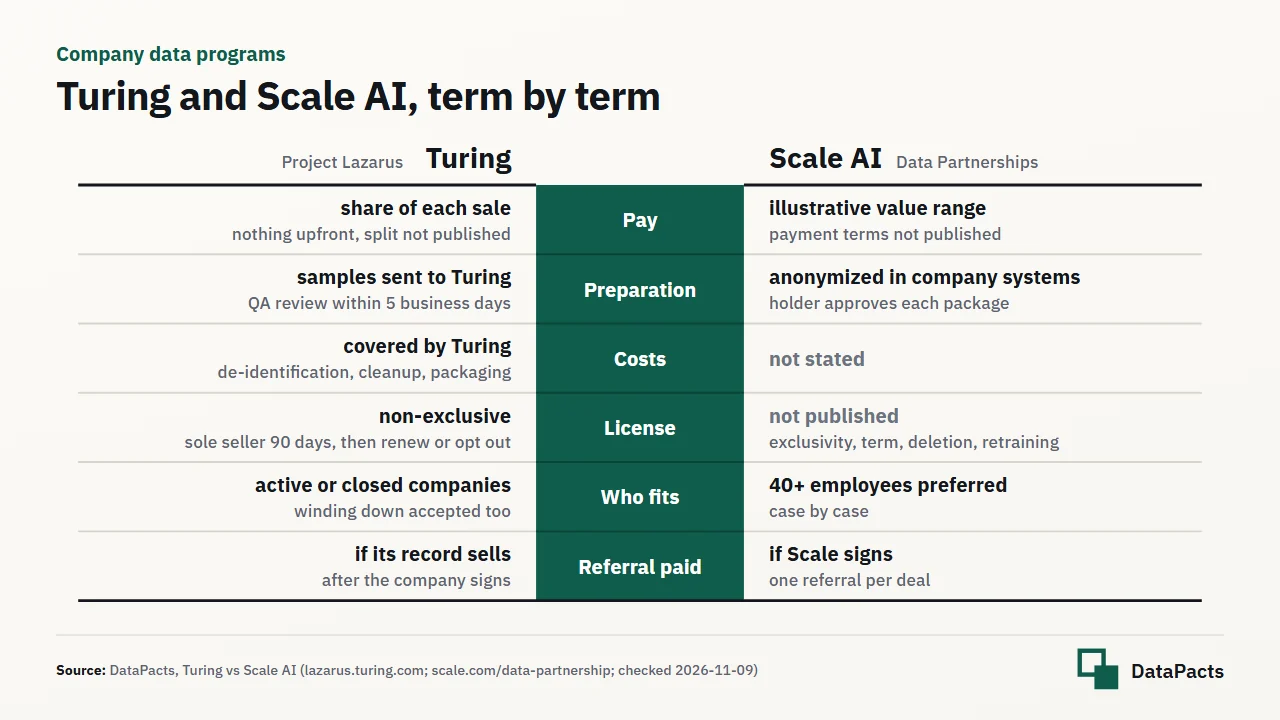
For a company weighing AI training data licensing, every term below is the company's own claim with a check date, 2026-11-09 unless stated. Turing publishes no revenue share percentage; Scale states USD 10,000 to USD 1,000,000 or more as an illustrative value and publishes no license terms.
Both offered introducers up to USD 50,000 as of 2026-11-09, with different triggers, and no seller payment under either program is on record in the sources checked.
No program here wins by fees. On court and complaint record, Scale holds a court-approved contributor settlement and five GDPR complaints, and Turing holds none in the sources checked.
Turing and Scale AI Side by Side, Dated
Each cell quotes the company's own page or a court or regulator record as checked on November 9, 2026, with the source in the last column. The table, as of 2026-11-09, carries no score, rank or winner.
| Attribute | Turing (Turing profile) | Scale AI (Scale AI profile) | Checked | Source |
|---|---|---|---|---|
| Legal entity, headquarters | Turing Enterprises, Inc.; United States; founded 2018 | Scale AI, Inc., Delaware corporation; affiliate Smart Ecosystem, Inc. dba Outlier AI; United States | 2026-11-09 | lazarus.turing.com footer; Outlier Terms of Use |
| Programs | Project Lazarus (operating records and code); RL environments | Scale Data Partnerships; Outlier; RL Environments, 2,000+ tasks | 2026-11-09 | lazarus.turing.com; scale.com/data-partnership; scale.com/rlenvironments |
| Data wanted | Chat, tickets, wikis and docs, source code and reviews, CRM, support, databases, design files, legacy stacks (Lotus Notes, Novell, file shares) | Data warehouses (BigQuery, Snowflake, Databricks), chat, email and calendar, documents, work tools, business platforms | 2026-11-09 | program pages |
| Stated eligibility | Active, winding down or wound down | 40+ employees "preferred starting point", case by case; established systems, real workflows, domain depth, a clear stakeholder owner | 2026-11-09 | program pages |
| Stated value to companies | Revenue share, no published percentage; newsletter of 2026-03-25: USD 1,000 per pull request up to USD 10,000 per modern codebase, legacy codebases USD 10,000 to 100,000+ | "$10K–$1M+ illustrative value per data partnership, scaling with cadence" | 2026-11-09 | lazarus.turing.com; Turing newsletter 57; scale.com/data-partnership |
| Payment terms | "Nothing upfront"; paid every time the record sells and when Turing builds tasks, evaluations or RL environments on it; timing after a sale not stated | Not published; "opportunity for recurring revenue" | 2026-11-09 | program pages |
| Data preparation and costs | A small sample slice on Turing's sampling request after a mutual NDA; QA review within 5 business days; Turing covers de-identification, cleanup and packaging | Anonymization inside the company's environment before extraction; per-package approval; on-prem or VPC; costs not stated | 2026-11-09 | program pages |
| License | License to Turing exclusive for the first 6 months; Turing may license the same record to more than one lab in that term; then extend or end the term (checked 2026-11-17); ownership does not change hands | Exclusivity, term, deletion and retraining not published | 2026-11-09 | program pages |
| Receiving labs | Not named | Not named | 2026-11-09 | program pages |
| Referral bonus | Up to USD 50,000; only if the company signs and its record sells | Up to USD 50,000; only if Scale signs; one per deal | 2026-11-09 | program pages |
| Ownership statement | Series E USD 111 million at a USD 2.2 billion valuation, 2025-06-10 | Meta holds a minority stake; valuation over USD 29 billion, 2025-06-12 | 2025-06-10 / 2025-06-12 | company blogs |
| Contributor pay terms | No rate on record | Through Outlier: weekly, hourly or per task, "Rates vary"; 900K+ experts; USD 500M+ (home page) vs USD 600M+ (about page) paid out | 2026-11-09 | outlier.ai |
| Contributor classification | Not on record | Independent contractors; no tax withholding except as required by law (ToS s.3); individual arbitration, class waiver (s.10) | 2026-11-09 | Outlier FAQ and Terms of Use |
| Court and complaint record | None in the sources checked | McKinney settled (final approval 2026-10-30); Schuster voluntarily dismissed; Ramey notice of settlement; 5 noyb GDPR complaints | 2026-11-09 | Records in the court and complaint table |
Where Turing and Scale AI Differ for a Company Licensing Data
The two programs differ on four points a company feels before signing: how money arrives, where the data is prepared, what the license keeps open, and which companies each program names as a fit.
A Share of Each Sale Against an Illustrative Value Range
Turing states that it pays a revenue share every time a company's record sells, with nothing upfront, while Scale states "$10K–$1M+ illustrative value per data partnership, scaling with cadence", each checked 2026-11-09. Turing adds that a company is also paid when Turing builds training tasks, evaluations or RL environments on the record. It publishes neither the split nor when money arrives after a sale.
Scale's figure is an illustration, not a price list. Scale designs partnerships "so there's opportunity for recurring revenue" but publishes no payment timing or structure.
The two models cannot be ranked: one depends on how often a record sells, the other on a negotiated agreement, and no seller payment under either is on record in the sources checked.
How a share of sales weighs against upfront and milestone shapes is covered under revenue share and other ways AI data buyers pay.
Samples Reviewed by Turing Against Anonymization Inside the Company's Systems
Turing states that a company sends a small slice of samples on Turing's sampling request after a mutual NDA (re-checked 2026-11-16) and that Turing reviews them within 5 business days, while Scale states that it anonymizes data inside the company's own environment before any data is extracted. As each company described it on 2026-11-09:
- Turing's steps: a short intake, an online mutual NDA, rough volumes per system, samples on a sampling request, QA review, then one revenue share agreement.
- Turing's costs: Turing covers de-identification, cleanup and packaging.
- Scale's location and approval: anonymization in place, per-package approval gates set by the data holder, on-prem or VPC options.
- Scale's costs: not stated.
Under Turing's model, samples leave the company for review; under Scale's, nothing is extracted until anonymization and approval are done. What remains the seller's own job under either model is covered in de-identification before licensing data.
A 6-Month Exclusive License Against Unpublished License Terms
Turing states that the license to Turing is exclusive for the first 6 months after signing, after which the company can extend or end the term (checked 2026-11-17), while Scale publishes no exclusivity, term, deletion or retraining terms.
Turing's page adds that during that term it may license the same record to more than one lab and that ownership does not change hands. It does not publish the agreement text or renewal terms.
Scale's program page leaves scope, duration, exclusivity, deletion and retraining to the signed agreement. Neither company names a receiving lab on its program page, as of 2026-11-09.
Only Turing's term is published; at Scale, every constraint sits in the agreement. The wider trade-offs of exclusive vs non-exclusive data licenses cover price, lock-in and carve-outs.
Closed Companies and Code at Turing, Established Companies at Scale
Turing states that Project Lazarus takes active, winding-down and wound-down companies, while Scale names 40 or more employees as its preferred starting point, decided case by case. Turing's list reaches code and legacy stacks such as Lotus Notes and Novell.
Its newsletter of 2026-03-25 adds USD 50 per organizational artifact bundled with a codebase. Four unnamed calculators on the Lazarus page value one made-up company at USD 197,000 to USD 800,000, which Turing does not present as its offer.
Scale asks for established systems, real workflows, domain depth and a stakeholder owner, and names warehouses such as Snowflake and platforms such as Salesforce and SAP.
Only Turing names a closed-company status. Who can sign for such a company is covered under selling data from a shut-down company.
Referral Bonuses: Two Up-to-USD-50,000 Offers With Different Triggers
Turing and Scale both state a referral bonus of up to USD 50,000, but Turing pays only if the referred company signs and its record sells, while Scale pays only if Scale signs a partnership agreement, each checked 2026-11-09. The table sets the two offers side by side as of 2026-11-09, without computed examples.
| Term | Turing Project Lazarus referral | Scale Data Partnerships referral | Checked | Source |
|---|---|---|---|---|
| Stated maximum | "Refer a company, earn up to $50K" | "Refer a company and earn up to $50,000 bonus" | 2026-11-09 | lazarus.turing.com; scale.com/data-partnership |
| When earned | Only if the referred company signs and its record sells | Only if Scale signs a partnership agreement | 2026-11-09 | same |
| Structure or formula | Not published | Not published; one referral paid per deal | 2026-11-09 | same |
| Referrer review | Not stated | Referrer profiles reviewed "within 1–2 business days"; referrals can be submitted before approval | 2026-11-09 | scale.com/data-partnership/apply |
| Paid-out claim | None stated | None stated | 2026-11-09 | program pages |
The maximum is the same; the trigger is not. Turing ties the bonus to a sale, which may never happen, Scale to signature, and neither model is better for the company being referred. Every published offer is compared under referral programs of AI data buyers.
Ownership and Independence: Meta's Minority Stake in Scale and Turing's Series E
Scale AI announced on 2025-06-12 that Meta would hold a minority of Scale's outstanding equity at a valuation of over USD 29 billion, while Turing's own funding post of 2025-06-10 states a USD 111 million Series E and names no lead investor. On Scale's own statement, Meta's holding is a minority stake; Scale gives no percentage.
Turing states the Series E valued it at USD 2.2 billion, "based on Q3 2024 revenue", and names Khazanah Nasional and WestBridge Capital among its investors. Neither company links its investors to the company data programs on its program page.
A data holder can ask either company which labs receive its records. Meta's own data buying is covered under Meta as a data buyer.
Expert Contributors: Pay Terms and Classification on Record
Neither company publishes a dated contributor pay rate: Outlier, the platform Scale operates, states that rates vary by expertise, project complexity and location, and no Turing rate is on record.
Outlier states "Competitive pay + quality-based rewards, paid weekly", hourly or per task, through PayPal, AirTM or ACH, processed on Tuesdays. It claims 900K+ experts and gives two totals: USD 500M+ paid to experts on its home page and USD 600M+ paid out on its about page, both checked 2026-11-09.
Outlier's FAQ engages contributors as independent contractors. Its Terms of Use, effective 2026-05-11, withhold no tax except as required by law (s.3) and require individual arbitration with a class waiver and a 30-day opt-out for US residents (s.10). No Turing contributor terms are on record.
A contract label sets the starting point, and the law tests it. The McKinney settlement alleged misclassification; a settlement is not a finding. The legal tests are set out under how AI training contributors are classified.
Court, Complaint and Incident Record of Turing and Scale AI
Scale's record holds a court-approved contributor settlement, a voluntarily dismissed contributor suit, a suit with a notice of settlement and five GDPR complaints filed in Europe, while no lawsuit, breach notice or regulator action naming Turing appears in the sources checked as of 2026-11-09. The table lists each event by date with its status as of 2026-11-09; allegations are not findings.
| Date | Company | Event | Forum / docket | Status as of 2026-11-09 | Source |
|---|---|---|---|---|---|
| n/a | Turing | None recorded: no lawsuit, breach notice or regulator action naming Turing Enterprises, Inc. | n/a | n/a | Court and regulator sources checked |
| 2025-01-17 | Scale AI | Schuster v. Scale AI, Inc. et al. filed (contributor class action, allegations) | N.D. Cal. No. 3:25-cv-00620-JSC | Voluntarily dismissed by notice dated 2026-08-10 (with prejudice as to named plaintiffs, without as to the putative class) | Dkt. 34 |
| 2025-02-11 | Scale AI | Ramey v. Scale AI, Inc. et al.: joint notice of settlement (Dkt. 32); claims not recorded | N.D. Cal. No. 3:24-cv-06999 | HireArt stipulation for dismissal 2025-05-12 (Dkt. 36); no dismissal order on the docket feed | docket feed |
| 2026-10-27 | Scale AI | 5 GDPR complaints by noyb with Intérêt à Agir, DIPLab and Reversing.Works (Outlier contributor tracking, Persona biometric checks, access requests) | Data protection authorities in France, Italy, the Netherlands and Austria | No authority decision recorded | noyb.eu |
| 2026-10-30 | Scale AI | McKinney v. Scale AI, Inc. et al. (contributor misclassification class settlement), gross USD 12,500,000; contributor payments reported on Form 1099, not W-2; class period 2020-12-10 to 2026-02-28 | Superior Court of California, County of San Francisco, CGC-24-620481 | Settled; final approval order filed 2026-10-30 | class notice and final approval order |
Every Scale record concerns contributors or their data, not a company data license. McKinney and Schuster were brought by contributors, and noyb's complaints concern how Outlier handles contributors' data in Europe.
Turing's empty row reflects the sources checked as of 2026-11-09, not a guarantee.
The full narratives of these suits sit under contributor lawsuits against human data platforms.
Which Company Each Program Fits
No program here is better by fees; each one's own stated criteria point to different companies, as of 2026-11-09.
Turing's stated terms point to:
- A closed or winding-down company.
- Codebases and legacy systems.
- A holder willing to wait for income per sale while keeping ownership.
- A holder that wants its record licensed to more than one lab through Turing.
Scale's stated terms point to:
- 40 or more employees with established systems.
- Raw data that must not leave before anonymization.
- Records in warehouses and business platforms.
- Openness to recurring terms.
Neither may suit:
- A company needing named receiving labs or published license terms before sharing anything.
- A company needing a fixed amount on signing.
Programs beyond these two are weighed under choosing a buyer for your data.
Licensing to Turing or Scale AI: Benefits, Risks, Downsides and Alternatives
Licensing to either company turns records into income whose size and timing cannot be read in advance, because Turing publishes no revenue share percentage and Scale publishes no payment timing or license terms.
Benefits
- Turing states it carries de-identification, cleanup and packaging costs, and ownership stays with the company.
- Scale states it anonymizes in place and approves data package by package.
- Both publish dated program terms and referral maximums.
Risks
- Turing's revenue share split is unpublished.
- Scale's license, deletion and retraining terms are unpublished.
- Scale's record holds a contributor settlement, GDPR complaints and a Meta minority stake.
Downsides
- Turing pays only when a record sells.
- Scale's payment timing is not published.
- Neither names the receiving labs.
Alternatives
- Another program, among them Handshake AI, Mercor and micro1.
- An intermediary or sell-side adviser.
- An enquiry for an independent introduction.
- Not licensing the data at all.
Keeping the data is a complete outcome. Every option is set out under alternatives to selling data to AI labs.
Where This Comparison Sits Among the Buyer Pages
This page sets two buyers against each other; the profiles hold each company's full record, and the directory and tables cover every other program. The directory of who buys AI training data lists every buyer type.
- Every program in one place: company data partnership programs.
- All terms side by side: AI data partnership payouts and program terms.
- Turing against other programs: micro1 vs Turing Project Lazarus and Turing vs Mercor.
- Scale against other programs: micro1 vs Scale AI, Mercor vs Scale AI and Scale AI vs Surge AI.
- Scale's records in depth: data buyer incidents, McKinney v. Scale AI and noyb complaints against Scale AI.
- The contributor side: human data for AI.
How This Comparison Is Checked and Kept Independent
Each cell is read from the company's own page, a court filing or a regulator record and dated; a cell changes only when the source has been read again. Turing comes first only because of the URL; see how DataPacts is funded. The court summary is information, not legal advice.
Frequently Asked Questions
Which pays companies more, Turing or Scale AI?
Neither can be ranked: Turing states a revenue share with no published percentage and Scale states an illustrative range per partnership, each checked 2026-11-09, and no seller payment under either is on record in the sources checked.
Does either company pay upfront for company data?
Turing states "Nothing upfront" and pays as records sell; Scale publishes no payment timing or structure, only that partnerships are designed with an opportunity for recurring revenue.
Can a company license the same records to Turing and Scale AI?
Not during Turing's term: Turing states that the license to Turing is exclusive for the first 6 months after signing (checked 2026-11-17); Scale publishes no exclusivity terms, so the signed agreements decide.
What do Turing and Scale AI pay experts, and how do you apply?
No dated rate is on record for either.
Scale's contributor work runs through Outlier AI, which states that rates vary. Applications and pay are compared under AI training jobs and platforms.
Who else competes with Turing and Scale AI for company data?
Handshake AI, Mercor and micro1 run comparable company data programs.
The rest are listed under Scale AI alternatives and Turing alternatives.