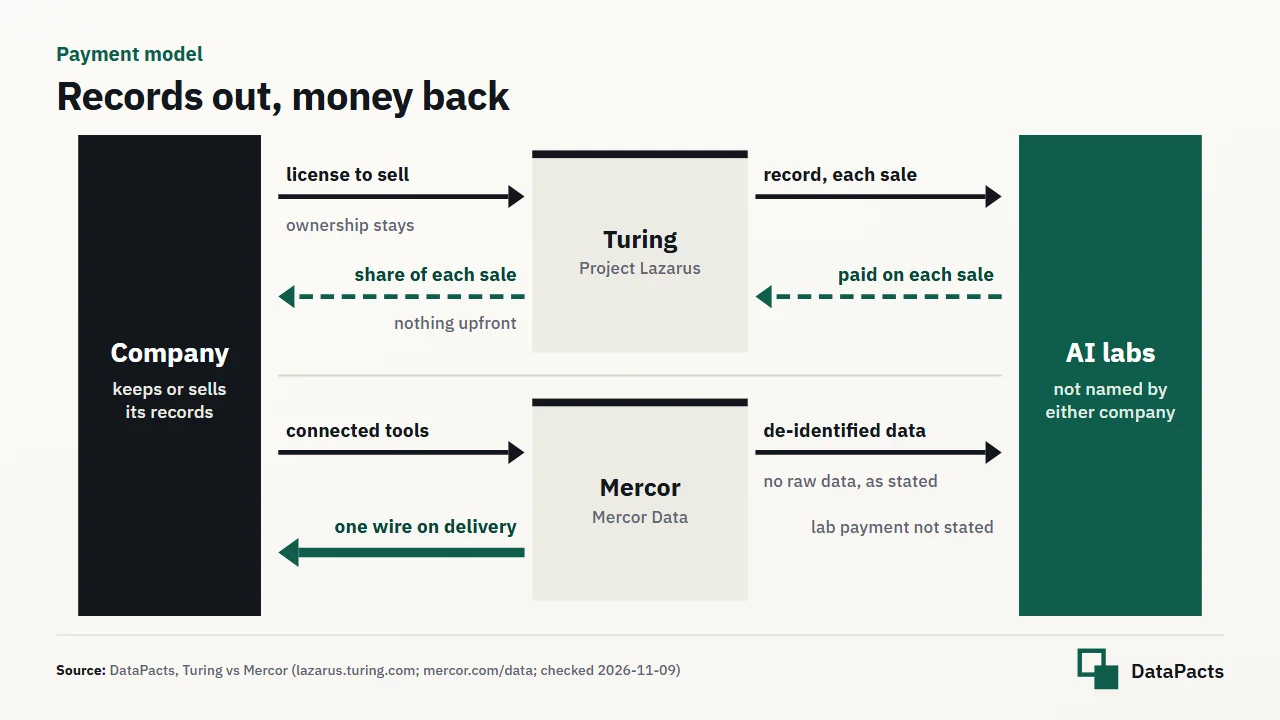
For a company weighing AI training data licensing, every term below is the company's own claim with a check date, mostly 2026-11-09. Turing publishes no price on its program page and no revenue share percentage; Mercor states deal ranges from USD 10,000 to USD 1,500,000 per company across 25 industry listings but publishes no license terms. No seller has confirmed a payment under either program.
No program here wins by fees. On court record, Mercor holds a breach case, a contractor suit and a bid in the Spirit Airlines bankruptcy sale (not approved as of 2026-11-09), and Turing holds none in the sources checked. Contributor pay and job applications are a separate question, answered in the FAQ below.
Turing and Mercor Side by Side, Dated
Each cell quotes the company's own page or a court record as checked on November 9, 2026, with the source in the last column; one Mercor feed value was re-read on 2026-11-10. The table compares both programs as of 2026-11-09 and carries no score, rank or winner.
| Attribute | Turing (Turing profile) | Mercor (Mercor profile) | Checked | Source |
|---|---|---|---|---|
| Legal entity | Turing Enterprises, Inc. | Mercor.io Corporation, Delaware corporation | 2026-11-09 | lazarus.turing.com footer; Spirit Dkt. 1463 Ex. B |
| Company data program | Project Lazarus | Mercor Data (Data Monetization) | 2026-11-09 | lazarus.turing.com; mercor.com/data |
| Data wanted | Chat, tickets, wikis and docs, source code and reviews, CRM, support, databases, design files, legacy stacks (Lotus Notes, Novell, file shares) | Records from Slack, Gmail, Salesforce, GitHub, Notion, Confluence, Drive, Outlook, MS Teams and "100+ supported tools"; 25 industry listings | 2026-11-09 | same |
| Stated eligibility | Active, winding down or wound down; most regions, strongest demand US, UK, Canada, EU; English records sell best | 8 target industries; size bands from 5 employees on 20 listings; 18 listings "Anywhere", 4 US or US preferred, 1 named markets, 2 not stated | 2026-11-09 | same; Mercor listings feed |
| Payout model | Revenue share; "Nothing upfront"; paid "every time it sells" and when Turing builds tasks, evaluations or RL environments on the record | Wire on delivery of the anonymized dataset; program page states no amount; "The more tools you share, the higher your payout will be" (re-read 2026-11-10) | 2026-11-09; 2026-11-10 | lazarus.turing.com; mercor.com/data |
| Amounts stated | None on the Lazarus page; split not published | USD 10,000 to 1,500,000 across 25 listings | 2026-11-09 | same; listings feed |
| Payment timing | After a sale: not stated | "Typically within 2-4 weeks of the signed agreement" vs "as soon as processing is complete" (same page) | 2026-11-09 | same |
| De-identification and costs | Turing covers de-identification, cleanup and packaging | Automated extraction and de-identification; Mercor covers extraction, anonymization and transfer costs, no setup fees or deductions | 2026-11-09 | same |
| License and window | License to Turing exclusive for the first 6 months after signing; Turing may license the same record to more than one lab in that term; then extend or end the term (checked 2026-11-17); ownership does not change hands | Not stated on the program page | 2026-11-09 | same |
| Who receives the data | AI labs, not named on the program page | AI labs, not named; "No AI lab buyer or third-party vendor ever sees your raw data" | 2026-11-09 | same |
| Referral fee to introducers | "Refer a company, earn up to $50K"; structure not published | USD 15,000 to 75,000 base per listing (none set on one), USD 90,000 on one listing re-read 2026-11-10; USD 10,000 booster on 24 of 25; feed "earn up to" USD 100,000 | 2026-11-09; 2026-11-10 | lazarus.turing.com; listings feed |
| Expert contributor pay | No rate on record | No rate on record; expert referral 20% of earnings, cap 4x hourly rate on hourly contracts | 2026-11-09 | talent.docs.mercor.com |
| Court and incident record | None in the sources checked | Security incident 2026-03-24 and 2026-03-30; In re Mercor.io Corporation Data Breach Litigation stayed pending mediation; White v. Mercor pending; Spirit alternate bid USD 7,500,000, sale not approved | 2026-11-09 | Court and regulator records in the record table |
Where Turing and Mercor Differ for a Company Licensing Data
The two programs differ on four points a company feels in a deal: when money arrives, what the license keeps, which companies qualify, and what prices each has put in public.
Revenue Share per Sale Against a Wire on Delivery
Turing states that it pays a revenue share every time a company's record sells, with nothing upfront, while Mercor states that it pays by wire once the anonymized dataset is delivered, each checked 2026-11-09. Turing adds that it also pays when it builds training tasks, evaluations or RL environments on the record. It publishes neither the split nor when money arrives after a sale.
Mercor states the wire comes "typically within 2-4 weeks of the signed agreement", yet the same page also says companies get paid "as soon as processing is complete". Mercor names no amount there, only that sharing more tools raises the payout.
A Turing record that never sells earns nothing, while Mercor's model, as stated, ends in a single wire. How a revenue share weighs against upfront and milestone shapes is covered under revenue share and other ways AI data buyers pay.
A 6-Month Exclusive License Against Unpublished License Terms
Turing states that the license to Turing is exclusive for the first 6 months after signing, during which it may license the same record to more than one lab (checked 2026-11-17), while Mercor's program page states no license scope, term or exclusivity at all.
After 6 months the company can extend or end the term, and ownership does not change hands. Turing publishes neither the agreement text nor renewal terms.
Mercor's page instead states that no AI lab buyer or third-party vendor ever sees a company's raw data and that it holds SOC 2 Type II. Neither company names a receiving lab or publishes its agreement.
Only the signed agreement shows what each license keeps. The wider trade-offs of exclusive vs non-exclusive data licenses cover price, lock-in and carve-outs.
Which Companies Each Accepts: Closed Companies and Industry Listings
Turing states that Project Lazarus takes active, winding-down and wound-down companies, while Mercor sorts companies by 8 target industries and 25 listings with their own size bands and locations.
Turing's intake separates companies shut down 90 days ago or less from those closed longer, and its FAQ states that demand is strongest in the US, the UK, Canada and the EU and that English records sell best.
Mercor's target industries run from legal and healthcare to logistics. Twenty listings set employee bands starting at 5, and 18 accept companies "Anywhere". No Mercor source records a closed-company status.
Only Turing names the closed status. Who can sign for such a company is covered under selling data from a shut-down company.
Published Price Points: Code Prices and Calculators Against Deal Ranges
Turing's Project Lazarus page names no price, while Mercor's 25 listings state deal ranges from USD 10,000 to USD 1,500,000 per company, checked 2026-11-09. Turing's newsletter of 2026-03-25 quotes USD 1,000 per pull request and up to USD 10,000 per modern codebase, USD 10,000 to USD 100,000+ per legacy codebase, and USD 50 per organizational artifact bundled with a codebase.
The Lazarus page also shows four unnamed calculators valuing one made-up company at USD 197,000 to USD 800,000, which Turing does not present as its offer. Whether the newsletter prices apply under the revenue share is not stated.
Code is where the two overlap. Mercor's Software Company listing states USD 50,000 to 500,000 for companies of 15 to 500 employees, checked 2026-11-09, and requires private repositories never made public, 3+ years of commit history from at least 10 engineers and 50,000+ lines of code owned outright, written by people with running tests.
The figures cannot be ranked: they differ in unit and date, and no seller has confirmed a payment under either. Other buyers' rates for licensing source code and codebases are compared on the code page, as of 2026-11-09.
Referral Fees for Introducers: Up to USD 50,000 Against Per-Listing Bases
Turing offers introducers up to USD 50,000 per referred company, paid only if the company signs and its record sells, while Mercor states a referral base per industry listing plus a USD 10,000 fast-signing booster, checked 2026-11-09. The table sets both referral offers side by side as of 2026-11-09, without computed examples.
| Term | Turing Project Lazarus referral | Mercor Data company referral (Refer a company) | Checked | Source |
|---|---|---|---|---|
| Fee structure | "Earn up to $50K" per referred company; structure not published | Base per listing USD 15,000 (Hedge Fund or Quant Firm) to USD 75,000 (Law Firm); none set on the Chem / Mat Science R&D records listing; Semiconductor & Materials USD 90,000 on re-read 2026-11-10 | 2026-11-09; 2026-11-10 | lazarus.turing.com; listings feed |
| Extra amounts | None stated | USD 10,000 fast-signing booster, 1-day window, to referrer and company, on 24 of 25 listings | 2026-11-09 | listings feed |
| Stated maximum | USD 50,000 | Feed "earn up to" USD 100,000 | 2026-11-09 | same |
| When earned | Only if the referred company signs and its record sells | Program page: when the referred company goes live; amount not stated there | 2026-11-09 | lazarus.turing.com; mercor.com/data |
| Claimed paid to referrers | None on record | USD 2,000,000 "in 2026" (figures block) vs USD 90,000 (stats block) | 2026-11-09 | listings feed |
Both state an "up to" maximum without a published way to reach it. Neither fee model is better for the referred company; every published offer is compared under referral programs of AI data buyers.
Expert Contributor Side: What the Record Shows on Pay
Neither company's contributor pay rate can be stated from the record: no dated Turing rate is on file, and no Mercor rate can be quoted from a dated page. Both supply expert contributors to AI labs, and Mercor stated on 2026-06-25 that its network holds "nearly five million" experts.
Mercor's expert referral pays the referrer 20 percent of the referral's earnings, up to four times the hourly rate on hourly contracts. White v. Mercor.io Corporation concerns contributors, not company data: an amended complaint of 2026-06-25 alleges misclassification and pleads a 26 U.S.C. § 7434 subclass, allegations only.
Rates by platform and field, each dated, are compared under pay for AI training work.
Court and Incident Record of Turing and Mercor
Mercor's public record holds a reported security incident, consolidated breach litigation stayed pending mediation, a contractor classification suit and an alternate bid in the Spirit Airlines bankruptcy, while no lawsuit, breach notice or regulator action naming Turing appears in the sources checked. The table lists each event by date with its status as of 2026-11-09.
| Date | Company | Event | Forum / docket | Status as of 2026-11-09 | Source |
|---|---|---|---|---|---|
| n/a | Turing | None recorded: no lawsuit, breach notice or regulator action naming Turing Enterprises, Inc. | n/a | n/a | Court and regulator sources checked |
| 2026-03-24 and 2026-03-30 | Mercor | Unauthorized access through compromised LiteLLM versions; reported to the California Attorney General | California AG sb24-625431 | Individuals notified 2026-06-25 and 2026-06-26 | oag.ca.gov |
| 2026-05-08 | Mercor | White v. Mercor.io Corporation (contractor classification, allegations) | N.D. Tex. 6:26-cv-00201-H | Pending; order on extension 2026-07-31 (Dkt. 24) | Dkt. 16 |
| 2026-05-19 | Mercor | Breach suits consolidated | N.D. Cal. Lead Case No. 3:26-cv-02821-WHO | Stay pending mediation stipulated 2026-07-21 (Dkt. 44) | Dkt. 44 |
| 2026-08-14 | Mercor | Alternate bid USD 7,500,000; Google LLC successful bid USD 10,000,000 | Bankr. S.D.N.Y. 25-11897 (SHL), Dkt. 1463 | Sale not approved; hearing 2026-11-17 (Dkt. 1779) | Dkt. 1463 |
| 2026-10-05 | Mercor | Consumer Privacy Ombudsman's Supplemental Report: further research into Mercor's security incident and whether it is an appropriate, qualified buyer | Dkt. 1684 | Part of the pending sale record | Dkt. 1684 |
The empty Turing row is a finding about the sources checked, not a guarantee, and no Spirit filing names Turing.
In In re Spirit Aviation Holdings, Inc., Mercor.io Corporation became alternate bidder on 2026-08-14, and the ombudsman's report of 2026-10-05 asks whether it is an appropriate, qualified buyer. The sale is not approved as of 2026-11-09, with a hearing set for 2026-11-17.
Whether either company is legitimate is answered on each profile, and every dated breach, complaint and dispute across buyers sits in data buyer incidents.
Which Company Each Program Fits
No program here is better by fees; each one's own stated criteria point to different companies, as of 2026-11-09. Both state that they carry de-identification costs, so that does not separate them.
Turing's stated terms point to:
- Closed or winding-down companies, a status its intake names.
- Companies with records in legacy systems such as Lotus Notes or Novell.
- Companies willing to wait for income in exchange for keeping ownership.
- Companies with English records and demand in the US, UK, Canada or EU.
Mercor's stated terms point to:
- Smaller companies in a listed industry, with size bands from 5 employees.
- Companies outside the US, since most listings accept companies "Anywhere".
- Companies that want one wire on delivery rather than income per sale.
- Companies that match a listing and meet its stated requirements.
Neither may suit:
- A company that needs the receiving labs named before signing, since neither names them.
- A company that needs a published agreement before sharing samples, since neither publishes one.
Other programs and buyer types are weighed under choosing a buyer for your data.
Licensing to Turing or Mercor: Benefits, Risks, Downsides and Alternatives
Licensing to either company converts records into income the company cannot fully see in advance, because Turing publishes no revenue share percentage and Mercor publishes no license terms.
Benefits
- Both state that they carry de-identification costs.
- Turing keeps ownership with the company and may license the same record to more than one lab.
- Mercor states a single wire on delivery.
Risks
- Turing's split and agreement are unpublished.
- Mercor's license terms are unpublished, and its breach litigation is unresolved.
- The Spirit ombudsman asked whether Mercor is an appropriate, qualified buyer.
Downsides
- Turing income arrives only if records sell.
- Mercor's program page gives two different payment timings.
- Neither company names the receiving labs.
Alternatives
- Another program, such as micro1 or Handshake AI.
- An intermediary or sell-side adviser.
- An enquiry for an independent introduction.
- Not licensing the data at all.
Keeping the data is a complete outcome; every option is laid out under alternatives to selling data to AI labs.
Where This Comparison Sits Among the Buyer Pages
This page sets two programs against each other; the profiles hold each company's full record, and the directory and tables cover every other program. The directory of who buys AI training data lists every buyer type.
- Every program in one place: company data partnership programs.
- All terms side by side: AI data partnership payouts and program terms.
- The other pairings with micro1: micro1 vs Turing Project Lazarus and micro1 vs Mercor.
- Pairings with Scale AI: Mercor vs Scale AI and Turing vs Scale AI.
- Options beyond Turing: Turing alternatives.
- Mercor's breach litigation and the bankruptcy sale it bid in, not approved as of 2026-11-09: Mercor data breach class actions and Spirit Airlines' data archive sale.
How This Comparison Is Checked and Kept Independent
Each cell is read from the company's own page or a court filing and dated; a cell changes only when the source has been read again. Turing comes first only because of the URL; see how DataPacts is funded.
Frequently Asked Questions
Is Turing part of Mercor?
No: Turing Enterprises, Inc. and Mercor.io Corporation are separate companies with separate company data programs, Project Lazarus and Mercor Data.
Which pays companies more, Turing or Mercor?
Neither can be ranked: Turing states a revenue share with no published percentage, and Mercor states deal ranges by industry, each a claim checked 2026-11-09; no seller has confirmed a payment under either.
Does either company pay upfront for company data?
Turing states "Nothing upfront" and pays as records sell; Mercor states payment by wire on delivery of the anonymized dataset, typically within 2-4 weeks of the signed agreement.
What do Turing and Mercor pay experts, and how do you apply?
No contributor rate is on record for either company.
Applications, assessments and pay are compared under AI training jobs and platforms.
Who else competes with Turing and Mercor for company data?
micro1 and Handshake AI run comparable company data programs.
Mercor's other options are listed by program under Mercor alternatives for licensing company data.