For a company weighing AI training data licensing, every figure here is the publishing company's own dated claim: micro1 states tiers from USD 100,000 to USD 3,000,000 or more, and Turing publishes no revenue share percentage, both checked 2026-11-09.
No program here wins by money. The two also differ on grant length, process, referral triggers and court record.
micro1 and Turing Project Lazarus Side by Side, Dated
Each cell quotes the company's own page, its published terms or a court record as checked on November 9, 2026, with the source in the last column. The table compares both programs as of 2026-11-09 and carries no score or winner.
| Attribute | micro1 (micro1 profile) | Turing Project Lazarus (Turing Project Lazarus profile) | Checked | Source |
|---|---|---|---|---|
| Legal entity | micro1 Inc. | Turing Enterprises, Inc. | 2026-11-09 | Data License Master Terms; lazarus.turing.com footer |
| Company data program | Company Data Partnerships | Project Lazarus | 2026-11-09 | micro1.ai/data-partnerships; lazarus.turing.com |
| Last announced funding (company's claim) | Series B at a USD 4,000,000,000 valuation, led by Dream Ventures, 2026-10-12 | Series E of USD 111,000,000 at a USD 2,200,000,000 valuation, 2025-06-10 | as dated | micro1.ai/blog/q3; turing.com Series E post |
| Data wanted | Six functional areas (software and engineering, finance and accounting, customer support, sales and CRM, legal and contracts, operations and logistics); agent trajectories | Chat, tickets, wikis, code and reviews, CRM, support, databases, design files, legacy stacks (Lotus Notes, Novell, file shares) | 2026-11-09 | same |
| Stated eligibility | 30+ full-time employees; data primarily English; US first, then other Western markets | Active, winding down or wound down; FAQ: most regions, strongest demand US, UK, Canada, EU; English records sell best | 2026-11-09 | same |
| Stated payout to the company | USD 100K-500K / 500K-3M / 3M+; agent trajectories USD 1-2M a year | Revenue share, "Nothing upfront", paid every time the record sells and when Turing builds on it; split not published | 2026-11-09 | same |
| Where the price is fixed | License Price in an Order Form, not published | One revenue share agreement, not published | 2026-11-09 | Data License Master Terms s.3; lazarus.turing.com |
| Payment timing | "in full within 30 days of acceptance" vs payment within 30 days of invoicing (same page) | Not stated | 2026-11-09 | micro1.ai/data-partnerships; lazarus.turing.com |
| Other price statements | Estimator example USD 50,284-92,776, "indicative estimate only" | Newsletter 57 (2026-03-25): USD 1,000 per pull request, up to USD 10,000 per modern codebase; legacy USD 10,000-100,000+; four unnamed calculators on one made-up company, not a Turing offer | 2026-11-09 | micro1.ai/data-estimate; turing.com newsletter 57; lazarus.turing.com |
| Paid-out claims | Post by Ali Ansari (self-described CEO): USD 5.8M to 9 businesses in 24 hours, unconfirmed by any seller; commitment of USD 1bn over 12 months, announced 2026-10-09 | None published in the sources checked | 2026-11-09 | LinkedIn post; micro1 blog |
| Grant and exclusivity | Worldwide, nonexclusive, irrevocable, perpetual, sublicensable; no-prior-grant warranty s.5.1; exclusivity and audit left to the Order Form | License to Turing exclusive for the first 6 months after signing; Turing may license the same record to more than one lab in that term; then extend or end the term (checked 2026-11-17) | 2026-11-09 | micro1.ai/legal/data-license-master-terms; lazarus.turing.com |
| Ownership and derivatives | micro1 owns derivatives, models, weights, outputs and synthetic data (s.2.2) | Ownership of the record does not change hands | 2026-11-09 | same |
| Deletion and retraining | Raw data deleted at the earlier of 120 days after delivery or termination; no duty to delete or retrain models | Not published | 2026-11-09 | same |
| Process and acceptance | AI interview, Order Form with Data Manifest, full transfer, 30 business days to reject then deemed accepted (s.1.3; page says 30 days), invoice | Intake, online mutual NDA, volumes, samples, QA review within 5 business days, agreement | 2026-11-09 | same |
| De-identification and costs | micro1 de-identifies itself; companies need not anonymize first | Turing covers de-identification, cleanup and packaging costs | 2026-11-09 | same |
| Who receives the data | Labs and enterprises in the US and allied countries | AI labs, not named; also Turing's own training tasks, evaluations and RL environments | 2026-11-09 | micro1.ai/data-payout; lazarus.turing.com |
| Referral reward to introducers | USD 50,000 up to USD 700,000; USD 75,000 up to USD 1M for defunct companies; 7.5% above | "Refer a company, earn up to $50K"; structure not published | 2026-11-09 | micro1.ai/company-referral; lazarus.turing.com |
| Court and incident record | Spirit notice of intent, ECF No. 1556, 2026-09-03, no amount; ombudsman review request | None in the sources checked | 2026-11-09 | Court records in the record table |
Where micro1 and Turing Differ for a Company Licensing Its Records
The two programs differ on five points a company feels in a deal: how and when money arrives, how long the grant runs, what happens after deletion, the order of the steps, and which records and companies each takes.
A Fixed Price After Acceptance or a Share of Each Sale
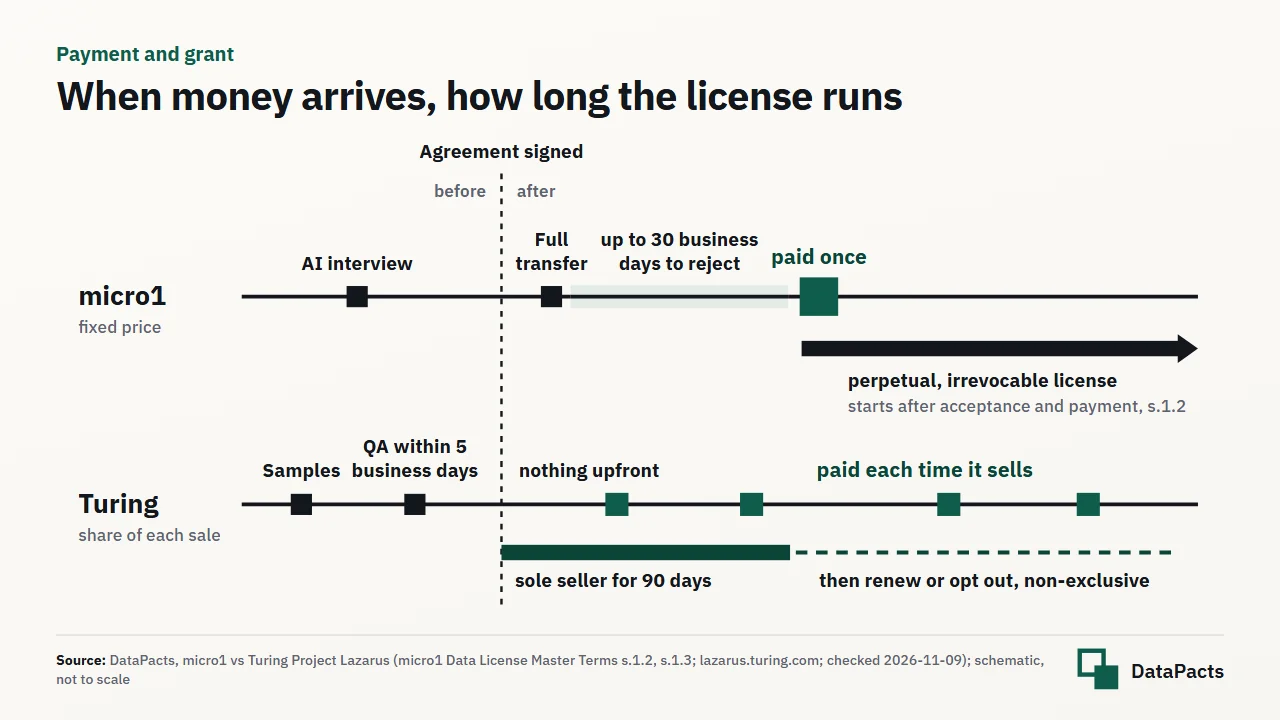
micro1 states three tiers, USD 100,000 to 500,000, USD 500,000 to 3,000,000 and USD 3,000,000 or more, paid after it accepts the data, while Turing states that Project Lazarus pays "Nothing upfront" and a revenue share every time a record sells, both checked 2026-11-09. The actual price is the License Price in an unpublished Order Form (s.3), and micro1's page gives two timings: "in full within 30 days of acceptance" and payment within 30 days of invoicing.
Turing states that it also pays when it builds training tasks, evaluations or RL environments on the record, but publishes no split or payment timing; a record that never sells earns no share.
Neither model can be ranked. On 2026-11-09, micro1's estimator example of USD 50,284 to 92,776, an "indicative estimate only", sat below its own lowest tier, and Turing's page showed four unnamed calculators valuing one made-up company at USD 197,000 to 800,000, which Turing does not present as its offer.
How each payment shape spreads risk is set out under upfront, milestone and revenue share payment.
A Perpetual Grant or a 6-Month Exclusive License
micro1's master terms grant micro1 a worldwide, nonexclusive, irrevocable and perpetual license that the company cannot later withdraw, while Turing states that the license to Turing is exclusive for the first 6 months after signing, during which it may license the same record to more than one lab, after which the company can extend or end the term (checked 2026-11-17). micro1's grant attaches after acceptance and payment (s.1.2), the company warrants no prior grant of the same data on the same or substantially similar terms (s.5.1), and exclusivity and audit are left to the Order Form.
Turing states that it may license the same record to more than one lab; what ending the term means for lab licenses already granted is not stated.
Signing order therefore matters, because micro1's warranty looks back at earlier grants. Sequencing several buyers is covered under running several AI data buyers in parallel.
Deletion, Retraining and What Each Company Keeps
micro1 deletes the raw data at the earlier of 120 days after delivery or termination but keeps every model and derivative built from it, while Turing states that ownership of the record does not change hands and publishes no deletion or retraining term. micro1 owns derivatives, models including weights, outputs and synthetic data (s.2.2), with no duty to delete or retrain them (s.4.4).
Liability is capped at 3x the Order Form fees (s.7.2), and the company indemnifies micro1 against IP, privacy, publicity and data protection claims (s.8.1).
Turing's revenue share agreement is not public, so no deletion, retraining or liability term can be read before signing.
What to ask either company about trained models is set out under retraining and model retention rights.
Full Transfer First or Samples First: Process and De-identification
Turing reviews samples shared under a mutual NDA within 5 business days before one revenue share agreement is signed, while micro1 signs an Order Form with a Data Manifest, receives the full data and then has 30 business days to reject it before it is deemed accepted. As stated, checked 2026-11-09:
- Step order: micro1: AI interview, onboarding, Order Form, transfer; Turing: intake of about 2 minutes, online NDA, volumes, samples.
- Acceptance: micro1's page says 30 days, its terms 30 business days (s.1.3), latent defects 60 days; Turing reviews samples only.
- De-identification: micro1 does it itself, so companies need not anonymize first; Turing covers de-identification, cleanup and packaging costs.
- Recipients: micro1 licenses only to US and allied-country labs and enterprises; Turing names no lab.
What stays the seller's own duty either way is covered under de-identification before licensing data.
Code, Agent Trajectories and Closed Companies
Turing names the systems it takes, from Slack, Jira and GitHub to Lotus Notes and Novell file shares, and accepts active, winding-down and wound-down companies, while micro1 names six functional areas plus agent trajectories and asks for 30 or more full-time employees.
For code, Turing's AGI Advance newsletter 57 of 2026-03-25 quotes USD 1,000 per pull request, up to USD 10,000 per modern codebase, and USD 10,000 to 100,000+ for legacy codebases, while Project Lazarus states only a revenue share. Turing does not say which applies; this page picks neither.
For closed companies, Turing's intake includes "Shut down ≤90 days ago" and ">90 days ago", with no minimum headcount recorded; micro1's referral page runs a separate defunct-company schedule. The route for a closed business is covered under selling data from a shut-down company.
Referral Rewards for Introducers: Paid on Approval or Paid on a Sale
micro1 pays introducers a flat USD 50,000 or USD 75,000 up to set deal values and 7.5 percent above them once the data is transferred and approved, while Turing states "Refer a company, earn up to $50K", paid only if the company signs and its record sells, both checked 2026-11-09. The table sets the two referral programs side by side as of 2026-11-09, without computed examples.
| Term | micro1 Company Data Partnerships Referral Program | Turing Project Lazarus referral | Checked | Source |
|---|---|---|---|---|
| Fee structure | Flat USD 50,000 (enterprise, deals up to USD 700,000) or USD 75,000 (defunct, up to USD 1M); "7.5% of the deal value for deals above $700,000" (USD 1 million for defunct); other partnerships 7.5%; "No cap on payouts" | "Refer a company, earn up to $50K"; structure not published | 2026-11-09 | micro1.ai/company-referral; lazarus.turing.com |
| When earned | After the referred company's data is transferred and approved; not on registration, application or signature | Only if the referred company signs and its record sells | 2026-11-09 | same |
| Referred company criteria | Enterprise: 30+ employees, US and Western markets, English; defunct: 30+ employees, "10+ Countries", English | Not stated beyond the program's eligibility | 2026-11-09 | same |
| Payment method | Referral page: wire; Referral Program Terms s.3.3(b): third-party Payment Processors | Not stated | 2026-11-09 | micro1.ai/legal/referral-terms; lazarus.turing.com |
A Turing referral can earn nothing after the company signs if its record never sells, while micro1's fee waits for transfer and approval and needs registration through the referrer's unique link. Neither model is better for the referred company. Every published offer is compared under referral programs of AI data buyers.
Contributor Work at micro1 and Turing: What the Record Shows on Pay
Neither company's contributor pay rate can be stated from the record, so this page compares only what each pays a company for its data. Both run expert-contributor work for AI labs beside their data programs, and no dated job listing or pay page for either appears in the sources checked.
Rates by platform and field, each with its date, are compared under pay for AI training work.
Court and Incident Record of micro1 and Turing
micro1's only court record tracked here is a notice of intent to bid for Spirit Airlines' data, filed without an amount, while no lawsuit, breach notice or regulator action naming Turing Enterprises, Inc. appears in the sources checked as of 2026-11-09. The table lists each event by date.
| Date | Company | Event | Forum / docket | Status as of 2026-11-09 | Source |
|---|---|---|---|---|---|
| 2026-08-14 | Neither (context) | Notice of Auction Results: Google LLC successful bid USD 10,000,000; Mercor.io Corporation alternate bid USD 7,500,000 | Bankr. S.D.N.Y. 25-11897 (SHL), Dkt. 1463 | Sale not approved; hearing 2026-11-17 (Dkt. 1779) | Dkt. 1463 |
| 2026-09-03 | micro1 | Notice of micro1 Inc.'s Intent to Submit a Competing and Superior Bid, no amount | ECF No. 1556 (listed in Dkt. 1703) | No amount in any filing read | Dkt. 1703 |
| 2026-10-05 | micro1 | Consumer Privacy Ombudsman's Supplemental Report: review requested if micro1, which proposed to de-identify the data itself, is considered | Dkt. 1684 | Part of the pending sale record | Dkt. 1684 |
| n/a | Turing | None recorded: no lawsuit, breach notice or regulator action naming Turing Enterprises, Inc. | n/a | n/a | Court and regulator records checked |
In In re Spirit Aviation Holdings, Inc., Bankr. S.D.N.Y. No. 25-11897 (SHL), the ombudsman's Supplemental Report (Dkt. 1684) asked to review if micro1, which proposed to de-identify the data itself rather than use an independent party, is considered.
The sale is not approved as of 2026-11-09, with the hearing adjourned to 2026-11-17 (Dkt. 1779). The empty Turing row is a finding about the sources checked, not a guarantee.
Every dated breach, complaint and dispute across buyers sits in data buyer incidents.
Which Company Each Program Fits
Neither program is better by money; each one's own stated criteria point to different companies, as of 2026-11-09.
micro1's stated terms point to:
- 30 or more full-time employees, English data, a US or Western market.
- A fixed price agreed before transfer.
- Reading the full contract first.
- AI agents that produce trajectories.
Turing's stated terms point to:
- Winding-down or wound-down companies.
- Legacy systems and code.
- Keeping ownership, with a 6-month exclusive license to Turing.
- Waiting for sales with nothing upfront.
Neither may suit:
- A company that needs the receiving labs named before signing, since neither names them.
- A company that must keep a right to require retraining or deletion of trained models.
Other buyer types are weighed under choosing a buyer for your data.
Licensing to micro1 or Turing: Benefits, Risks, Downsides and Alternatives
Licensing to either company turns records into income the company cannot fully see in advance, because micro1's price sits in an unpublished Order Form and Turing publishes no revenue share percentage.
Benefits
- micro1's tiers and full master terms are public before any negotiation.
- Turing asks nothing upfront, covers processing costs and leaves ownership with the company.
- Both take on de-identification: micro1 does it itself, and Turing carries its cost.
Risks
- micro1's grant is perpetual and irrevocable, with no retraining duty.
- Turing's split, payment timing and agreement text are not public.
- The Spirit ombudsman questioned micro1's self-de-identification plan.
Downsides
- micro1's price sits in an unpublished Order Form.
- A Turing record that never sells earns nothing.
- Neither company names the receiving labs.
Alternatives
- Another program, such as Handshake AI or Mercor.
- An intermediary or sell-side adviser.
- An enquiry for an independent introduction.
- Not licensing the records at all.
Keeping the data is a complete outcome; every option is laid out under alternatives to selling data to AI labs.
Where This Comparison Sits Among the Buyer Pages
This page sets two programs against each other; the profiles hold each company's full record. The directory of who buys AI training data covers every buyer type.
- Every program: company data partnership programs.
- All terms side by side: AI data partnership payouts and program terms.
- The neighboring pairings: micro1 vs Mercor and Turing vs Mercor.
- Code buyers and rates: licensing source code and codebases.
- Options beyond each company: micro1 alternatives and Turing alternatives.
- The sale micro1 appears in, not approved as of 2026-11-09: Spirit Airlines' data archive sale.
How This Comparison Is Checked and Kept Independent
Each cell is read from the company's own page, its published terms or a court filing and dated; a cell changes only when the source has been read again. The order puts micro1 first only by URL; see how DataPacts is funded.
Frequently Asked Questions
Does micro1 or Turing pay a company upfront?
Neither pays at signing: micro1 states payment after it accepts the data, and Turing states "Nothing upfront", paying a revenue share each time the record sells, both checked 2026-11-09.
Can a company license the same records to micro1 and Turing?
Not freely: micro1's terms ask the company to warrant no earlier similar grant, and Turing states that the license to Turing is exclusive for the first 6 months after signing (checked 2026-11-17), so the order matters.
Which of the two accepts closed companies?
Turing's intake accepts active, winding-down and wound-down companies; micro1's program asks for 30+ full-time employees, and its referral page runs a separate schedule for defunct companies with 30+ employees.
What do micro1 and Turing pay experts, and how do you apply?
No contributor rate is on record for either company.
Applications, assessments and pay are compared under AI training jobs and platforms.
Which of the two publishes its contract?
micro1 publishes its Data License Master Terms (last updated 2026-11-08); Turing publishes its model, process and referral terms but not its revenue share agreement.
Clause-by-clause differences across buyers are in the license clause matrix.