Figma's own content training, on by default for Starter and Professional teams since August 15, 2024, concerns Figma's models and is not a license to anyone else; six data programs name Figma on their own pages (checked November 9, 2026).
Figma files are one source in AI training data licensing, and not licensing them is a valid result. This page covers the export routes Figma names, Figma's training setting by plan, the rights inside a design file and the programs that ask for Figma.
What Licensing Figma Files for AI Training Involves
Licensing Figma files means granting an AI developer, or a vendor or intermediary that supplies one, the right to train on an exported copy of the company's design files, while the company keeps its own workspace.
Mercor states that its Design & Web Agency listing asks for "Figma files and production code for the same projects" and "A portfolio of shipped sites or products over 3+ years", checked November 9, 2026.
Collinear AI states a one-time snapshot with the seller keeping ownership. Brendan Foody, who describes himself as Mercor's CEO in his own post, states that Figma appears at 40 % of more than 300 partner enterprises across 90 systems, a claim checked November 9, 2026.
Design files as a type of data across tools are covered under design files as AI training data; this page stays on what is specific to Figma.
Figma Export Routes: Export Panel, Local .fig Copies and the REST API
Figma names three ways to get design work out of its platform: the export panel for selected objects, a local copy of a whole file in its own .fig format, and its REST API.
The table lists route names only, as of 2026-11-10. Figma's help center and developer documentation were opened on that date, and the rules for each route are left to those pages.
| Route | What it is for | Plan and permission rules | Source |
|---|---|---|---|
| Export panel | selected layers, frames, components or pages as files | check Figma's help page | help.figma.com, "Export static designs from Figma" (opened 2026-11-10) |
| Local copy (.fig) | a whole design file in Figma's own format | check Figma's help page | help.figma.com, "Save a local copy of files" (opened 2026-11-10) |
| REST API | programmatic read of files, versions and comments | check Figma's developer documentation | developers.figma.com/docs/rest-api (opened 2026-11-10) |
| Admin tools | organization-level controls that depend on the plan | not on record | figma.com (to confirm with Figma) |
Rules can differ by plan and permission and change over time; check Figma's documentation for the company's plan. No format, plan rule or limit is stated here because none is on record.
What to confirm on Figma's help pages before choosing a route:
- whether a whole team or organization can be exported at once, and by whom
- whether viewers or guests can export a given file, which the file owner's settings may decide
- whether comments, version history and FigJam boards come out with the file
- which API token type and limits apply on the company's plan
Figma's Terms and Its Content Training Setting
Figma's content training setting decides whether Figma uses a team's files to train Figma's own AI features; it is not a license to any other company and pays nothing.
Figma states that content training has been in effect since August 15, 2024, with the default set by plan.
Figma also states that its customers' content is used unless an admin opts out, that the admin changes this in team settings and that third-party model providers are not permitted to train on customer data. All of this was checked November 9, 2026.
| Plan | Content training | Who can change it | In effect since | Payment | Checked | Source |
|---|---|---|---|---|---|---|
| Starter and Professional | on by default | team admins (team settings) | 2024-08-15 | none | 2026-11-09 | help.figma.com |
| Organization and Enterprise | off, not toggleable | n/a | 2024-08-15 | none | 2026-11-09 | help.figma.com |
The table shows Figma's own training of its AI features and is not a license to a third party.
Files of a Starter or Professional team with the setting on may already sit in Figma's training set, which a buyer asking for exclusivity may raise. How the toggle works and where it stops is covered under opting out of AI training on platform settings.
Documents a seller reads:
- the Figma Terms of Service in force (effective March 11, 2026, checked November 9, 2026), on Customer Content and termination
- the Figma AI Terms
- the company's own client and employment contracts
Client Work, Fonts, Stock Assets and UI Kits Inside Figma Files
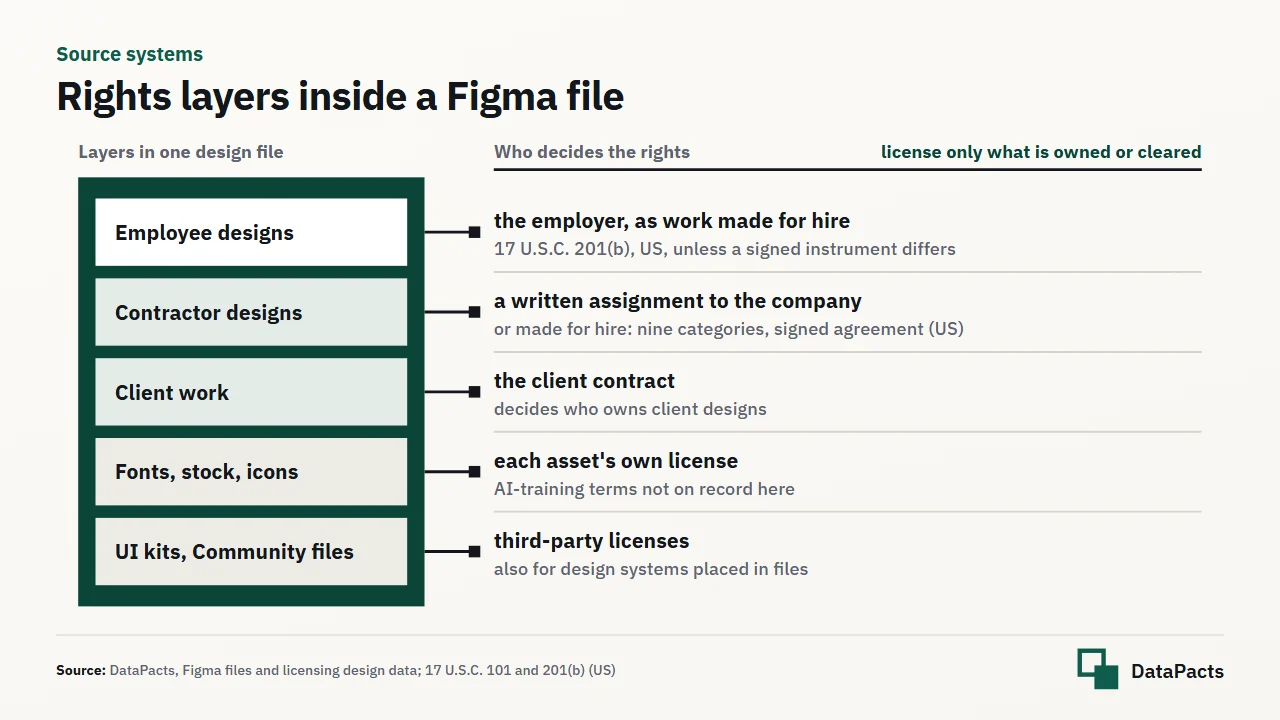
A Figma file holds several layers of rights at once, and a company can license only the layers it owns or has cleared.
Under 17 U.S.C. 201(b), the employer of a work made for hire is its author and owns all rights unless a signed written instrument says otherwise.
Under 17 U.S.C. 101, a commissioned work counts as made for hire only in nine listed categories and with a signed written agreement, so who owns client designs depends on the contract. The agency side of this question sits under who owns client work in an agency.
The layers inside a file:
- Employee designs: work made for hire, owned by the employer under 17 U.S.C. 201(b).
- Contractor and freelancer designs: owned by the company through a written assignment, or as work made for hire only in the nine listed categories with a signed written agreement.
- Client work: the client contract decides, and Mercor states that "Client work you can't license" is not a fit.
- Fonts, stock photos and icons placed in files: each is governed by its own license, and the AI-training terms of those licenses are not on record here.
- UI kits, Community files and design systems: third-party licenses apply, and Mercor states that "Open-source design systems such as Material" and templates or sites generated by AI are not a fit.
Mercor's listing asks for "The right to license the work, either your own or cleared with clients", which is the standard a buyer applies (checked November 9, 2026).
This page is information, not legal advice. Each layer belongs in the rights audit for data you want to license.
Data Programs That Name Figma
Six data programs name Figma among the systems or files they ask for or handle, each listed here with its role and the date its page was checked.
The table compares the programs alphabetically, as of 2026-11-09, with each program's own page as source. It has no payout column by design.
| Program | Role | What it states it asks for or handles (own words) | One published term relevant to Figma files | Checked | Source |
|---|---|---|---|---|---|
| Collinear AI paid data licensing | RL-environment builder | "Figma" among Slack, Gmail, Jira and others | one-time snapshot; seller keeps ownership | 2026-11-09 | collinear.ai/data-acquisition |
| Handshake AI Data Partnerships | human-data platform | sources named include "Figma" | license terms not published | 2026-11-09 | joinhandshake.com/ai/data-partnerships/license |
| Mercor Data (Design & Web Agency listing) | human-data platform | "Figma files and production code for the same projects" | not a fit: "Client work you can't license" | 2026-11-09 | api.data.mercor.com listing design-agency |
| SimpleClosure AssetHub | intermediary (shutdown service) | "WorkspaceData (Slack, Google Drive, email, Notion, Figma, tickets)" | sensitive employee, compensation, health and personal information excluded | 2026-11-09 | simpleclosure.com/product/assethub |
| Troveo business data | intermediary (marketplace) | "Jira, Linear, Asana, Notion, Figma" | licenses on the seller's behalf; no OAuth access or install required | 2026-11-09 | troveo.ai/business-data |
| Turing Project Lazarus | human-data platform | "design files (Figma)" | license to Turing exclusive for the first 6 months; Turing may license the record to more than one lab in that term | 2026-11-17 | lazarus.turing.com |
Roles are as each company describes itself; intermediaries handle or license data on the seller's behalf and do not acquire it, and no program is ranked or recommended.
Terms differ. Collinear AI states access is revocable after transfer, Handshake states its license terms are not published, Turing states that the license to Turing is exclusive for the first 6 months after signing (checked November 17, 2026), and SimpleClosure states it takes a percentage only if assets are sold or licensed.
Troveo states it licenses on the seller's behalf with no OAuth access or install. Payouts sit with AI data partnership payouts and program terms compared, each dated.
Names, Comments and Confidential Content in Figma Files
Figma files are rarely only shapes: they carry the names of the people who made and commented on them and, often, real customer data pasted into mockups.
- Comments and mentions: names and opinions
- Version history and file owners: names of authors
- Mockups and prototypes: real customer records or screenshots
- User-research boards in FigJam: interview notes and participant details
- Client logos, unreleased products and pricing: confidential, though not personal
Programs state removal or exclusion before delivery. SimpleClosure states it excludes sensitive employee, compensation, health and personal information, and Handshake states "All data is scoped, de-identified, and confidential", both checked November 9, 2026.
Text inside images survives masking of text layers, so screenshots need their own review; methods for PII removal and de-identification before licensing apply to comments and mockups first.
Benefits, Risks, Downsides and Alternatives of Licensing Figma Files
Licensing Figma files can earn license income from finished design work the company already holds, and it also places client work and other people's assets in a model that cannot be untrained.
Benefits:
- Mercor states USD 20,000 to 890,000 to the company for a design agency's archive, "Depends on archive size and rights", checked November 9, 2026.
- Collinear AI states the seller keeps ownership of the data.
Risks:
- Client and third-party rights in fonts, stock assets and UI kits may not be cleared.
- Personal data sits in comments and mockups.
- Figma's terms stay unsummarized here until the seller reads them.
Downsides:
- Turing states that the license to Turing is exclusive for the first 6 months after signing.
- SimpleClosure states a percentage taken if assets sell or license.
Alternatives:
- not licensing, and weigh whether to sell or license your data at all
- licensing only work the company made in-house
- a time-limited exclusive license, as Turing states it offers
- keeping the files for internal use
No option here is advised; the decision is the company's.
Where Figma Fits Among Source Systems and the Seller Process
Figma is one source system among several a company may license, and its export comes after the readiness check and before de-identification and the choice of buyer.
Compare export rights and mechanics by source system. Buyers ask for the code behind the designs too, which sits under GitHub repositories and code data, and Notion workspace export covers another system in the same programs. The full sequence is set out under how to sell or license company data to AI companies.
- data sale readiness
- data inventory for an AI data sale
- customer consent and confidentiality clauses
- the data manifest
- choosing a buyer for your data
- AI data licensing agreement
Figma Files of a Closed or Insolvent Company
A closed company can license its Figma files only if someone with authority still controls the workspace and holds an export before the subscription ends. SimpleClosure states it handles workspace data including Figma for shutting-down startups, and Turing lists intake statuses "Shut down ≤90 days ago" and ">90 days ago", both checked November 9, 2026.
No Figma retrieval period after termination is on record here. Read more on selling data from a shut-down or defunct company. Deadlines are covered under exporting company data before shutting down.
Program Pages Named on This Page
The program terms above come from each program's own page, checked November 9, 2026.
- company data partnership programs
- who buys AI training data
- Handshake AI profile
- Mercor profile
- SimpleClosure AssetHub profile
- Turing Project Lazarus profile
- Collinear AI
- Troveo
Frequently Asked Questions
Can a company sell its Figma files to AI companies?
Yes, a company can license Figma files it owns or has cleared, usually as a license rather than a sale, and six data programs name Figma on their own pages. Mercor asks for the right to license the work, either the company's own or cleared with clients.
How does a company export all of its Figma files?
Figma names a local .fig copy for whole files, the export panel for selected objects and its REST API, and the rules for each plan are on Figma's help pages. No limits, formats or plan rules are stated here.
Does Figma train AI on customers' design files?
Figma states that content training has applied since August 15, 2024, on by default for Starter and Professional teams and off for Organization and Enterprise, checked November 9, 2026.
How services train on their users is covered under user data and platform terms.
What are Figma files worth to an AI buyer?
No public price exists for Figma files as such; Mercor states USD 20,000 to 890,000 for a design and web agency's archive of Figma files and code, checked November 9, 2026.
For method, see how much company data is worth to AI companies.