Publication in the Gazzetta Ufficiale (Serie Generale n. 223 of 2025-09-25, 25G00143) is not the in-force date.
This page reads only the training-data articles, as read on Normattiva and in the Gazzetta Ufficiale on 2026-11-10, for holders deciding whether to reserve or license content and developers deciding what they may mine. The Italian layer of AI training data licensing rests on these articles.
What Legge 132/2025 Says About Training Data, Article by Article
Six articles of the law matter for data used for AI training, and the table gives each one's rule, its status and the section of this page that reads it.
| Article of L. 132/2025 | Rule for training data | In force or status | Read on this page | Source |
|---|---|---|---|---|
| art. 4(4) | parental consent below 14 for access to AI and resulting processing; 14 to 17 may consent with accessible information | in force 2025-10-10 | minors section | normattiva.it |
| art. 8 | health-research processing of relevant public interest; secondary use, anonymization and synthesis; AGENAS guidelines; 30-day notice to the Garante | in force 2025-10-10 | health section | normattiva.it |
| art. 16 | delegation for decrees on data, algorithms and mathematical methods for training | decree pending; none adopted as of 2026-11-09 | art. 16 section | normattiva.it |
| art. 24 | delegation for AI Act adaptation and illicit AI use; no mention of training data | decrees pending as of 2026-11-09; amended 2026-06-26, content not described | this section | normattiva.it |
| art. 25(1)(b) | adds art. 70-septies L. 633/1941: AI mining in conformity with arts. 70-ter and 70-quater | in force 2025-10-10 | mining section | normattiva.it |
| art. 26(3) | adds art. 171(1)(a-ter) L. 633/1941: mining in breach of arts. 70-ter and 70-quater an offence; multa EUR 51 to 2,065 | in force 2025-10-10 | offence section | gazzettaufficiale.it; normattiva.it |
The rest of the law (principles, sector uses and the AgID and ACN authorities under art. 20) is not a set of training-data rules and is summarized on the Italian overview.
Art. 24 delegates decrees on AI Act adaptation without mentioning training data, and Normattiva marks arts. 19 and 24 as amended on 2026-06-26, a change this page does not describe.
Art. 70-septies: The Mining Article Read Through Arts. 70-ter and 70-quater
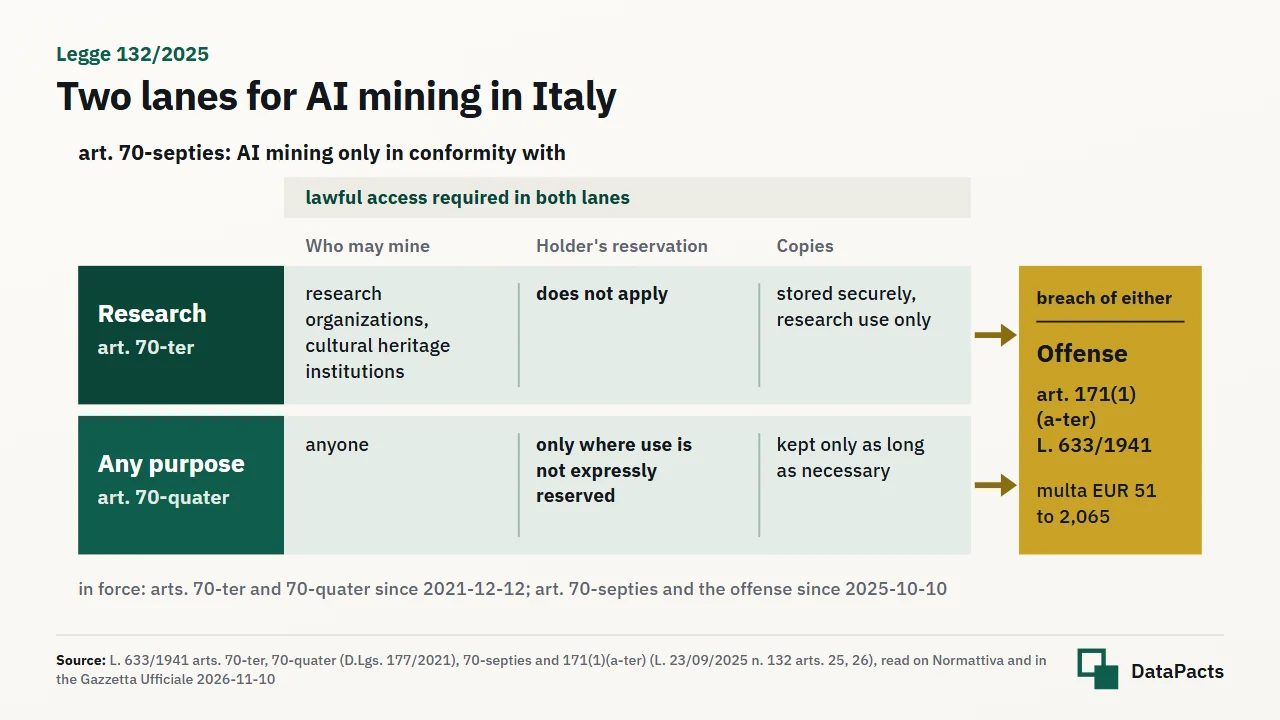
Art. 70-septies does not create a new exception: it permits reproductions and extractions for mining through AI models and systems, including generative ones, only in conformity with arts. 70-ter and 70-quater, so the conditions of those two articles decide every case.
Both articles entered the copyright law (L. 633/1941) with D.Lgs. 8 novembre 2021 n. 177, art. 3(1), which transposed Directive (EU) 2019/790 and took effect on 2021-12-12, and the table compares them.
| Condition | Art. 70-ter (scientific research) | Art. 70-quater (any purpose) | Source |
|---|---|---|---|
| Who may mine | research organizations and cultural heritage institutions; bodies under commercial control with preferential access excluded | anyone with lawful access | normattiva.it |
| Access | lawful access | lawful access | normattiva.it |
| Holder's reservation | not applicable | mining only where the use is not expressly reserved by holders of copyright and related rights or database makers | normattiva.it |
| Form of reservation | not applicable | not stated in the text read | n/a |
| Copies | stored with adequate security, used only for research including verification of results | kept only for the time necessary for the mining | normattiva.it |
| Contract override | clauses contrary to paras. 1, 6 and 7 void | not stated in the text read | normattiva.it |
| Introduced by | D.Lgs. 177/2021, art. 3(1), in force 2021-12-12 | same | normattiva.it |
| Breach | art. 171(1)(a-ter) offence | art. 171(1)(a-ter) offence | gazzettaufficiale.it |
Table as of 2026-11-10.
Lawful Access, the Berne Proviso and How Long Copies May Be Kept
Art. 70-septies applies only to works or other materials online or in databases to which the miner has lawful access, and it opens by leaving the Berne Convention untouched ("Fermo restando quanto previsto dalla Convenzione di Berna", ratified by L. 20 giugno 1978 n. 399). Lawful access is also the entry condition of art. 70-ter(1) and art. 70-quater(1).
Retention is limited in both lanes. Under art. 70-quater(2) copies may be kept only for the time necessary for the mining, and under art. 70-ter(6) research copies are stored with an adequate level of security and used only for scientific research, including verification of results. The text does not quantify "necessary".
The Holder's Reservation Under Art. 70-quater and What the Text Leaves Unstated
Outside research, mining for AI is lawful in Italy only where the holders of copyright and related rights, or the makers of a database, have not expressly reserved the use.
Art. 70-quater(1) says the use "non è stato espressamente riservato", so a reservation turns a mining question into a licensing question, and mining in breach of it is the art. 171 offence covered below.
The form of the reservation for online content, machine-readable or not, is not stated in the Normattiva text read for this page and is not described here. The protocols for expressing a reservation are covered under machine-readable TDM reservations.
Research Mining Under Art. 70-ter: Who Qualifies and Why Contracts Cannot Override It
Art. 70-ter permits mining for scientific research by research organizations and cultural heritage institutions without regard to any reservation, and it excludes bodies that commercial companies control with preferential access to the results. The beneficiaries are:
- research organizations: universities and their libraries, research institutes and similar bodies that are non-profit, reinvest profits in research or pursue a public-interest mission recognized by a member state (art. 70-ter(4));
- cultural heritage institutions: libraries, museums and archives open to the public (art. 70-ter(3));
- not beneficiaries: bodies under commercial control with preferential access to results (art. 70-ter(5)).
Holders may apply security and integrity measures only as far as necessary (art. 70-ter(7)), and contract clauses contrary to paragraphs 1, 6 and 7 are void (art. 70-ter(9)), so a commercial AI developer cannot rely on it.
The comparison with the EU research and commercial exceptions is on the page for the EU text and data mining exception.
When Mining for Training Becomes an Offence: Art. 171(1)(a-ter)
Art. 26(3) of Legge 132/2025 added letter a-ter to art. 171(1) of the copyright law, which punishes whoever reproduces or extracts text or data from works or other materials online or in databases in breach of arts. 70-ter and 70-quater, also through AI systems.
On this page's reading, the triggers are mining reserved content and research mining outside art. 70-ter, and the penalty is the multa of EUR 51 to 2,065 stated in the Gazzetta Ufficiale notes of 2025-09-25 (Normattiva's art. 171 page still shows the lire wording).
The offence attaches to the miner, so a documented reservation plus a license separates a lawful training set from an exposed one. No prosecution under letter a-ter is recorded here. Art. 26's other offences do not concern training data and are not covered.
The Art. 16 Delegation: Criteria for the Training-Data Decrees and Their Status
Art. 16 empowers the Government to adopt, within 12 months of 2025-10-10, legislative decrees giving an organic discipline of the use of data, algorithms and mathematical methods to train AI systems, without obligations beyond those of the AI Act (Regulation (EU) 2024/1689).
Drafts are proposed by the President of the Council of Ministers and the Minister of Justice, parliamentary committees have 60 days to give an opinion, and art. 16(3) sets the criteria in the table.
| Element | Text of art. 16 | Status | Source |
|---|---|---|---|
| Object | organic discipline of the use of data, algorithms and mathematical methods for training AI systems, within the AI Act's scope, "senza obblighi ulteriori" | delegation in force | normattiva.it |
| Proposers and opinions | President of the Council of Ministers and Minister of Justice; 60-day opinion of parliamentary committees | no transmitted draft recorded | normattiva.it |
| Criterion (a) | identify the cases that need a legal regime and the rights and obligations of the party carrying out the use | pending | normattiva.it |
| Criterion (b) | compensatory or injunctive remedies and a sanctions system | pending | normattiva.it |
| Criterion (c) | disputes to the business-court sections (sezioni specializzate in materia di impresa) | pending | normattiva.it |
| Deadline | 12 months from 2025-10-10 (computed 2026-10-10); plus 60 days (computed 2026-12-09) if the opinion period ends in the last 30 days or later | no adopted decree found as of 2026-11-09 | normattiva.it |
Table as of 2026-11-09.
The deadline of 2026-10-10 is computed from the entry-into-force date, and the extension to 2026-12-09 applies only if a draft's opinion period ends within the last 30 days before the deadline or later.
Whether any draft reached Parliament is not recorded here, and no adopted decree was found as of 2026-11-09. Until one exists, training data in Italy stays governed by arts. 70-ter, 70-quater and 70-septies and by the GDPR.
Health Research Data Under Art. 8: Secondary Use, Synthetic Data and the 30-Day Notice
Art. 8 declares the processing of data, including personal data, for AI research in healthcare by public and non-profit bodies, IRCCS and private parties in qualifying projects to be of relevant public interest under Art. 9(2)(g) GDPR (Regulation (EU) 2016/679). Four paragraphs set the paths:
- art. 8(2): secondary use of personal data without direct identifiers, special categories included, is always authorized for those bodies, with a general notice on the controller's website and no new consent where consent was previously required;
- art. 8(3): anonymization, pseudonymization or synthesis is always permitted after an Art. 13 GDPR notice;
- art. 8(4): AGENAS may issue guidelines on anonymization and synthetic data after the Garante's opinion, and whether any have been issued is not recorded here;
- art. 8(5): the controller notifies the Garante with the information under Arts. 24, 25, 32 and 35 GDPR (and processors under Art. 28), and processing may start 30 days later unless the Garante blocks it.
Art. 8(6) leaves the Garante's inspection, prohibition and sanction powers unaffected. On this page's reading, the paths serve the listed research bodies and projects and are not a route for a commercial sale of patient data. The EU route for secondary use is covered under the European Health Data Space.
Minors Under 14: Parental Consent Under Art. 4(4) and Data Later Offered for Training
Art. 4(4) requires the consent of the holder of parental responsibility for a child under 14 to access AI technologies and for the resulting processing of personal data, in line with the GDPR and the Italian Privacy Code (d.lgs. 30 giugno 2003 n. 196).
A minor aged 14 to 17 may consent to processing linked to the use of AI systems if the information and communications under art. 4(3) are easily accessible and understandable.
For a data deal, this reads as a check by age band: a holder offering interaction data from an AI service used by minors confirms how consent was collected for each band.
Whether art. 4(4) consent covers later reuse by a third party for training is not addressed by the law or by any guidance on record.
Licensing Data Under Legge 132/2025: Benefits, Risks, Downsides and Alternatives, Including Not Licensing
Legge 132/2025 makes a reservation plus a license the clearest lawful route to commercial training on Italian content, but it adds conditions on health data and minors and leaves a decree pending, and not licensing remains a valid choice.
Benefits
- A reservation under art. 70-quater means commercial mining needs permission.
- A license avoids the art. 171(1)(a-ter) offence for the miner.
- A license replaces the open-ended retention limit with agreed terms, after a rights audit before licensing data confirms the holder owns what it licenses.
Risks
- Research bodies may mine regardless of a reservation, and contrary contract clauses are void (art. 70-ter(9)).
- Health data carry the art. 8(5) notice and the Garante's continuing powers.
- Minors' data need consent checked by age band under art. 4(4).
Downsides
- The art. 16 decrees are pending, so the future regime for training data is unknown.
- The form of a valid reservation is not stated in the text read.
Alternatives
- Reserve and license.
- Reserve and do not license.
- Offer de-identified or synthetic data where art. 8(3) applies.
- Do not license at all.
The full decision is set out in should you sell or license your data to AI companies.
Beyond Legge 132/2025: The Italian Overview, EU Instruments and the Sale
Legge 132/2025 is one layer of Italian law on training data, and the EU instruments sit above it. The Italian overview, Italy's rules for licensing data for AI training, sets it beside the Garante's practice, staff data and royalty withholding.
- Every jurisdiction compared: AI training data law by jurisdiction.
- The EU layer: European Union rules for AI training data.
- The duties art. 16 may not exceed: EU AI Act Article 53.
- Legal basis and notices for minors' and patients' data: GDPR and AI training data.
- Article 9 health data: special category data in AI training.
- Buyers and prices for clinical data: medical and clinical data for AI training.
- Mining exceptions compared: copyright and AI training across jurisdictions.
- The German wording of the same exceptions: Germany's text and data mining sections.
- The French wording: France's text and data mining opt-out.
- The regulator's decisions: Garante Privacy and AI training data.
- The EUR 15 million decision of 2024-11-02 and the Rome court judgment: Italian Garante v. OpenAI.
- Staff communications: licensing employee email and chat data in Italy.
- Retention and use clauses that replace the statutory limits: AI data licensing agreements.
- Alternatives, including not selling: alternatives to selling data to AI labs.
What This Page Does Not Cover
This page covers the articles of Legge 132/2025 that concern training data, not the authorship of works created with AI under the amended art. 1 of the copyright law. AI in justice, public administration, the professions and the workplace, and the deepfake and aggravating-circumstance offences, are outside this reference.
How This Page Is Sourced and Dated
Every rule here cites the article of Legge 132/2025 or of L. 633/1941 as published on Normattiva and in the Gazzetta Ufficiale, with the date it was read.
The approach is explained in how we source, date and check every figure. This page is general information about Italian law, not legal advice for any specific deal.
Frequently Asked Questions
When did Legge 132/2025 enter into force?
On October 10, 2025. The Gazzetta Ufficiale published it on 2025-09-25 (Serie Generale n. 223), which is the publication date and not the date it took effect.
Can an AI developer mine works in Italy that the holder has reserved?
Not for commercial mining: art. 70-quater allows it only where the holder has not expressly reserved the use. Research organizations under art. 70-ter are excepted, and mining in breach is an offence under art. 171(1)(a-ter).
Has the Italian Government adopted the art. 16 training-data decree?
No adopted decree was found as of November 9, 2026. The deadline computes to 2026-10-10, with a 60-day extension only if the parliamentary opinion period ends within the last 30 days before it or later.
Is the consent of a minor aged 14 enough under Italy's AI law?
Yes, from 14: a minor aged 14 to 17 may consent if the information is easily accessible and understandable. Below 14, art. 4(4) requires the consent of the holder of parental responsibility.