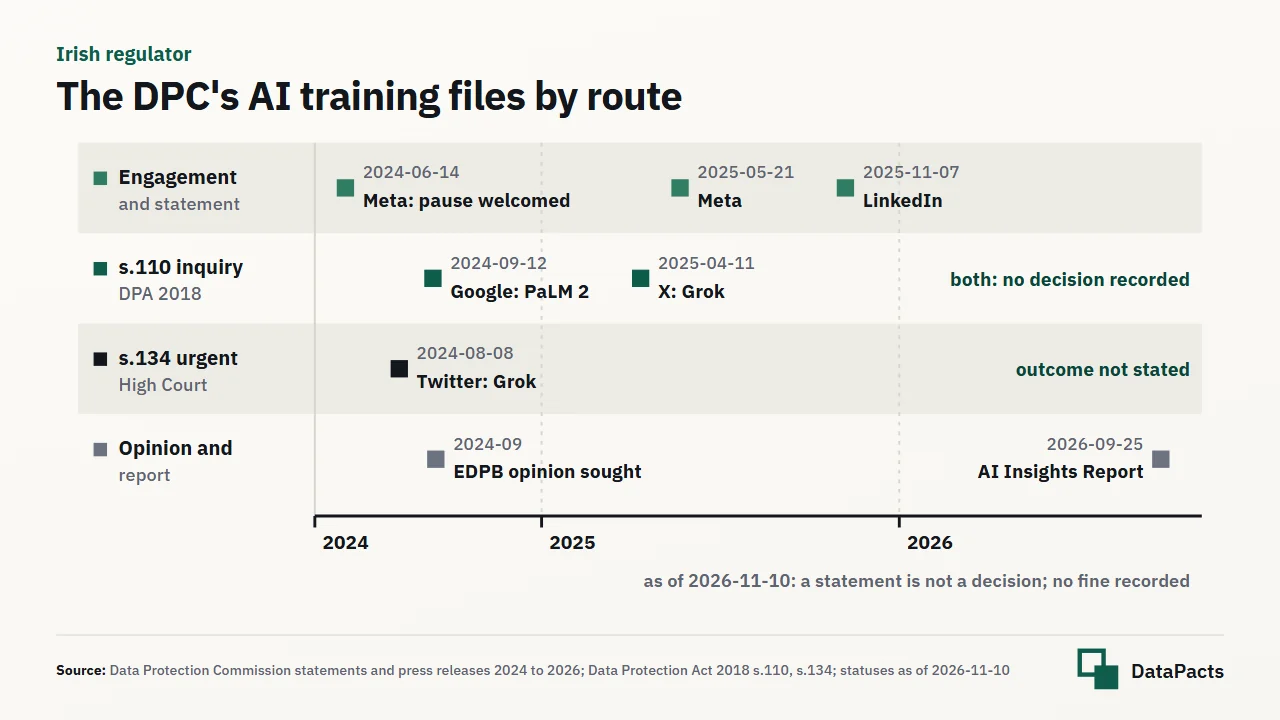
As of November 10, 2026, none of these files has a decision or a fine recorded on this page.
The DPC describes itself as lead supervisory authority for many of the large global technology companies, which is why its files matter to anyone supplying data to those buyers.
This page sets the DPC's steps in the market for AI training data licensing side by side, with the route used, the status and what they ask of a data holder. The DPC reports that it engaged with about 180 AI products and services from 2021 to 2025, its own count.
How the DPC Supervises AI Training: Engagement, Inquiries and High Court Applications
The DPC has used three routes on AI training: supervisory engagement ending in a public statement, an inquiry under section 110 of the Data Protection Act 2018, and an urgent application to the High Court under section 134.
- Engagement: the DPC reviews a company's plans and publishes a statement, as for Meta and LinkedIn. A statement is not a decision.
- Section 110 inquiry: a formal investigation, used for Google's PaLM 2 (announced September 12, 2024) and X's Grok training (announced April 11, 2025).
- Section 134 application: where the DPC considers there is an urgent need to act to protect data subjects' rights, it may apply to the High Court on notice. The DPC's own report describes orders that suspend, restrict or prohibit processing. On AI training it used this route against Twitter on August 8, 2024.
An inquiry is an investigation, not a finding, and the statute text is paraphrased here, not quoted.
The DPC's AI Training Files, 2024 to 2026
Every step below comes from the DPC's own statements and press releases, dated, with the route used and its status as of November 10, 2026.
| Date | Company or entity | Model or matter | DPC route | What the DPC did or examines | Status as of 2026-11-10 | Source |
|---|---|---|---|---|---|---|
| 2024-06-14 | Meta | LLM training on public Facebook and Instagram content of EU/EEA adults | engagement | welcomed Meta's decision to pause | followed by the 2025-05-21 statement | dataprotection.ie |
| 2024-08-08 | Twitter (now X) | Grok training on EU/EEA users' data | s.134 urgent High Court application | application on notice | outcome not stated here; record number not public | dataprotection.ie (AI Insights Report) |
| 2024-09 | Meta (EU-wide question) | AI model training | request to the EDPB | sought a formal GDPR opinion for EU-wide consistency | opinion adopted 2024-12-17 | dataprotection.ie; edpb.europa.eu |
| 2024-09-12 | Google Ireland Limited | PaLM 2 | s.110 inquiry; Art. 35 GDPR | whether a DPIA was required and carried out before processing | no decision recorded | dataprotection.ie |
| 2025-04-11 | X Internet Unlimited Company | Grok LLMs, public posts of EU/EEA users | s.110 inquiry | lawfulness and transparency of processing for training | no decision recorded | dataprotection.ie |
| 2025-05-21 | Meta | generative AI training, planned start 2025-05-27 as reported by the DPC | engagement, statement | documents reviewed and changes made; report expected October 2025 | actual start not confirmed; report not recorded | dataprotection.ie |
| 2025-11-07 | generative AI training on EU/EEA members' data | engagement, statement | not approved or found compliant; no further intervention at present; report within five months | monitoring | dataprotection.ie | |
| 2026-09-25 | about 180 AI products and services (2021 to 2025) | AI Insights Report | report | private-messages position; legitimate interests a focus | published; the DPC's own count | dataprotection.ie |
No row records a DPC decision or fine on AI training.
Meta: The June 2024 Pause and the May 2025 Statement
Meta's file shows the DPC working through engagement rather than an inquiry: on June 14, 2024 the DPC welcomed Meta's decision to pause training its large language model on public content shared by adults on Facebook and Instagram across the EU/EEA.
In September 2024 the DPC sought a formal GDPR opinion from the European Data Protection Board for EU-wide consistency, and the opinion (28/2024, adopted December 17, 2024) is covered on the anonymity page.
In its statement of May 21, 2025 the DPC reported that Meta's training was scheduled to begin on May 27, 2025, a planned date, and the DPC does not confirm the actual start.
The statement lists an updated legitimate interest assessment, DPIA and compatibility assessment, updated transparency notices and an easier objection form, and it says a report on safeguards was expected in October 2025.
Whether that report was delivered is not stated here, and the statement is not an approval. The objection form, the noyb letter and the German court record sit on the page for Meta AI training on EU user data.
X and Grok: An Urgent High Court Application, Then an Inquiry
X's file is the only one on this page where the DPC went to court: on August 8, 2024 it applied to the High Court under section 134 over the use of EU users' data to train Grok.
The DPC's AI Insights Report records the application against Twitter, now X; this page does not state its outcome or a court record number.
On April 11, 2025 the DPC announced an inquiry under section 110 into X Internet Unlimited Company (XIUC). It examines whether personal data in publicly accessible posts by EU/EEA users was lawfully processed to train the Grok LLMs, a family of models developed by xAI, with lawfulness and transparency in focus.
The DPC said its decision to commence was notified to XIUC that week, and no decision is recorded. Grok's provider is SpaceXAI LLC, formerly xAI LLC, as stated in its Grok 4.7 training summary of 2026-09-21; see the xAI data buyer profile for what xAI acquires.
Google PaLM 2: An Inquiry Into a Missing Impact Assessment
The Google file asks a narrower question: whether Google Ireland Limited carried out a data protection impact assessment under Article 35 of the GDPR before processing EU/EEA personal data to develop Pathways Language Model 2 (PaLM 2).
The DPC announced the section 110 inquiry on September 12, 2024. Article 35(1) requires an assessment prior to processing likely to result in a high risk, especially with new technologies. No reference number is public and no decision is recorded on this page as of November 10, 2026.
The assessment itself is explained in DPIA for an AI data licensing deal.
LinkedIn: Not Approved, but No Further Intervention
LinkedIn's file, which the headline above does not name, shows the DPC's latest pattern: on November 7, 2025 it stated that it had not approved, or found compliant, LinkedIn's use of members' personal data for generative AI training, and that further regulatory intervention was not considered necessary at present.
LinkedIn informed the DPC in March 2025 of its intention to train its own generative AI models on EU/EEA members' data, with processing from early November 2025. The DPC requires a report within five months of processing starting and says it will keep monitoring.
What the DPC's Files Ask of a Company Before Training Starts
Read together, the files list the documents and safeguards the DPC looks for before personal data is used for training, and a company licensing such data to a buyer can ask for the same set.
- A legitimate interest assessment (Meta, May 2025).
- A data protection impact assessment (Meta; the PaLM 2 inquiry turns on it).
- A compatibility assessment where data is reused for a new purpose (Meta).
- Updated transparency notices to the people concerned (Meta).
- An easier objection form (Meta).
- A report on safeguards after training starts (Meta, expected October 2025; LinkedIn, within five months).
The DPC's AI Insights Report of September 25, 2026 adds that it is "unlikely that a controller will be able to demonstrate that data subjects expect the usage of their private messages or other private data for AI training".
That is a regulator view, not a court holding, and the report names legitimate interests as a legal basis for AI training as a focus area. The test itself is set out under legitimate interest for AI training data.
Licensing Personal Data Under DPC Supervision: Benefits, Risks, Downsides and Alternatives, Including Not Licensing
The DPC's files do not forbid licensing data with personal data in it, but they show what a buyer under Irish supervision will be asked for, and not licensing remains a valid choice.
Benefits
- A buyer whose training the DPC has reviewed has documents a seller can request.
- The published LinkedIn file shows which safeguards drew no further intervention at present.
- Public, dated statements reduce guesswork on what is expected.
Risks
- Section 134 shows the DPC can go to court quickly.
- Two inquiries remain without a recorded decision.
- Private messages are unlikely to meet data subjects' expectations, per the DPC.
Downsides
- Preparing the legitimate interest, impact and compatibility assessments costs time before any income.
- A regulator statement is not an approval, so it does not settle a deal's legal basis.
Alternatives
- Not licensing at all.
- Licensing only non-personal or anonymized data.
- Licensing after the two inquiries end, without assuming an outcome.
- Licensing with objection and deletion terms, as set out under customer consent and confidentiality clauses before licensing data.
The wider choice is covered in should you sell or license your data to AI companies.
Beyond the DPC: Irish Law, the Meta Matter and the EU Privacy Rules
The DPC is one Irish institution, and the rest of the Irish layer is covered elsewhere. The copyright reservation, the Data Protection Act's place in a deal and Irish programs for sellers sit under Irish rules for licensing data for AI training.
- GDPR and AI training data: legal basis, notices and transfers.
- when an AI model is anonymous: the opinion the DPC requested.
- purpose compatibility when reusing data for AI training: the compatibility assessment.
- Italian Garante v. OpenAI: another authority's AI training file.
- opting out of AI training: platform settings and objection forms.
- platforms licensing user content to AI: platforms whose users' posts are the data.
- AI training data law by jurisdiction: every jurisdiction compared.
- France CNIL guidance on AI training data: another regulator's guidance.
What This Page Does Not Cover
This page covers DPC action on data used to train AI models, not DPC action on what models generate, such as the inquiry into Grok's image outputs opened in February 2026. Staff data protection courses and fines on other processing are outside the reference.
How This Page Is Sourced and Dated
Each step here cites the DPC's own statement or press release and its date, and every status is given as of the date it was checked.
The rules are in how we source, date and check every figure, and this page is general information about the Irish regulator's published actions, not legal advice for any specific deal.
Frequently Asked Questions
Has the DPC fined any company over AI training?
No: as of November 10, 2026 none of the DPC's AI training files recorded on this page has ended in a fine or a published decision. The inquiries into Google and X are announced, and the Meta and LinkedIn files are statements.
Which DPC inquiries into AI training are still open?
Two inquiries have no recorded decision: the PaLM 2 inquiry into Google Ireland Limited (2024-09-12) and the Grok training inquiry into X Internet Unlimited Company (2025-04-11). Both run under section 110 of the Data Protection Act 2018, and no decision is recorded for either.
Is the DPC the regulator for every AI developer in the EU?
No. The DPC describes itself as lead supervisory authority for many of the large global technology companies, and other authorities act too, for example Italy's Garante against OpenAI.