Slack's API Terms, effective October 10, 2025, bar apps distributed outside the organization from training a large language model on API data, and the bar binds the app developer, not the data owner.
The route matters in AI training data licensing because three things differ: the vendor term that binds the extraction, who decides what leaves the company, and what revoking access ends. Google and Atlassian carry comparable limits, no program publishes its connector's permissions, and revoking a connection does not end a license already granted.
Vendor terms and program statements below were checked on November 9, 2026 unless a line says otherwise; the DataPacts Editorial Team explains how we source, date and check every figure.
What a Buyer Connector Is and How It Differs From an Owner's Own Export
A connector reads company systems through the vendor's API under permissions the company grants, so the extraction runs on the program's code rather than the company's export tool. Three forms appear in program statements, checked November 9, 2026:
- an OAuth or marketplace app installed in the workspace, as Mercor's "Connect" step and "100+ supported tools" suggest;
- an API token or service account that reads in-scope systems, which Centific states it does read-only;
- a read-only connection to a code host, which Pangea.ai states for GitHub, GitLab and Bitbucket.
Some programs need no connection: Troveo states "No OAuth access or install required", and Turing states it sends "a sampling request built around your systems" (re-checked 2026-11-16).
Connector or Native Export, Point by Point
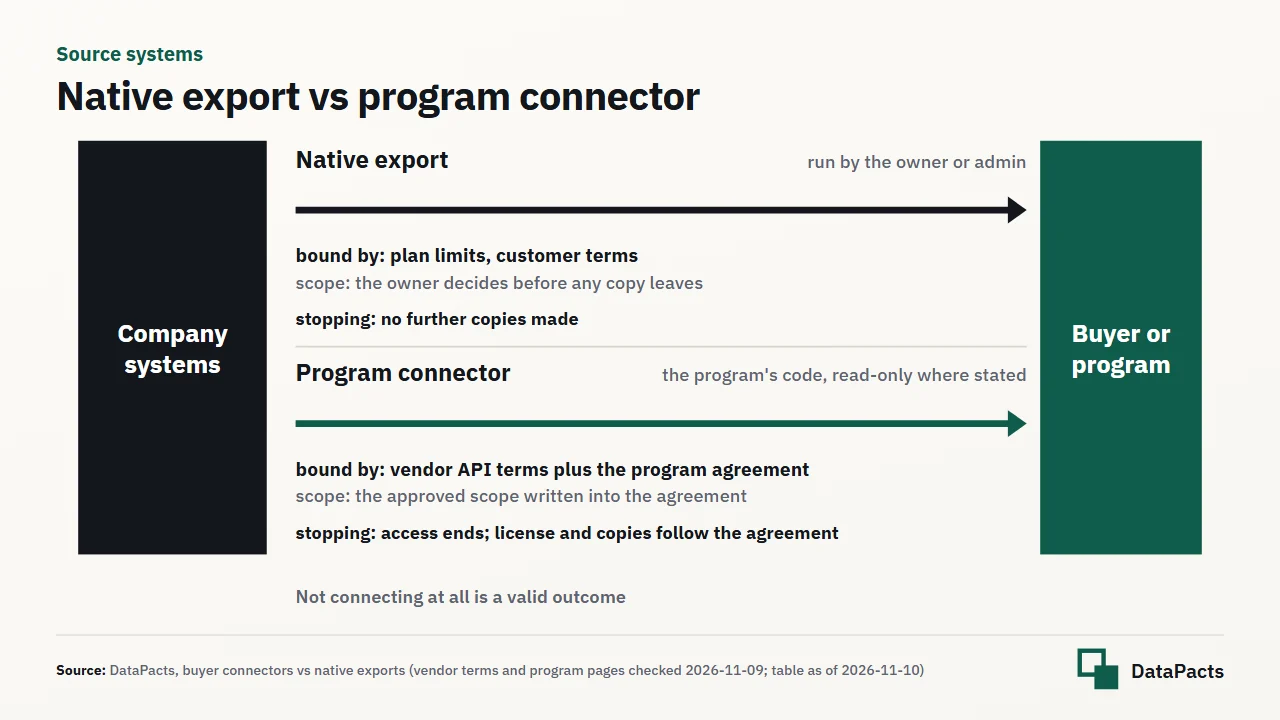
The two routes differ less in the data than in who runs the extraction, which term binds it and what the company can still stop. The table compares six control points, as of 2026-11-10, with program pages checked 2026-11-09.
| Point | Native export by the owner | Connector run by a program | Source |
|---|---|---|---|
| Who runs extraction | workspace owner or admin | the program's code, read-only where stated | centific.com |
| Term that binds the route | plan limits and customer terms | vendor API or developer terms plus the program agreement | slack.com; developers.google.com |
| Who decides scope | the owner, before any copy leaves | approved scope written into the agreement | centific.com; magmahq.ai |
| Who sees raw data | the owner, then the recipient | depends on where extraction runs; Mercor states no buyer sees raw data, Scale AI states it anonymizes inside the company's environment | mercor.com; scale.com |
| Security evidence | the owner's own controls | the program's claims (SOC 2 Type II, KMS keys, isolated environments) | mercor.com; replay.ai |
| Effect of stopping | no further copies made | access ends; license and copies follow the agreement | pangea.ai; micro1.ai |
What Vendor API Terms Say About AI Training Through an App
Vendors write their AI training limits into the terms for apps and developers, and the strictest published ones bar an app from training on the data it reads or from selling it. The table lists the instrument, the rule and the date, as of 2026-11-10, with terms checked 2026-11-09.
| Vendor | Instrument | Rule on AI training or resale by apps | Effective or dated | Source |
|---|---|---|---|---|
| Slack | API Terms | apps distributed outside the organization may not train an LLM on API Data; no bulk export except under an additional agreement | effective 2025-10-10 | slack.com/terms-of-service/api |
| Google Workspace | Workspace API user data policy | no transfer, sale or AI model training with API user data beyond a user's personalized model | checked 2026-11-09 | developers.google.com |
| Atlassian (Jira, Confluence) | Developer Terms s.9.2 | developers may not sell End User Data | effective 2025-12-01 | developer.atlassian.com |
| GitHub | Acceptable Use Policies | no selling personal information gathered via the API, such as to recruiters | checked 2026-11-09 | docs.github.com |
| Microsoft 365, Teams | none on record | not on record | n/a | n/a |
| Salesforce | none on record | not on record | n/a | n/a |
Who the Terms Bind: App Developers, Not the Workspace Owner
Slack's and Atlassian's terms bind the developer of the app, so a company's own export is outside them while a program's connector is inside them.
Slack announced its API terms change on May 29, 2025, applied it at once to new apps and from June 30, 2025 to existing apps, and exempts bulk export only under an additional agreement. Atlassian's Developer Terms s.9.2 bar developers from selling End User Data.
No program states whether its connector is an app distributed outside the organization or holds an additional agreement, so the seller asks in writing. A vendor training its own models is a separate question: Slack states it does not train generative AI without affirmative opt-in consent, which belongs under user data and platform terms.
Systems Where No App Term on AI Training Is on Record
For Microsoft 365, Teams, Salesforce and Figma no vendor term on third-party AI training with API-read data is on record, as of November 10, 2026. Figma's training setting concerns Figma's own models (training on customer content began August 15, 2024, Figma states) and says nothing about an outside app.
Microsoft states the Teams Export API needs an active Teams license for each exported user. The absence of a term is not permission, so the seller reads the customer agreement and the program agreement.
Scopes and Permissions a Connector Asks For
No program among those checked publishes the exact permissions its connector requests, so the scope exists only in what the company approves and what the agreement writes down.
Centific states the owner chooses applications, teams and periods and that exclusions are enforced in extraction code, and Magma states its read-only encrypted connection is limited to the approved scope under a separate written agreement (both checked November 9, 2026).
Mercor states that "Connecting more tools generally results in a higher payout", so breadth is rewarded.
A company asks each program in writing:
- whether the connection is read-only or can write;
- which workspaces, channels, repositories and date range it reaches;
- whether an admin or an individual user consents;
- how long the token lives and who holds it;
- where the extraction runs.
Atlassian's Jira Cloud backups exclude automation flows, third-party app data and Assets, so a connector may reach records that a native backup lacks, and such records belong in the data inventory for an AI data sale before anything is approved.
Security Evidence and Audit Trails Programs State for Connections
Security claims on program pages are the programs' own statements, and the evidence a company can check is an audit report, a key-management setup or an audit trail named in the agreement. Checked November 9, 2026:
- Centific states payment after acceptance with an audit trail;
- Mercor states SOC 2 Type II, AWS KMS keys and "No AI lab buyer or third-party vendor ever sees your raw data";
- Replay states an isolated environment per engagement;
- Scale AI states anonymization inside the company's environment, with on-prem or VPC options.
A security incident at a connecting program is a documented risk. Mercor reported unauthorized access through compromised LiteLLM versions, with breach dates of March 24 and March 30, 2026 in its notice to the California Attorney General, and the consolidated class action is In re Mercor.io Corporation Data Breach Litigation, N.D. Cal.
Lead Case No. 3:26-cv-02821-WHO (consolidated May 19, 2026). The sources describe affected experts' information, not connected company data.
Where a connector operator processes personal data for the company, Regulation (EU) 2016/679 applies (in force May 24, 2016, applying from May 25, 2018): Art. 28(3) sets processor terms, Art. 32 security and Art. 33(1) a 72-hour breach notice. The processor duties sit within the rules on GDPR and AI training data.
Revoking a Connection and What the Buyer Keeps
Revoking a connector stops future reads, but the license and the copies already taken follow the agreement, not the revocation. A company revokes in the vendor's admin console and confirms it in writing. Programs state the consequences differently, checked November 9, 2026 (micro1's terms: last updated November 8, 2026):
- Collinear AI states a one-time snapshot with access revocable after transfer;
- Labelbox Prism states deletion within 30 days under its kill clause, no further training, transfer or sublicensing after revocation, and that "Models already trained on the data cannot be unlearned";
- micro1's terms grant a worldwide, nonexclusive, irrevocable, perpetual license (s.1.2) and require deletion at the earlier of 120 days after delivery or termination, with no duty to retrain (s.4.4);
- Pangea.ai states withdrawal before presentation, then 30 days' notice, processes that may continue 90 days, and completed licenses that survive.
Origin Lab states it deletes working copies with written confirmation if either side passes, and the license clause decides the rest, as the deletion, return and machine unlearning clauses show.
Who Controls What Leaves the Company Under Each Route
Under a native export the company decides scope, date range and redaction before any copy leaves; under a connector those decisions sit in the program's extraction code and approval gates.
Centific states "You license your data. You never hand it over.", Scale AI states per-package approval gates, and Avelence, a broker, states no default system access, with extraction and de-identification on a separate copy.
Troveo, a marketplace, states it packages anonymized data with a manifest. SimpleClosure, a shutdown service, states a seller connects a GitHub repository or submits a form, and states 95 % of its AssetHub workspaces include Slack and 82 % GitHub (article of September 3, 2026).
A route that avoids connecting at all is a sample route, covered under samples, clean rooms and proving data quality.
Connecting, Exporting or Neither: Benefits, Risks, Downsides and Alternatives
A connector saves the company the export work and hands control of the extraction to the program, and not connecting is a valid outcome. The lists below set the route against its costs.
Benefits
- The program carries extraction and anonymization: Mercor states it covers those costs, and Turing states it covers de-identification and packaging.
- A connection limited to an approved scope.
Risks
- A connector sits inside the vendor's API terms, such as Slack's bar on LLM training and bulk export.
- A security incident at the operator.
Downsides
- Scopes are not published, so the company relies on the agreement.
- Revocation does not end the license.
Alternatives
- A native export that the company redacts itself.
- A sample-only route on a sampling request.
- Work inside the company's own environment.
- Not licensing at all, set out in alternatives to selling data to AI labs.
Where Connectors Sit Among Source Systems and the Seller Steps
Each system page holds the export detail and the vendor term for one system; this page holds the connection question they share. The hub maps them under export rights and mechanics by source system.
- Slack data and AI training: API Terms effective October 10, 2025.
- Microsoft Teams data: the Export API needs a license per exported user.
- Microsoft 365 exports: a Purview export package expires after 14 days.
- Google Workspace exports: the Workspace API user data policy.
- Jira data: Developer Terms s.9.2.
- GitHub repositories: a migration archive is deleted after seven days.
- Salesforce data export: no connected-app term on record.
- Figma files: the training default concerns Figma's own models.
The seller steps that follow a route decision:
- PII removal and de-identification.
- Delivering licensed data to an AI buyer (page not yet published).
- Security during an AI data sale (page not yet published).
Programs Named on This Page
The connection, security and revocation statements above come from these program pages, each checked on November 9, 2026, and the profiles are listed alphabetically:
Further programs sit in company data partnership programs, and the dated comparison is AI data partnership payouts and program terms compared. Centific, Collinear AI, Labelbox Prism, Magma, Origin Lab, Replay, Troveo, Avelence and SimpleClosure are named from their own pages.
Not Legal Advice
This page describes vendor and program terms for information and is not legal advice; vendor terms change, so the current text governs.
Frequently Asked Questions
Can an AI data buyer connect directly to a company's Slack?
Some programs connect read-only, but Slack's API Terms bar apps distributed outside the organization from training an LLM on API Data or bulk exporting it without an additional agreement. No program states which category its connector falls into.
Does revoking a connector delete data the buyer already copied?
No: revoking stops new reads, and copies already taken follow the agreement. micro1's terms, for example, require deletion of the data within 120 days of delivery or at termination, if earlier, but no deletion or retraining of models already built.
Is a read-only connector safer than a native export?
Read-only limits what the program can change, not what it can copy. Scope, key management and audit evidence decide the risk, and programs publish these only as claims.
Do vendor API terms bind the company that owns the data?
Slack's API Terms and Atlassian's Developer Terms bind app developers; a company's own export runs under its customer terms instead.