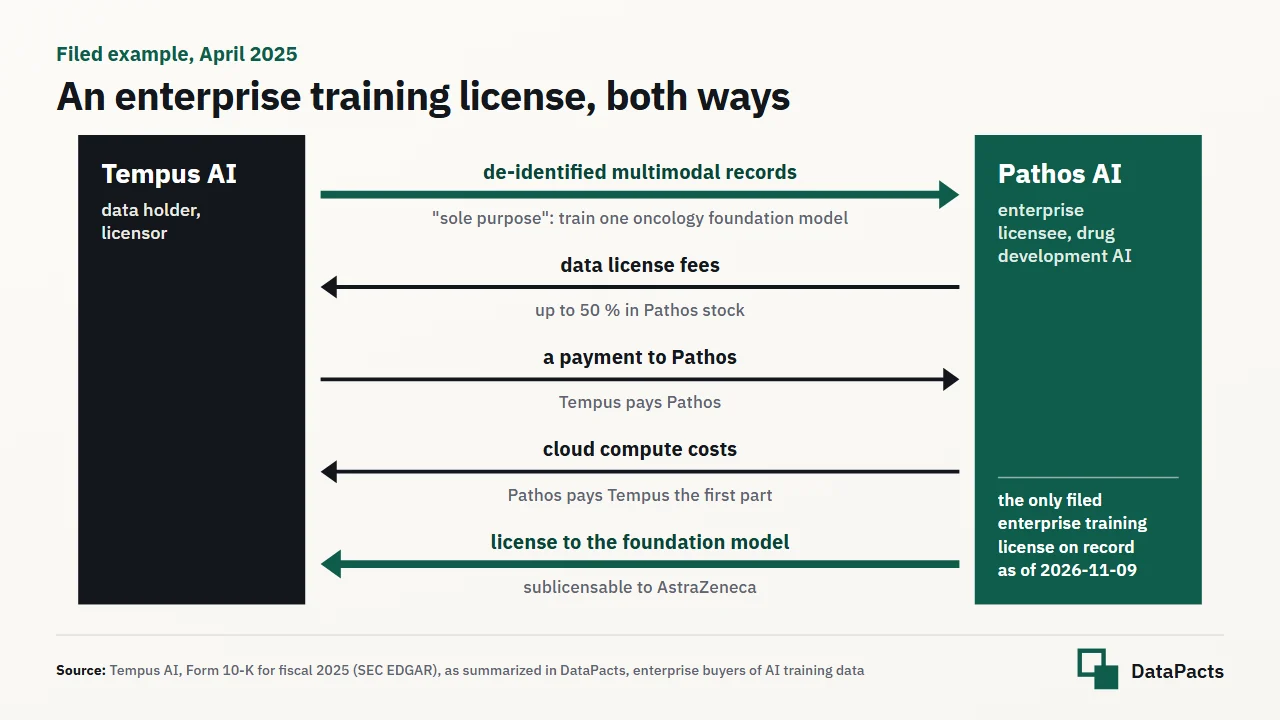
The clearest filed example is Pathos AI's April 2025 license of de-identified oncology records from Tempus AI, granted for the sole purpose of training a foundation model, and most other enterprise model building on record uses data the company already holds, as Epic's research paper of 2025-11-07 describes.
Compared with lab deals, the filed enterprise terms add a model license back to the data holder, part payment in stock and a time-limited exclusivity window. This page sets out those records, what they cover and where they stop, as part of the buyer side of AI training data licensing.
What Makes an Enterprise a Training Data Buyer
An enterprise buyer is a company whose main business is not building general AI models that acquires data to train or fine-tune a model for its own products or research.
The label describes the use, not the size of the company: a drug developer or diagnostics company qualifies when a license or its own filing ties the data to a model it runs itself.
Frontier labs differ in two ways. Several lab licenses state display only or do not state training, and labs buy at platform scale: Reddit's S-1 states USD 203.0 million in aggregate contract value for its January 2024 licenses, with the counterparties not named. See how frontier AI labs as data buyers license platform and publisher content.
Enterprises also appear far more often as sellers than as buyers. micro1 states a USD 1 billion commitment over 12 months to enterprise data acquisition, announced 2026-10-09, which is buying from enterprises, not by them.
Enterprise Licensees and Model Builders on Record
The table lists six records for five enterprises, in date order, each with the use its source states and the party that states the value.
Six records for five enterprises, as of 2026-11-09:
| Enterprise | Record | Data | Use as stated | Value as stated (stated by) | Date | Source |
|---|---|---|---|---|---|---|
| GSK plc | license from 23andMe | genetic and phenotypic database | drug target discovery and research; not AI training specifically | USD 20 million upfront, one-year non-exclusive license (23andMe 8-K) | 2023-10-30 | sec.gov 8-K |
| Pathos AI, Inc. | license from Tempus AI | comprehensive de-identified multimodal dataset | "for the sole purpose of" developing and training a foundation model in oncology | USD 200 million over three years, incl. USD 50 million upfront (Tempus 10-K FY2025) | 2025-04 | sec.gov 10-K |
| Epic Systems Corporation | own model trained on pooled records | de-identified Epic Cosmos data, 118 million patients | training of Curiosity models, up to 1 billion parameters | no purchase on record | 2025-11-07 | arXiv 2508.12104v3, Epic's paper |
| Tempus AI, Inc. | own models trained on held records | over 1.6 billion pages of clinical text | training its own LLMs (Tempus's claim) | no purchase on record | 2025-12-31 | sec.gov 10-K |
| Bristol-Myers Squibb Company | Onco SOW with Tempus AI | multimodal oncology records, Lens access, services | not stated; use with Pathos's platform allowed | USD 137.5 million aggregate fixed payments through 2031-12-31 (Tempus 10-Q) | 2026-10-14 | sec.gov 10-Q |
| Pathos AI, Inc. | Neuro Order Form with Tempus AI (sublicense to Bristol-Myers Squibb Company) | 500,000 de-identified neurology records over five years; Tempus Agent | not stated | up to USD 55.0 million, USD 100 per delivered record (Tempus 10-Q) | 2026-10-22 | sec.gov 10-Q |
Only one of the six records states training as the licensed use: the 2025 Pathos AI license. No other enterprise is on record with a filed training license as of November 9, 2026.
Pathos AI: An Oncology Foundation Model Trained on Licensed Records
Pathos AI, Inc., a drug development AI company, licensed a comprehensive de-identified multimodal dataset from Tempus AI in April 2025 for the sole purpose of developing and training a foundation model in oncology.
Tempus states in its 10-K for fiscal 2025 that the fees are USD 200 million over three years, including USD 50 million paid upfront as of April 2025.
A later neurology order form of 2026-10-22 covers up to USD 55.0 million per Tempus's 10-Q, and it does not state training as the use. Each contract is set out under Tempus AI clinical data licensing deals.
Enterprises That Train on Records They Already Hold
Many enterprises that build models train them on records they already hold, so no purchase takes place and no license fee is on record.
Epic's research paper (version 3, 2025-11-07) states that its Curiosity models, up to 1 billion parameters, were trained on de-identified Epic Cosmos data covering 118 million patients and 115 billion discrete medical events.
Epic states that Cosmos holds over 300 million unique patient records from 310 health systems. Tempus states in its 10-K that over 1.6 billion pages of clinical text were used to train its own LLMs, as of 2025-12-31.
Holding data is not the same as being free to train on it. The WhatsApp Business Platform terms, last modified 2026-09-23, bar AI training on Platform Data except fine-tuning for the business's exclusive use (section 4.7).
Enterprise Licenses Where Training Is Not Stated
Some large enterprise data licenses do not state training as the use, and a page on enterprise buyers keeps them apart rather than counting them as training purchases.
Bristol-Myers Squibb Company's Onco SOW with Tempus of 2026-10-14 carries USD 137.5 million in aggregate fixed payments through 2031-12-31 and allows use with Pathos's platform, but Tempus's 10-Q does not state training.
GSK plc's license from 23andMe of 2023-10-30 is a one-year non-exclusive data license including certain analysis services, with USD 20 million upfront per 23andMe's 8-K, for drug target discovery and research, not AI training specifically. Not stated is not the same as excluded.
What Enterprises Buy: Domain Records, Not Web-Scale Corpora
The enterprise purchases on record are narrow, deep and regulated: de-identified clinical, molecular, imaging and genetic records priced per contract or per record, not crawled text or platform-wide archives.
- Multimodal oncology records for one foundation model (Pathos AI, 2025).
- Neurology records delivered at 100,000 a year over five years, priced at USD 100 per delivered record (Pathos AI order form, 2026-10-22).
- A genetic and phenotypic database for target discovery, not AI training specifically (GSK plc, 2023-10-30).
Lab purchases look different: Reddit's data API access "to display, train on, and otherwise use" Reddit content (announced 2024-02-22, value not disclosed), publisher archives and image libraries.
The records in the enterprise examples are health data, so de-identification and consent rules travel with them. Read the rules and buyers for medical and clinical data for AI training before treating any such record as available.
How Enterprise Terms Differ From Frontier-Lab Deals
The filed enterprise license differs from published lab and program terms in four ways: a single stated purpose, a model license back to the data holder, payment partly in the buyer's stock, and money flowing in both directions.
Enterprise terms compared with lab and program terms, as of 2026-11-09:
| Term | Enterprise example (Pathos AI and Tempus) | Lab and program examples | Source |
|---|---|---|---|
| Stated use | "sole purpose" of training one foundation model in oncology | Google and Reddit: "to display, train on, and otherwise use"; several publisher deals state display only or do not state training | Tempus 10-K; blog.google 2024-02-22 |
| Value disclosed | USD 200 million over three years, stated by the licensor | Reddit: USD 203.0 million aggregate for January 2024 licenses, counterparties not named | Tempus 10-K; Reddit S-1 |
| Payment form | up to 50 % in Pathos Series D Preferred Stock; later order priced per delivered record | micro1: license attaches after acceptance and payment | Tempus 10-K and 10-Q; micro1.ai terms |
| Who keeps the model | Tempus receives a license to the Foundation Model, sublicensable to AstraZeneca | micro1 owns derivatives, models, weights and outputs | Tempus 10-K; micro1.ai terms (2026-11-08) |
| Money in both directions | Tempus pays Pathos USD 35 million; Pathos pays Tempus the first USD 60.0 million of cloud compute costs | none stated in the lab and program terms on record | Tempus 10-K |
| Exclusivity | side letter: no license of the neurology records to third parties other than Bristol-Myers Squibb Company, Pathos and certain subcontractors until 18 months after the later of delivery and 2027-10-22 | micro1 grant nonexclusive, irrevocable, perpetual | Tempus 10-Q; micro1.ai terms |
The comparison rests on one enterprise deal and published lab and program terms, so it describes those records, not every enterprise.
Per-record pricing and a time-limited restriction on licensing the same records to others are the two terms that most affect a data holder's later options. They are covered in detail under field of use and scope limits in AI data licenses.
Routes Enterprises Use to Acquire Training Data
Enterprises acquire training data through four routes on record: a direct license from a data holder, a catalog membership, a vendor's commissioned collection, and a program that licenses company records on to labs and enterprises.
- Direct license: Pathos AI and Tempus, as above.
- Catalog membership: the Linguistic Data Consortium states for-profit Standard membership at USD 34,000 and Subscription at USD 40,000, and that for-profit members retain commercial rights to data acquired during membership (checked 2026-11-09).
- Commissioned collection: Mecka states it sells dataset access and task-specific collection to robotics labs, frontier model teams and enterprises, with license terms not published (checked 2026-11-09).
- Program resale: micro1 states it licenses company data exclusively to labs and enterprises in the US and allied countries, a statement about recipients, while its Data License Master Terms grant is nonexclusive (checked 2026-11-09).
Marketplaces list datasets for purchase as a fifth channel and are covered on their own page. None of these vendors or programs is ranked or recommended here, and each figure is the party's own claim with its check date. Every dataset vendors and data labs entry on record has a page of its own.
Licensing Data to an Enterprise Model Builder: Benefits, Risks, Downsides and Alternatives
For a data holder, an enterprise licensee trades the scale of a lab deal for a narrower grant, and the filed example shows both what that can bring and what it costs.
Benefits
- A stated single purpose limits what the licensee may do with the records.
- An upfront payment: USD 50 million paid as of April 2025 in the Pathos license, per Tempus.
- A license back to the model trained on the data, for the data holder.
Risks
- Part of the fee may be paid in a private company's preferred stock.
- Fees tied to delivery are a maximum, not a guarantee, as with the neurology order of 2026-10-22 for up to USD 55.0 million.
- A licensee may terminate on notice with a fee, as the Bristol-Myers Squibb Company SOW allows on 12 months' notice.
Downsides
- A restriction window on licensing the same records to others.
- Counter-commitments such as hosting compute and a payment to the licensee.
- One enterprise buyer per domain dataset means few comparable offers, so a holder has little to benchmark a price against.
Alternatives, including not licensing at all
- Keep the records and train an own model, as Tempus states it does.
- License through a vendor or program instead.
- License non-exclusively without a side letter.
- Not license at all, which is a valid outcome.
The full decision, including not selling, is set out in should you sell or license your data to AI companies.
Where Enterprise Buyers Sit Among Labs, Vendors, Programs and Public Buyers
Enterprises are one of the buyer categories in the directory, and the pages below cover the other categories and the seller steps around them. The directory itself is who buys AI training data, and the related pages are:
- Company data partnership programs
- AI training data marketplaces
- Operating companies licensing their data (enterprises as sellers)
- Choosing a buyer for your data
- Exclusive vs non-exclusive data licenses
- AI data licensing deals
- Governments and public institutions buying training data
- Enterprise workflow RL environments
Companies and Programs Named on This Page
The vendor and program terms above come from each party's own pages, checked November 9, 2026.
- Bristol-Myers Squibb Company
- Epic Systems Corporation
- GSK plc
- Linguistic Data Consortium
- Mecka
- micro1
- Pathos AI, Inc.
- Tempus AI, Inc.
Frequently Asked Questions
Do companies buy data to train their own AI models?
Yes, though few such purchases are public: the clearest filed example is Pathos AI's license of de-identified oncology records from Tempus AI solely to train a foundation model.
Where can a company buy AI training data?
A company can license data directly from a holder, join a catalog such as the Linguistic Data Consortium, commission collection from a vendor, or buy listed datasets on a marketplace. The Linguistic Data Consortium states for-profit Standard membership at USD 34,000, checked 2026-11-09.
How much do enterprises pay for training data?
Public enterprise prices are rare: Tempus states USD 200 million over three years for the Pathos license (10-K, fiscal 2025) and USD 100 per delivered record for a later neurology order (10-Q, 2026-10-22).
Methods for estimating the value of a company's own records are in what company data is worth to AI companies.