AWS states a listing fee of 3 % on public offers and 3 %, 2 % or 1.5 % on private offers by total contract value, effective 2024-01-05, and it describes provider eligibility in two statements that do not match.
Every AWS figure on this page is AWS's own statement, checked on 2026-11-09 and re-read on 2026-11-10, and AWS Data Exchange does not buy data. DataPacts is not AWS. It is an independent reference on AI training data licensing. Not listing is a valid choice.
What AWS Data Exchange Handles and What the Provider Keeps
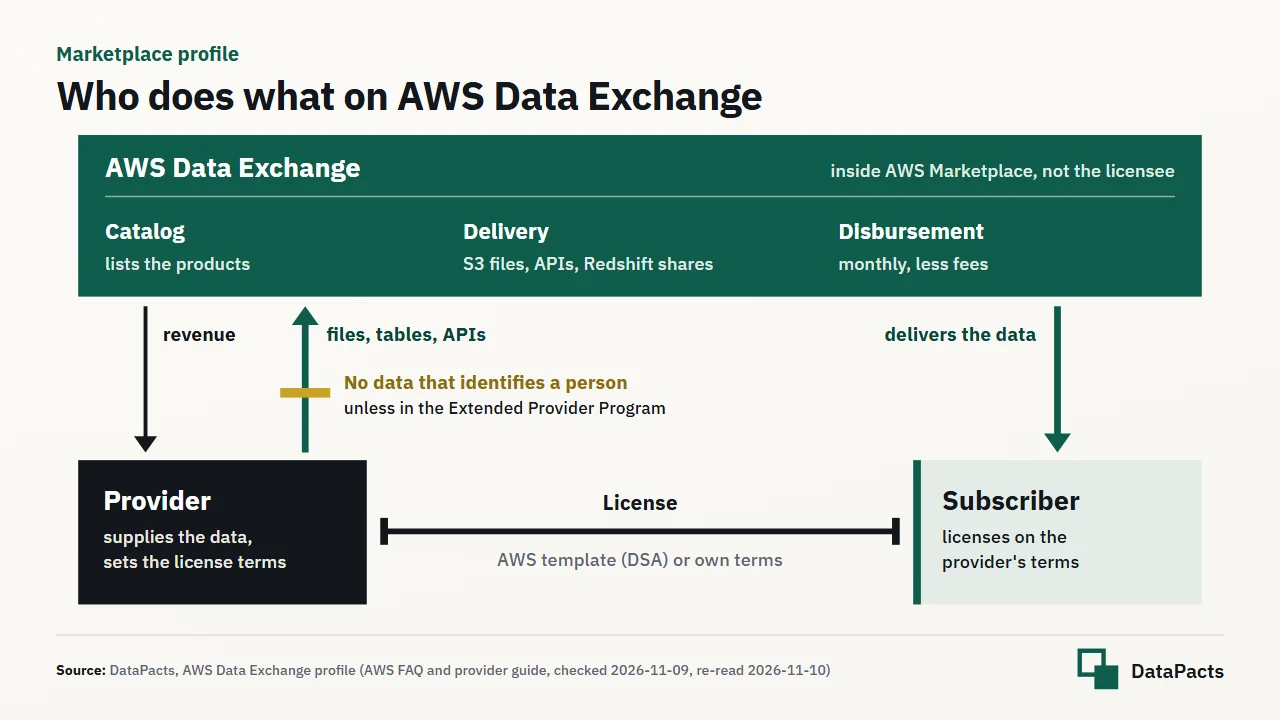
AWS Data Exchange runs the catalog, the delivery and the monthly disbursement of subscription revenue less fees, while the provider supplies the data and the license terms.
AWS delivers data as files in S3, as APIs or as Redshift data shares. The provider decides what is listed and under which terms, AWS applies its fee when revenue is disbursed, and the subscriber is the party that licenses the data from the provider.
AWS Data Exchange is therefore a place where a license is concluded, not a licensee.
- AWS handles: the catalog inside AWS Marketplace, delivery as S3 files, APIs or Redshift data shares, and the monthly disbursement less fees.
- The provider keeps: the data itself and the license terms, set either through AWS's optional Data Subscription Agreement template or through its own terms.
AWS states that the service lists more than 3,500 data products and more than 300 providers, checked 2026-11-09 and the product count re-read 2026-11-10. Both figures are AWS's own claims.
The pages checked give no count of subscribers that are AI developers, so the share of listings or buyers connected to AI training is not stated here.
AWS Data Exchange Company Identity
AWS names Amazon Web Services, Inc. as the operator of AWS Data Exchange, a United States company; no registry number appears on the pages checked.
The table below records the identity attributes as of 2026-11-09 with the AWS page behind each.
| Attribute | Value | Source |
|---|---|---|
| Operator | Amazon Web Services, Inc. (brand AWS Data Exchange) | aws.amazon.com/data-exchange/faqs/ |
| Registry number | none found on the pages checked | n/a |
| Website | aws.amazon.com/data-exchange/ | aws.amazon.com/data-exchange/ |
| Headquarters country | United States | aws.amazon.com/data-exchange/faqs/ |
| Founded | not recorded | n/a |
| Type | cloud data marketplace inside AWS Marketplace delivering files (S3), APIs and Redshift data shares | aws.amazon.com/data-exchange/faqs/ |
| Relation to Amazon.com, Inc. | separate profile; the marketplace is distinct from Amazon.com, Inc.'s own AI data licensing | data.sec.gov (Amazon.com, Inc. filings index) |
No founding date is on the pages checked either. The marketplace is a different subject from Amazon.com, Inc.'s own purchases of content for AI models, and the two profiles should not be read as one.
AWS Data Exchange Provider Terms, Dated
AWS publishes its provider terms across three pages, its FAQ, its listing-fee page and its provider getting-started guide, and the table below holds each term as AWS states it, as of 2026-11-09 and re-read on 2026-11-10.
| Term | What AWS states | Checked | Source |
|---|---|---|---|
| Program | AWS Data Exchange provider listing | 2026-11-09 | docs.aws.amazon.com listing fees |
| Data accepted | third-party data files, tables and APIs | 2026-11-09 | docs.aws.amazon.com provider getting started |
| Eligibility | FAQ: legal entity domiciled in the US or an EU member state; provider guide: 13 jurisdiction entries (see #eligibility) | 2026-11-09, re-read 2026-11-10 | aws.amazon.com FAQ; provider guide |
| Personal data | no information that can identify a person unless the provider is in the Extended Provider Program, "except information that is already legally available to the public" such as open court records or public company filings | 2026-11-16 | aws.amazon.com FAQ |
| Listing fee | 3 % public; 3 %, 2 %, 1.5 % private by contract value; 1.5 % renewals; effective 2024-01-05 (see #listing-fees) | 2026-11-09, re-read 2026-11-10 | docs.aws.amazon.com listing fees |
| Uplifts | channel partner private offer plus 0.5 %; South Korea buyers plus 1 % from 2025-04-01 | 2026-11-09, re-read 2026-11-10 | docs.aws.amazon.com listing fees |
| Payout | monthly disbursement less fees | 2026-11-09 | aws.amazon.com FAQ |
| License | optional Data Subscription Agreement template or the provider's own terms | 2026-11-09 | aws.amazon.com FAQ |
| Tax and bank | US: W-9 and US bank; non-US: W-8, VAT or GST number, US bank or Hyperwallet virtual US account | 2026-11-09, re-read 2026-11-10 | docs.aws.amazon.com provider getting started |
| Process | register as an AWS Marketplace seller; qualification by the AWS Data Exchange team | 2026-11-09 | docs.aws.amazon.com provider getting started |
| Referral fee | none recorded | 2026-11-09 | n/a |
The table does not settle whether a subscriber may use the data for AI training, whether the license is exclusive or how long it runs, or whether the subscriber must delete the data when the subscription ends. On AWS Data Exchange those points are whatever the provider's Data Subscription Agreement or own terms say.
A provider that licenses data to AI developers therefore reads its own terms as the real contract, and the fee table that follows covers only what AWS keeps, not what the license permits. The cross-buyer view sits in the program terms compared table.
AWS Data Exchange Listing Fees by Offer Type
AWS states a listing fee of 3 % on AWS Data Exchange public offers and 3 %, 2 % or 1.5 % on private offers by total contract value, effective 2024-01-05.
Renewals carry 1.5 %. Two uplifts add to the applicable fee: 0.5 % on a channel partner private offer, and 1 % on transactions with buyers in South Korea from 2025-04-01, charged to the seller.
The Korean rate is a seller-side charge tied to the buyer's location, and the rules for licensing data in South Korea page covers the local side.
| Offer type | Listing fee AWS states | Effective | Source |
|---|---|---|---|
| Public offer | 3 % | 2024-01-05 | docs.aws.amazon.com listing fees |
| Private offer, total contract value under USD 1 million | 3 % | 2024-01-05 | docs.aws.amazon.com listing fees |
| Private offer, USD 1 million to under USD 10 million | 2 % | 2024-01-05 | docs.aws.amazon.com listing fees |
| Private offer, USD 10 million and above | 1.5 % | 2024-01-05 | docs.aws.amazon.com listing fees |
| All renewals | 1.5 % | 2024-01-05 | docs.aws.amazon.com listing fees |
| Channel partner private offer | plus 0.5 % on the applicable fee | 2024-01-05 | docs.aws.amazon.com listing fees |
| Transactions with buyers in South Korea | plus 1 %, charged to the seller | 2025-04-01 | docs.aws.amazon.com listing fees |
Table as of 2026-11-09, re-read 2026-11-10. Fees as AWS states them.
Worked examples, calculated from AWS's stated rates and effective 2024-01-05:
- A private offer of USD 500,000 falls under the 3 % tier, so the fee is USD 15,000.
- A private offer of USD 2,000,000 falls in the 2 % tier of 2024-01-05, so the fee is USD 40,000, and its renewal at 1.5 % costs USD 30,000.
- A public offer to a buyer in South Korea carries 3 % plus the 1 % regional fee from 2025-04-01, a combined 4 %.
AWS states that it disburses subscription revenue monthly less fees, so the provider receives the net amount rather than a payout set by AWS. Whether a subscriber pays upfront, in milestones or by revenue share is a matter between provider and subscriber, as the page on when AI data buyers pay sets out.
Who May List on AWS Data Exchange: Two Statements From AWS
AWS's FAQ says providers must be a legal entity domiciled in the United States or an EU member state, while its provider guide lists 13 eligible jurisdiction entries, from Australia to the United States.
The table below sets the two statements side by side as of 2026-11-09, re-read 2026-11-10, and neither is called wrong.
| AWS page | Wording | Jurisdictions | Source |
|---|---|---|---|
| AWS Data Exchange FAQ | "valid legal entity domiciled in the United States or a member state of the EU" | US, EU member states | aws.amazon.com/data-exchange/faqs/ |
| Provider getting-started guide | resident or incorporated in a listed jurisdiction | 13 entries: Australia, Bahrain, EU member states, Hong Kong SAR, Israel, Japan, New Zealand, Norway, Qatar, Switzerland, UAE, UK, US | docs.aws.amazon.com provider getting started |
A provider outside the US or the EU should ask AWS in writing, before registering, which statement applies to it, and should keep the reply with its records.
DataPacts does not rule on eligibility, and the same uncertainty applies to a sole trader or an individual, whom the FAQ wording does not mention. The seller page on selling data to AI companies from outside the US holds the wider border questions.
Paid products add tax and bank prerequisites, which depend on where the provider is located:
- US providers: a W-9 and a US bank account.
- Non-US providers: a W-8, a VAT or GST registration number, and either US bank information or a Hyperwallet virtual US account.
Payments to a non-US provider can also meet tax at source, which is covered under withholding tax on data license payments.
No Data That Identifies a Person: The AWS Data Exchange Rule
AWS states that data products on AWS Data Exchange may not include information that can be used to identify any person, unless the provider is enrolled in its Extended Provider Program.
The FAQ excepts "information that is already legally available to the public", such as newspaper articles, open court records, public company filings or public online profiles (checked 2026-11-16).
The rule applies to the product, not to the provider's internal files, and it applies to every data type, whether text, tables, audio or logs.
A company that holds customer, employee or user records and wants to list them must first turn them into data that no longer identifies anyone, or leave them out. The criteria of the Extended Provider Program are not set out on the pages checked, and AWS refers providers to AWS Support for details.
The method for removing identifiers is a separate subject, treated under PII removal and de-identification. The record types below are examples of what a provider would need to strip or aggregate, and they carry no legal conclusion:
- Customer records with names, addresses or account numbers.
- Employee communications such as email and chat.
- Call recordings with voices or spoken identifiers.
Licensing Data for AI Training Through an AWS Data Subscription Agreement
On AWS Data Exchange the provider decides what a subscriber may do with the data, either by using AWS's optional Data Subscription Agreement template or by uploading its own terms.
AWS does not decide the use. A provider that licenses data to AI developers decides whether the permitted use includes model training, whether it excludes it, or whether it limits training to named purposes.
That is a drafting choice with commercial weight, because the license is the only document that governs the data after delivery. A broad template clause that is left unread can permit uses the provider never intended, and a narrow one can rule out the training use that gives the data its value to the subscriber.
The provider's questions are the usual ones in an AI data licensing agreement: the permitted use, exclusivity, the term, deletion at the end of the subscription, and whether the subscriber must attribute the source. These are questions for the provider, not AWS terms, and the clause detail sits on the contract page.
The pages checked set no AWS clause that defines AI training use for a listing. Permitted use is whatever the provider's Data Subscription Agreement or own terms say, so two providers can license similar data on very different terms. The provider also carries the work of enforcing its own terms.
From Registration to a Live Listing on AWS Data Exchange
AWS's provider pages describe the route in stages, from registering as an AWS Marketplace seller to publishing a product whose subscribers license the data on the provider's terms.
- Register as an AWS Marketplace seller.
- Request qualification by the AWS Data Exchange team.
- Give tax and bank information for paid products, by provider location as set out under eligibility.
- Publish the product with its data sets.
- Attach the Data Subscription Agreement template or the provider's own terms.
Each step is AWS's, and the order shows where a provider can stall: qualification and tax details come before any paid listing, so a company that has not yet settled its entity, tax status and bank details cannot move straight to publishing.
Setup within the AWS console is not covered here. The generic route, from rights check to listing text, is described in the guide on how to sell a dataset.
AWS Data Exchange Reputation, Complaints and What Is Not on Record
No complaint, incident or lawsuit about AWS Data Exchange from a primary or named-person source was found on 2026-11-09.
AWS Data Exchange has no referral program on record, so there is no referral fee to disclose, and review aggregator pages are not used as a source for any claim here.
Several items are not stated on the pages checked: a registry number, a founding date, the criteria of the Extended Provider Program, any AWS rule for AI training use, and any count of AI developers among subscribers. The absence of a recorded complaint is a dated finding, not a quality rating.
Benefits, Risks, Downsides and Alternatives to Listing on AWS Data Exchange
Listing on AWS Data Exchange puts data in a catalog that AWS says holds more than 3,500 products, at a published fee, but it excludes personal data outside the Extended Provider Program and leaves the license and its enforcement to the provider.
Benefits:
- A catalog of more than 3,500 products and 300 providers, by AWS's own claim.
- A published fee, effective 2024-01-05, that falls to 2 % or 1.5 % on large private offers.
- Delivery and monthly disbursement handled by AWS.
- License terms the provider sets, with an optional AWS template.
Risks:
- Two eligibility statements from AWS that do not match, which leaves a provider outside the US or EU uncertain.
- The personal-data rule, which excludes any information that can identify a person outside the Extended Provider Program.
- A 1 % regional fee on transactions with buyers in South Korea.
Downsides:
- Tax and bank prerequisites for paid products, including a W-8, a VAT or GST number and a US bank or Hyperwallet account for non-US providers.
- A 0.5 % uplift on channel partner private offers.
- No AWS rule on AI training use, so every protection depends on the provider's own terms.
Alternatives:
- Other cloud marketplaces, such as Snowflake Marketplace and Databricks Marketplace.
- Direct licensing to an AI developer.
- A broker or sell-side adviser.
- Not listing at all.
None of these is better by default, and a provider can use more than one at once. The fit depends on the data, the rights held and the willingness to carry contract enforcement, which the page on alternatives to selling data compares, including keeping the data.
AWS Data Exchange Among Cloud Data Marketplaces and Seller Guides
AWS Data Exchange is one of 19 marketplaces compared on DataPacts, and one of three cloud platforms there, with Snowflake Marketplace and Databricks Marketplace, that accept third-party datasets from providers.
The parent directory of AI training data marketplaces holds the cross-marketplace comparison, and the profiles of Snowflake Marketplace, Databricks Marketplace and Datarade, a data directory with provider plans, sit beside this one.
A side-by-side of Datarade vs AWS Data Exchange is planned. The wider set of programs is under who buys AI training data, the seller guide on choosing where to place your data compares routes, and VAT and sales tax on data licensing covers indirect tax. Handing the files over is covered under delivering licensed data to an AI buyer.
More About AWS Data Exchange
AWS Data Exchange, Amazon and Paid AI Training Work
AWS Data Exchange is a marketplace for data providers, not a buyer of data and not a place for individuals to find paid AI training tasks. Amazon.com, Inc. has a separate profile, Amazon's own data licensing, and that is a different subject.
Reach plc states in its half-year report of 2026-07-22 that it "secured deals with large tech firms such as AWS", which is Reach's claim about AWS as a licensee, with the terms covered under Reach plc AI licensing deals. Individuals looking for paid AI training tasks will find them under AI training jobs and platforms.
Frequently Asked Questions About AWS Data Exchange
What is AWS Data Exchange?
AWS Data Exchange is a data marketplace inside AWS Marketplace, operated by Amazon Web Services, Inc., where providers list data files, tables and APIs and subscribers license them on the provider's terms. AWS delivers the data as S3 files, APIs or Redshift data shares.
How much does AWS Data Exchange charge data providers?
AWS states a 3 % listing fee on public offers and 3 %, 2 % or 1.5 % on private offers by contract value, with 1.5 % on renewals, effective 2024-01-05. Uplifts apply for channel partner private offers and for buyers in South Korea.
Does AWS Data Exchange buy data?
No. AWS hosts the listing, delivers the data and disburses subscription revenue monthly less fees, and the subscriber licenses the data from the provider.
Can an individual sell data on AWS Data Exchange?
AWS's two pages differ: the FAQ asks for a legal entity in the US or an EU member state, while the provider guide admits residents or entities of 13 listed jurisdictions. A provider outside those places should ask AWS in writing.
Can data bought on AWS Data Exchange be used to train AI models?
That depends on the provider's Data Subscription Agreement or own terms, which set the permitted use. AWS supplies an optional template, and the pages checked set no AWS clause for AI training use.