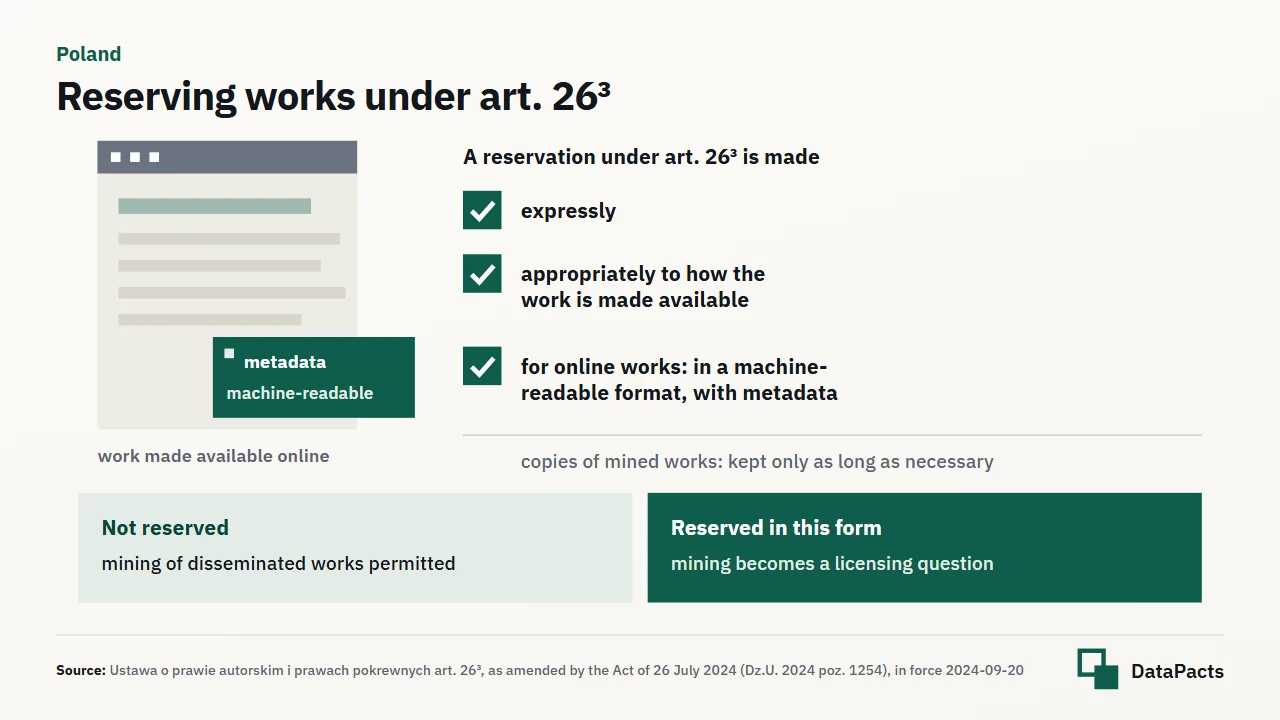
Article 26³ has been in force since 2024-09-20, and the AI systems act has applied since 2026-08-11.
This page sets out the Polish rules as of 2026-11-09. It is part of the wider reference on AI training data licensing and marks gaps instead of filling them.
Each figure is dated and checked against the official text, as described in the method for sourcing and dating every figure.
What Polish Law Adds to EU Rules Before a Company Licenses Data for Training
Polish law decides four things on top of the EU instruments: the form of a reservation against mining, where a national authority can be asked how the AI Act applies, what an employer may do with staff email, and how US royalties are taxed.
- Reservation against mining: copyright act art. 26³, with metadata for online works.
- National AI authority: arts 8 to 13 of the AI systems act, individual opinions on applying the AI Act.
- Staff email: Kodeks pracy art. 22³ §1-3.
- Tax: the US treaty rate of 10 % on royalties paid to Polish residents.
The GDPR (Regulation (EU) 2016/679, applies from 2018-05-25) applies directly in Poland. Positions of the Polish data protection authority, the Polish data protection act and rules on recording calls are not recorded on this page.
Polish Instruments and Authorities That Apply to a Training Data Deal
Nine Polish instruments, authorities and record gaps shape a training-data license, and the table gives each citation, its date and whether it is final or not stated. "Not stated" means no primary source was verified on 2026-11-09, not that no rule exists.
| Instrument | Citation | Dates | What it decides in a data deal | Final or not stated | Source |
|---|---|---|---|---|---|
| Copyright act art. 26³ | Ustawa o prawie autorskim i prawach pokrewnych art. 26³(1)-(3), as amended by the Act of 26 July 2024, Dz.U. 2024 poz. 1254 | promulgated 2024-08-19; in force 2024-09-20; art. 1 pkt 24 from 2025-02-20 | mining permitted unless reserved; reservation express and appropriate; online works: machine-readable format with metadata | final | api.sejm.gov.pl |
| Act on AI systems | Ustawa z dnia 3 lipca 2026 r. o systemach sztucznej inteligencji, Dz.U. 2026 poz. 1003; arts 5, 8 to 13 | promulgated 2026-07-27; in force 2026-08-11; arts 8 to 18 from 2026-10-28 | KRiBSI designated (art. 5); individual opinions on applying the AI Act (arts 8 to 13) | final; effect and deadline of an opinion not stated | api.sejm.gov.pl |
| GDPR | Regulation (EU) 2016/679 | applies from 2018-05-25 | legal basis, notices and transfers for personal data in the set | final | eur-lex.europa.eu |
| UODO positions on AI training | not stated | not stated | not stated | not stated | n/a |
| Polish data protection act | not stated | not stated | not stated | not stated | n/a |
| Kodeks pracy art. 22³ | Kodeks pracy art. 22³ §1-3, t.j. Dz.U. 2026 poz. 1245 | consolidated text published 2026-09-24 | business email monitored only where necessary; secrecy of correspondence; notice per art. 22² §6-10; no disclosure authorized | final | api.sejm.gov.pl |
| Kodeks pracy art. 22² (other monitoring) | not stated beyond §6-10 | not stated | not stated | not stated | n/a |
| Recording of calls and meetings | not stated | not stated | not stated | not stated | n/a |
| Withholding tax on data license payments: US-Poland treaty rates on royalties | IRS Tax Treaty Table 1, Rev. May 2023, income codes 10 and 12 | as of 2026-11-09 | 10 % US withholding on both codes for Polish residents, subject to limitation on benefits | final | irs.gov |
How Each Polish Rule Reaches the Seller and the Buyer
The table lists each instrument; the sections below show what each one asks of the data holder and of the AI developer.
Reserving Works From Mining Under Article 26³: Machine-Readable Format With Metadata
Article 26³ of the Polish copyright act (Ustawa o prawie autorskim i prawach pokrewnych), added by the Act of 26 July 2024 (Dz.U. 2024 poz. 1254) and in force since 2024-09-20, permits reproduction of disseminated works for text and data mining unless the rightholder has reserved otherwise.
The reservation is made expressly and appropriately to the way the work is made available. For works made publicly available online it is made in a machine-readable format, as defined in art. 2 pkt 7 of the 2021 open data act, together with metadata, and copies are kept only as long as necessary.
A reservation in this form turns mining into a licensing question. On our reading, a robots.txt line alone does not obviously carry the metadata the wording asks for, and no court decision on the point is stated here.
Art. 1 pkt 24 of the amending act applies from 2025-02-20; its content is not recorded here, and art. 26² is not described. The Directive's rule and the opt-out debate sit on the page about the EU text and data mining exception.
The 2026 Act on AI Systems: KRiBSI and Individual Opinions
Poland's Act of 3 July 2026 on artificial intelligence systems (Dz.U. 2026 poz. 1003), promulgated on 2026-07-27 and in force since 2026-08-11, implements the EU AI Act nationally and designates in art. 5 the Komisja Rozwoju i Bezpieczeństwa Sztucznej Inteligencji (KRiBSI) as supervisory authority and single point of contact.
Arts 8 to 13 let a company request an individual opinion from the Commission on how the AI Act applies to it, and art. 9 sets the content of the request. Arts 8 to 18 and chapters 3 to 5, 8 and 9 apply from 2026-10-28.
In a data deal, a seller or buyer can on our reading ask the Commission before signing. The binding effect of an opinion and its issue deadline are not stated here. Provider duties on training data, Article 53 of Regulation (EU) 2024/1689 (applies from 2025-08-02), remain EU duties.
Personal Data in the Set: UODO Positions Not Yet Recorded
No position of the Urząd Ochrony Danych Osobowych (UODO), Poland's data protection authority, on AI training data is recorded on this page as of 2026-11-09, so personal data in a Polish set is assessed under the GDPR alone here.
The Polish data protection act is not recorded either. noyb states that its complaints of 2024-06-06 about Meta's training went to 11 authorities, Poland's among them, and the outcome is not recorded. Legal basis, notices and transfers are covered on the page about the GDPR and AI training data.
Staff Email Under Kodeks Pracy Article 22³: Monitoring Is Not Disclosure
Article 22³ §1-3 of the Polish Labor Code (consolidated text Dz.U. 2026 poz. 1245, published 2026-09-24) lets an employer monitor business email only where this is necessary for work organization and the proper use of work tools, and it authorizes no disclosure of mailbox content to an outside party. The provision sets three conditions:
- Monitoring is necessary for work organization and the proper use of work tools.
- Monitoring does not breach the secrecy of correspondence or other personal rights.
- The notice rules of art. 22² §6-10 apply.
Licensing a mailbox archive to an AI buyer is a disclosure the provision does not cover, so on our analysis a seller needs another basis, such as consent or a GDPR ground.
The content of art. 22² beyond its notice paragraphs, including camera monitoring, is not recorded here. The comparison of mailbox rules is on the page about licensing a company email archive.
Recorded Calls and Meetings: Not Yet Recorded for Poland
No Polish rule on recording calls or meetings, or on passing recordings to a third party, is recorded on this page as of 2026-11-09, so recordings are assessed under the GDPR alone here. The comparison pages in the last section cover recorded jurisdictions.
Royalty Payments Between Poland and the United States
A US buyer paying a royalty to a Polish-resident seller withholds 10 % on copyright royalties (income code 12) and 10 % on other industrial royalties (income code 10) under IRS Table 1, Rev.
May 2023, subject to the treaty's limitation-on-benefits test. Polish withholding when a Polish buyer pays a non-resident is not stated here. Other countries are compared on the withholding page.
Enacted and Open: Polish Changes as of November 2026
Eight dated items show how Polish law has added to the EU layer since 2024, and the table keeps statutes, staged commencements and third-party complaints apart.
| Date | Item | Citation or actor | Status as of 2026-11-09 | Source |
|---|---|---|---|---|
| 2026-10-28 | Arts 8 to 18 and chapters 3 to 5, 8 and 9 of the AI systems act apply (individual opinions) | Dz.U. 2026 poz. 1003 | in force | api.sejm.gov.pl |
| 2026-09-24 | Consolidated text of the Labor Code published | Dz.U. 2026 poz. 1245 | published | api.sejm.gov.pl |
| 2026-08-11 | Act on AI systems enters into force | Dz.U. 2026 poz. 1003 | in force | api.sejm.gov.pl |
| 2026-07-27 | Act of 3 July 2026 on AI systems promulgated | Dz.U. 2026 poz. 1003 | final | api.sejm.gov.pl |
| 2025-02-20 | Art. 1 pkt 24 of the 2024 copyright amendment applies (content not recorded) | Dz.U. 2024 poz. 1254 | in force | api.sejm.gov.pl |
| 2024-09-20 | Copyright amendment, including art. 26³, enters into force | Dz.U. 2024 poz. 1254 | in force | api.sejm.gov.pl |
| 2024-08-19 | Act of 26 July 2024 amending the copyright act promulgated | Dz.U. 2024 poz. 1254 | final | api.sejm.gov.pl |
| 2024-06-06 | noyb complaints about Meta AI training filed with 11 authorities, Poland's among them | noyb (its own statement) | outcome not recorded | noyb.eu |
Both statutes are final, and no Polish bill on training data is recorded here. The noyb row is noyb's own statement. The full dispute is on the page about Meta AI training on EU user data.
Benefits, Risks, Downsides and Alternatives of Licensing Data Under Polish Law, Including Not Selling
Polish law lets a company license data it holds the rights to, and a properly formed reservation gives published content license value, but the metadata requirement, the staff email limits and unrecorded rules add conditions, and not licensing remains a valid choice.
Benefits
- A reservation in machine-readable form with metadata keeps a license necessary for online content.
- An individual opinion from KRiBSI can be requested under arts 8 to 13.
- A 10 % US treaty rate applies to royalties paid to Polish residents, as of 2026-11-09.
Risks
- A reservation without metadata may not meet art. 26³ for online works.
- Disclosing mailbox content falls outside art. 22³.
- UODO practice on training data is not recorded here.
Downsides
- Marking content with metadata and preparing staff notices cost time before any income.
- Items not stated here, such as the opinion deadline, UODO practice and recording rules, mean advice per deal.
Alternatives
- License only content without personal data.
- Keep the data and record a reservation under art. 26³.
- License de-identified data.
- Not selling or licensing at all, among the alternatives to selling data to AI labs.
Beyond the Polish Layer: EU Instruments, Topic Comparisons and the Sale
Polish law stops at the EU layer above it and at the contract; the pages below cover the EU instruments, compare topics across jurisdictions and apply the rules to a sale.
- European Union rules for AI training data, the parent and the EU layer above Polish law.
- AI training data law by jurisdiction, every jurisdiction compared.
- EU AI Act Article 53, what the AI Act asks of model providers.
- copyright and AI training across jurisdictions, how reservation rules compare.
- employee data and AI training rules by jurisdiction, employee data rules compared.
- call and meeting recording consent rules compared.
- privacy law and AI training data compared across jurisdictions.
- web scraping for AI training, including reserved content.
- robots.txt for AI crawlers, machine-readable signals.
- Germany rules for licensing data, the neighbor next door.
- company data partnership programs, compared.
- selling data to AI companies from outside the US.
- sell or license company data to AI companies, the steps of a sale.
How This Page Is Sourced and Dated
Every rule here cites the official ELI record of the Sejm (api.sejm.gov.pl), EUR-Lex or the IRS treaty table, with the date it was checked.
The rules for dating and checking are set out in the method for sourcing and dating every figure. This page is general information about Polish law, not legal advice for any specific deal.
Frequently Asked Questions
How does a Polish rightholder reserve works from AI mining?
By a reservation made expressly and appropriately, and for online works in a machine-readable format together with metadata. Article 26³ of the copyright act has applied since 2024-09-20.
Is Poland's AI systems act in force?
Yes, since 2026-08-11. Its arts 8 to 18, including the individual-opinion articles, apply from 2026-10-28, and the binding effect of an opinion is not stated.
Can a Polish employer license staff mailboxes for AI training?
Article 22³ of the Labor Code allows monitoring of business email, not disclosure of mailbox content. A license needs another basis.
What does a US buyer withhold from royalties paid to a Polish company?
10 % on copyright royalties and on other industrial royalties, as of 2026-11-09. IRS Table 1 applies subject to the limitation-on-benefits test.