The Third Circuit wrote on 2026-09-29 that "the market for licensing headnotes as text to train AI is rapidly developing", in its ROSS ruling on Westlaw headnotes. One buyer states a value range for law firms (checked 2026-11-09), and no signed deal for legal documents is on record as of 2026-11-10.
DataPacts Editorial Team checked the buyer pages, rules and court records cited here on 2026-11-09 and 2026-11-10, following how we source, date and check every figure.
What Counts as Legal Data in an AI Training License
Legal data in an AI license means records produced by legal work: matter files, court filings, contracts, policies, templates and research workflows, and the editorial content legal publishers add to court opinions.
The table sets each record type against what buyers say they ask for or exclude, as of 2026-11-10 (statements checked 2026-11-09, Mercor re-read 2026-11-10).
| Legal record type | Who asks for it (own statement) | Who excludes it (own statement) | Rule or ruling that applies | Source |
|---|---|---|---|---|
| Complete files from closed matters or completed transactions | Mercor Law Firm listing: 500+ documents per matter; client consent or fully anonymizable | Regulr excludes law-firm client files; Data Licensing Advisors takes no legal organizations | SRA Code for Firms 6.3; StGB s.203 | api.data.mercor.com; regulr.ai; datalicensingadvisors.com; sra.org.uk; gesetze-im-internet.de |
| Active matters | none | Mercor: not a fit | confidentiality duty as above | api.data.mercor.com |
| Single court filings without the rest of the file | none | Mercor: not a fit | 17 U.S.C. 105(a) for works of the US Government only | api.data.mercor.com; govinfo.gov |
| Privileged material and communications | none | Mercor (material clients won't release), AfterQuery (never used), Regulr (excluded) | none recorded here | api.data.mercor.com; afterquery.com; regulr.ai |
| Legal research workflows, process documentation, reusable templates | Handshake AI | none stated | employer owns works made by employees: 17 U.S.C. 201(b), CDPA 1988 s.11(2) | joinhandshake.com; govinfo.gov; legislation.gov.uk |
| Contracts, policies, compliance procedures | micro1; Sureform; Data Licensing Advisors | none stated | counterparty confidentiality terms | micro1.ai; sureformhq.com; datalicensingadvisors.com |
| Editorial legal content (headnotes) | none on record | none on record | 2,243 Westlaw headnotes held copyrightable, 3d Cir., 2026-09-29 | ca3.uscourts.gov |
"Not stated" never means "allowed". Templates and workflows made by employees belong to the employer as first owner, which is why they need no client consent while matter files do. These record types are part of the wider range of data types AI companies buy.
Court Records Versus Client Files
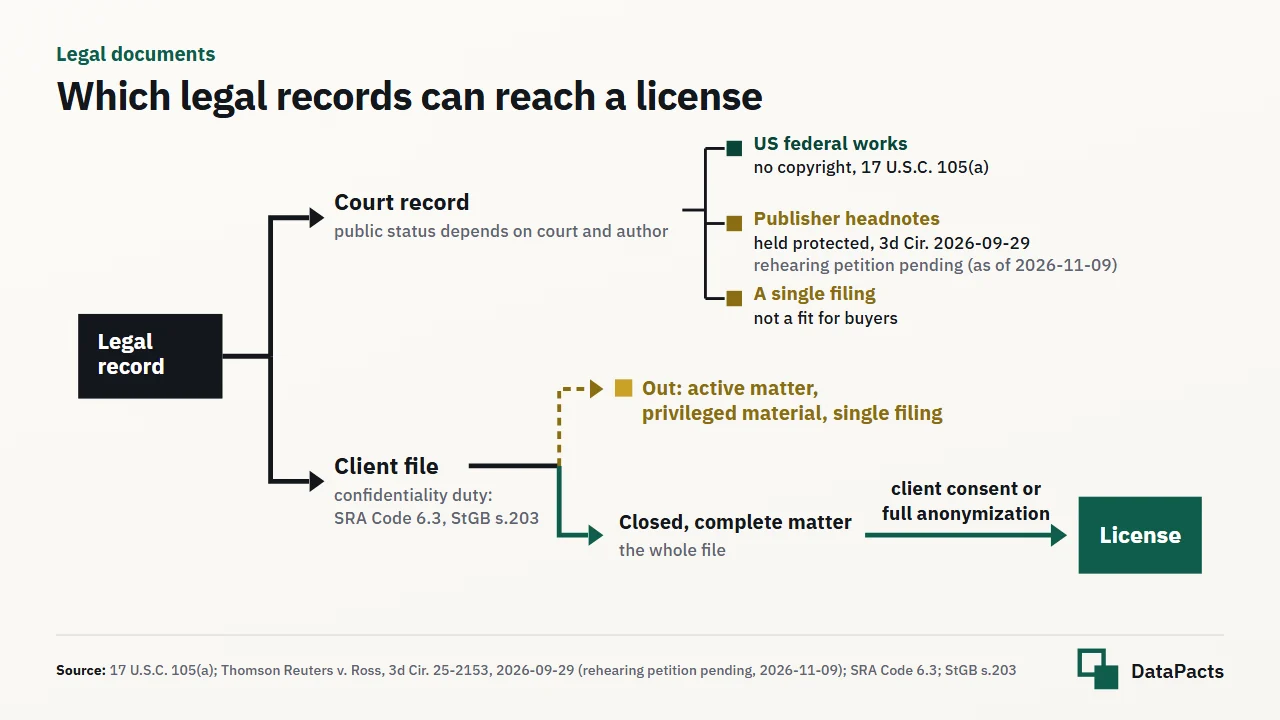
Court records and client files are different assets: a court record may be public, while a client file is held under a confidentiality duty, and buyers ask for the second, complete and closed, not single filings. Mercor lists single filings without the rest of the file as not a fit (re-read 2026-11-10).
17 U.S.C. 105(a) states that "Copyright protection under this title is not available for any work of the United States Government". The rule reaches works of the US Government only, never state government works, and works transferred to the Government can still be protected.
Headnotes show the other side. The Third Circuit held on 2026-09-29 that 2,243 Westlaw headnotes added by a publisher to court opinions are copyrightable, so public opinions and the editorial layer are separate assets. Material free of copyright is covered under public domain and openly licensed material.
Archives that hold judicial data raise a separate problem. Italy's Garante issued provvedimento n. 741 on 2024-11-27, a formal warning (avvertimento, GDPR Art. 58(2)(a)) that the content-sharing agreement of 2024-09-24 between GEDI Gruppo Editoriale S.p.A. and OpenAI could breach GDPR Arts. 9, 10, 13, 14 and Chapter III, because newspaper archives hold special-category and judicial data. The GDPR applies from 2018-05-25 (Art. 99(2)).
Privilege and Client Confidentiality in Legal Documents
Every buyer or intermediary that states a rule on privileged legal material excludes it, so privilege removes documents from a license rather than lowering their price. Each party states its own rule:
- AfterQuery states that payroll, privileged legal material and credentials are never used (checked 2026-11-09).
- Mercor lists privileged material that clients won't release, active matters and single filings without the rest of the file as not a fit (re-read 2026-11-10).
- Regulr, an intermediary, excludes law-firm client files and privileged communications (checked 2026-11-09).
The court-supervised Spirit Airlines sale draws the same line in a transaction: its Form of Bill of Sale (Dkt. 1463, Bankr. S.D.N.Y. No. 25-11897) excludes privileged materials and requires their return or destruction if they are transferred.
The sale was not approved as of 2026-11-09, with a hearing set for 2026-11-17 (Dkt. 1779), and the holder decides with its own counsel what privilege means for a transfer. For how those sales treat the rest of a debtor's data, see US bankruptcy data sales.
Professional Secrecy Rules With Primary Citations
A lawyer's secrecy duty applies before any license term: in England and Wales, SRA Code of Conduct for Firms 6.3 requires firms to keep current and former clients' affairs confidential unless disclosure is required or permitted by law or the client consents (version in effect from 2025-04-11).
In Germany, StGB s.203 makes a lawyer's disclosure of a client's secret a criminal offense, punishable by up to one year or a fine.
Under s.203(6) the penalty rises to up to two years or a fine where the offender acts for remuneration or to enrich or harm, and under s.205(1) the offense is prosecuted only upon request.
Rules for lawyers in the United States and other jurisdictions are not summarized here. Firm-level thresholds and buyer terms sit with law firms licensing data to AI companies.
Who Acquires Legal Documents, and Who Only Handles Them
Four buyers state on their own pages which legal records they take or refuse, and three intermediaries handle or screen such records for owners without acquiring anything. The buyers are AfterQuery, Handshake AI, Mercor and micro1, and the table gives what each takes or refuses.
Data Licensing Advisors, Regulr and Sureform advise, introduce or manage licensing for owners. The table lists each company by role, as of 2026-11-10, in alphabetical order within a role.
| Company | Role for legal records | What it acquires, handles or excludes (own statement, checked 2026-11-09) | Source |
|---|---|---|---|
| AfterQuery | buyer (business records) | business records; privileged legal material never used; re-identification test before delivery | afterquery.com/data-partnerships |
| Handshake AI (Stryder Corp. d/b/a Handshake) | buyer | legal research workflows and templates | joinhandshake.com/ai/data-partnerships |
| Mercor (Mercor.io Corporation) | buyer | complete closed matter files from law firms; legal first among 8 target industries | api.data.mercor.com; mercor.com/data |
| micro1 (micro1 Inc.) | buyer | "Legal & contracts" records: contracts, policies, compliance procedures | micro1.ai/data-partnerships |
| Data Licensing Advisors | intermediary, advises sellers | lists contracts among records it places; takes no legal organizations | datalicensingadvisors.com |
| Regulr (Regulr AI, Inc.) | intermediary, sell-side adviser | excludes law-firm client files and privileged communications | regulr.ai |
| Sureform | intermediary, identifies buyers and manages licensing | documents, contracts, designs | sureformhq.com |
Intermediaries introduce, advise or manage licensing for owners and do not acquire data.
Legal-tech software vendors are not listed. Every buyer and program is compared on who buys AI training data.
What Legal Documents Are Worth: One Stated Range, No Public Deal
One buyer publishes a range for legal records: Mercor states USD 50,000 to 1,250,000 per law firm, depending on matter size and completeness, checked 2026-11-09 and unchanged on 2026-11-10.
- The range is a deal range to the company, and its stated driver is matter size and completeness.
- Mercor states that it covers extraction, anonymization and transfer costs (checked 2026-11-09).
- The deal tracker holds no signed, disclosed deal for legal documents by a law firm, legal publisher or court-record holder as of 2026-11-10.
No per-document or per-matter price is published; the only size signal is Mercor's 500+ documents per matter. Price points for other data types appear in AI training data prices per record.
The range is one buyer's claim and not a typical price.
The ROSS Ruling and the Market for Licensing Legal Text
The Third Circuit affirmed on 2026-09-29 that ROSS Intelligence's use of 2,243 Westlaw headnotes to train a non-generative legal search tool was not fair use (No. 25-2153), and wrote that "the market for licensing headnotes as text to train AI is rapidly developing".
ROSS's petition for panel rehearing or rehearing en banc (Doc. 225, dated 2026-11-03) was pending as of 2026-11-09. Claims, rulings and status are set out in Thomson Reuters v. Ross Intelligence.
Contracts and Policies Held Outside Law Firms
Legal documents are not only a law firm asset: any company holds contracts, policies and compliance procedures, and one buyer program and two intermediaries name them. micro1 names "Legal & contracts" and "contracts, policies, compliance procedures" among records wanted, for companies with 30+ full-time employees.
Sureform names "documents, contracts, designs", and Data Licensing Advisors lists contracts among records it places (all checked 2026-11-09).
A contract can carry the counterparty's confidentiality terms, which can bar licensing the document. The license form a holder signs matters as well: micro1's Data License Master Terms, last updated 2026-11-08, grant in s.1.2 a worldwide, nonexclusive, irrevocable, perpetual and sublicensable license.
The clauses that bind a holder before licensing are set out under customer consent and confidentiality clauses.
Licensing Legal Documents: Benefits, Risks, Downsides and Alternatives, Including Not Licensing
Licensing legal documents can earn from closed files and firm know-how that sit unused, but secrecy and privilege rules fall on the holder, and a license already granted cannot be withdrawn from a trained model.
Benefits
- Mercor states a deal range for law firms (see the value section), a claim and not a promise.
- Firm-owned templates and workflows, which Handshake AI states it wants, need no client consent, because the employer owns works made by employees (17 U.S.C. 201(b); CDPA 1988 s.11(2)).
Risks
- Disclosure of client secrets is a criminal offense in Germany (StGB s.203), and SRA Code 6.3 binds firms in England and Wales.
- Every party that states a rule excludes privileged material.
- A regulator can warn on archives that hold judicial data, as the Garante did in provvedimento n. 741 of 2024-11-27.
Downsides
- micro1's terms state a perpetual, irrevocable license (s.1.2) and, in s.4.4, no duty to retrain.
- Mercor asks for client consent, or documents that can be fully anonymized, across matters with 500+ documents.
Alternatives
- License only firm-owned templates and workflows.
- License anonymized closed matters non-exclusively.
- Keep the archive for in-house use.
- Not licensing at all, weighed under whether to sell or license your data.
Neighboring Record Types and the Seller Steps for Legal Documents
This page covers legal records as a data type; general business documents, process documentation, email and financial records have their own pages, as do law firms as sellers. Neighboring pages:
- documents, wikis and drive files: general business documents
- SOPs, playbooks and process documentation: process documentation
- company email archive: matter correspondence held as email
- accounting, ERP and financial records: financial records
- Clio and law practice management data: exporting from practice management systems
- expert contributor work by field: paid evaluation work for lawyers is a separate route from licensing records (DataAnnotation lists legal among expert work areas, checked 2026-11-09)
Seller steps:
- Run a rights audit to find who owns each record.
- Apply PII removal and de-identification when anonymizing matter files.
- Check the list of company data that cannot be licensed for records that stay out of any license.
- Read the AI data licensing agreements clause by clause before signing.
This page is information, not legal advice. The law that applies to legal records is covered in AI training data law by jurisdiction, and how US courts weigh copying for training in fair use and AI training in US law.
Frequently Asked Questions
Are court records free to use for AI training?
Not as a class. 17 U.S.C. 105(a) leaves works of the US Government without copyright protection, but it does not reach state government works, and editorial additions such as the 2,243 headnotes were held copyrightable on 2026-09-29. Rules differ by country: see copyright and AI training across jurisdictions.
Do AI buyers accept privileged documents?
No buyer on record does. Mercor lists privileged material clients won't release as not a fit (re-read 2026-11-10), AfterQuery states privileged legal material is never used, and Regulr excludes privileged communications (checked 2026-11-09). Removing identifiers is covered under anonymization vs pseudonymization.
How much are legal documents worth to AI companies?
Mercor states USD 50,000 to 1,250,000 per law firm, depending on matter size and completeness (checked 2026-11-09). No signed deal for legal documents is on record. Methods and other price points are covered under what company data is worth to AI companies.
Advisers and agents can use the introducer form.