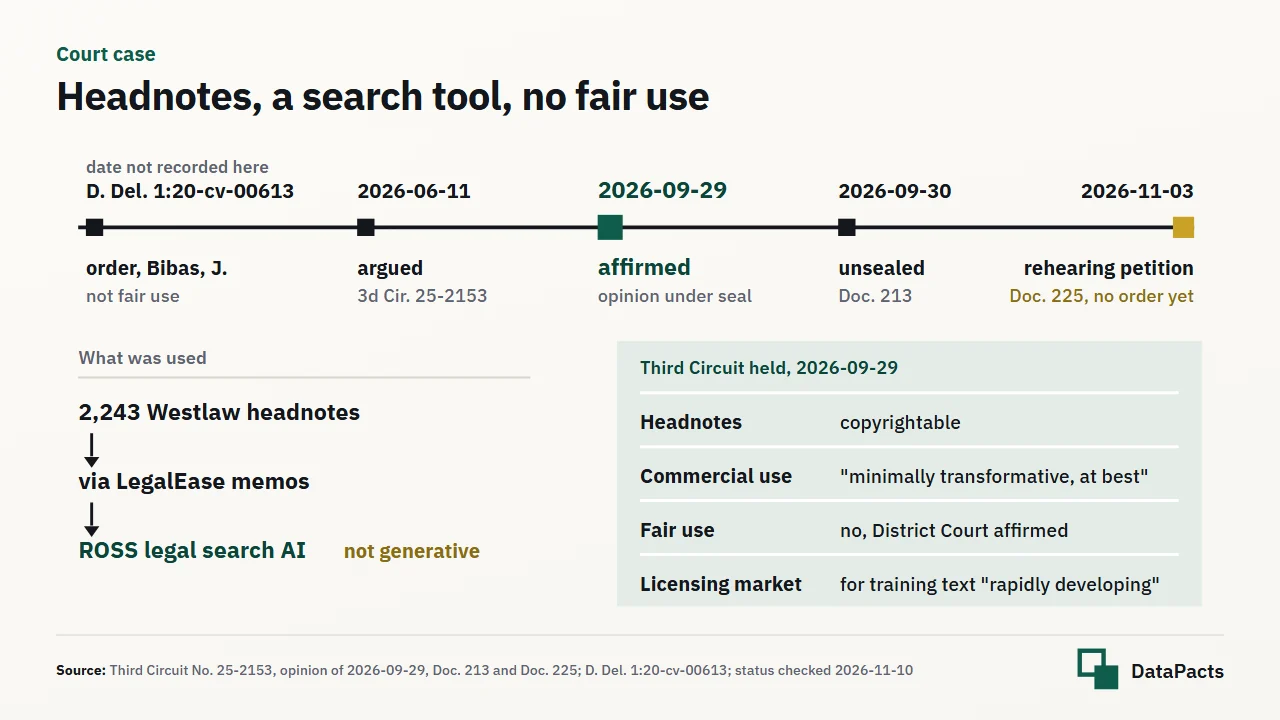
No earlier federal appellate fair use ruling on AI training is recorded in the DataPacts case tracker as of 2026-11-16, and the ruling concerns how a developer obtained text for an AI system without a license from the owner of that text.
The ruling covers a search tool, not a generative model, and the opinion says so in terms.
As of November 16, 2026, ROSS's petition for panel rehearing or rehearing en banc (Doc. 225, dated November 3, 2026) has no order on the docket, and the case then returns to the District Court for remaining issues.
ROSS Intelligence is the defendant legal research company. This page is part of the independent reference on AI training data licensing, is not affiliated with any party and gives no legal advice.
All facts and dates here come from the Third Circuit opinion and docket entries, and how figures are sourced and dated is set out on the methodology page.
Thomson Reuters v. Ross at a Glance: Courts, Dockets, Parties and Status
The appeal is decided and a rehearing petition is pending, so the ruling is not yet the last word in the case. The table lists the case facts as of 2026-11-10 with the document behind each.
| Field | Value | Source |
|---|---|---|
| Case | Thomson Reuters Enterprise Centre GmbH and West Publishing Corp. v. ROSS Intelligence Inc. | 3d Cir. opinion |
| Courts | U.S. District Court for the District of Delaware; U.S. Court of Appeals for the Third Circuit (interlocutory appeal) | 3d Cir. opinion |
| Dockets | D. Del. No. 1:20-cv-00613; 3d Cir. No. 25-2153 | 3d Cir. opinion |
| Judges | Bibas, J., sitting by designation (District Court); Montgomery-Reeves, J., with Restrepo and Bove (panel) | 3d Cir. opinion |
| Plaintiffs | Thomson Reuters Enterprise Centre GmbH; West Publishing Corp. | 3d Cir. opinion |
| Defendant | ROSS Intelligence Inc. | 3d Cir. opinion |
| Data at issue | 2,243 Westlaw headnotes, used through LegalEase memos to train a non-generative legal search AI | 3d Cir. opinion |
| Ruling | not fair use; District Court order affirmed 2026-09-29 | 3d Cir. opinion |
| Status | rehearing petition dated 2026-11-03 (Doc. 225); amicus filings in support through Doc. 240 (2026-11-12); no order on the petition as of 2026-11-16 | 3d Cir. Doc. 225; CourtListener docket 25-2153 |
What Thomson Reuters Claimed About ROSS's Training Data
Thomson Reuters claimed that ROSS infringed its copyrights in Westlaw headnotes by using them, through memos prepared by LegalEase, to train ROSS's legal search AI. Headnotes are the short editorial summaries of points of law that Westlaw attaches to court opinions.
The opinion identifies 2,243 headnotes as the works at issue. ROSS's AI was a legal search tool that returns existing legal material, not a generative model, and ROSS raised fair use as its defense.
The dispute therefore turned on two questions: whether short editorial summaries of the law are protected by copyright at all, and whether using them as training input was a fair use if they are. The plaintiffs are Thomson Reuters Enterprise Centre GmbH and West Publishing Corp., and the defendant is ROSS Intelligence Inc.
The wider question of legal texts as training data and what they are worth belongs to the page on legal documents and case files as AI training data, which this page does not repeat.
Thomson Reuters v. Ross Docket Entries, Delaware to the Third Circuit
Five dated entries carry the case from the District Court ruling to the rehearing petition: the District Court's partial summary judgment order, the Third Circuit argument, the sealed opinion, the unsealing order and ROSS's petition. The table lists them as of 2026-11-10, each with its source.
| Date | Court and entry | What it decided or reported | Source |
|---|---|---|---|
| date not recorded here | D. Del., partial summary judgment order (Bibas, J.) | headnotes copyrightable; ROSS's use not fair use; appealed on an interlocutory basis | 3d Cir. opinion (describes and affirms it) |
| 2026-06-11 | 3d Cir., oral argument | argued | 3d Cir. opinion |
| 2026-09-29 | 3d Cir., opinion filed under seal | affirmed; 2,243 headnotes; not fair use | ca3.uscourts.gov opinion PDF |
| 2026-09-30 | 3d Cir., Doc. 213 | opinion unsealed; parties agreed no redactions were needed | CourtListener Doc. 213 |
| 2026-11-03 | 3d Cir., Doc. 225 | ROSS petition for panel rehearing or rehearing en banc | CourtListener Doc. 225 |
No order on the rehearing petition was located as of 2026-11-10.
The District Court's Summary Judgment Ruling (Judge Bibas)
Judge Bibas, a Third Circuit judge sitting by designation in the District of Delaware (No. 1:20-cv-00613), granted Thomson Reuters partial summary judgment, holding that the headnotes were copyrightable and that ROSS's use of 2,243 of them infringed and was not fair use.
That is the order the Third Circuit later affirmed, and the appellate opinion is the text that now controls the two questions it decided.
The order went up on interlocutory appeal, before any trial, which is why the Third Circuit could rule on fair use while the District Court case stayed open. The table above leaves the date of the order blank because this page states only what the opinion itself records.
The Interlocutory Appeal, Third Circuit No. 25-2153
The Third Circuit heard argument on June 11, 2026 in No. 25-2153, with Judges Montgomery-Reeves, Restrepo and Bove on the panel. The appeal is from the District Court order, not from a final judgment, which keeps the remaining issues in the District Court.
The opinion is the court's own text and is the primary source for every holding on this page. The appeal reached the Third Circuit before the case was tried, so the panel reviewed the District Court's legal conclusions on copyrightability and fair use, not a jury verdict or a damages award.
The Opinion of September 29, 2026 and Its Unsealing
The Third Circuit filed its opinion under seal on September 29, 2026 and unsealed it by order the next day (Doc. 213), after the parties agreed that no redactions were needed.
The two court dates explain why a reader may meet either September 29 or September 30 for the ruling: the first is the filing, the second the unsealing. Judge Montgomery-Reeves wrote the opinion, with Judges Restrepo and Bove.
The opinion records four holdings:
- The 2,243 headnotes are copyrightable.
- ROSS's use was "minimally transformative, at best" and commercial.
- The use was not fair use, and the District Court order is affirmed.
- "The market for licensing headnotes as text to train AI is rapidly developing."
The affirmance does not reverse anything, and the opinion does not send fair use back for trial. The first holding fixes the status of headnotes as protected editorial work.
The second and third describe how the court weighed the purpose of ROSS's use: the use was commercial and only minimally transformative. The fourth is the sentence on which the licensing discussion below rests.
Why the Third Circuit Stressed That ROSS's AI Was Not Generative
The opinion notes that ROSS's AI "was not a generative AI", which limits how far the ruling reaches into suits over generative models. The court decided a search tool built on headnotes and did not decide whether training a model that writes new text is fair use.
A reader comparing the ruling with suits over large language models should therefore treat it as a precedent for non-generative uses and as an open question for generative ones.
The four statutory factors and the other US rulings are compared on the page about fair use and AI training in US law. The contrast is Bartz v. Anthropic, where the Order on Fair Use called training "exceedingly transformative" (Dkt. 231, June 23, 2025).
The opinion's footnote 7 cites the Statement of Interest that the United States filed on September 1, 2026 in MDL No. 3143.
In it, the Department of Justice argues that training a large language model that can generate original responses is transformative. That is the government's argument as the opinion cites it, not a holding of any court.
Status as of November 10, 2026: Rehearing Petition and Remaining Issues
As of November 10, 2026, ROSS's petition for panel rehearing or rehearing en banc, dated November 3, 2026 (Doc. 225), is the latest docket entry located, and no order on it was found. The petition carries the names of Gibson, Dunn & Crutcher, Pillsbury and White & Case as signing firms.
The docket listing, read on November 16, 2026, shows motions for leave and amicus briefs in support of rehearing filed from November 9 to November 12, 2026 (Doc. 229 to Doc. 240), among them the Foundation for American Innovation, Authors Alliance and Professor Brian L. Frye, and no order on the petition.
The petition asks the panel or the full court to reconsider the decision of September 29, 2026, and until the court acts on it the affirmance is not the last word.
Once the appeal ends, the case returns to the District Court for remaining issues. What those issues are and whether a trial date exists are not recorded here, and no Supreme Court filing is recorded.
Pending and final steps stay apart on this page: the holdings above are decided on appeal, while the petition and the remaining issues are not.
What the Ruling Means for Licensing Text as Training Data
The Third Circuit treated the lost market for licensing headnotes as AI training data as real, writing that "the market for licensing headnotes as text to train AI is rapidly developing".
On this record, a developing licensing market for training text counted against fair use, which links the court's reasoning to the sale and license of text for AI training.
How legal publishers and firms license data is set out under law firms licensing data to AI companies, and this page does not repeat it. What the record supports:
- A licensing market for training text counted against fair use on this record.
- Editorial summaries such as headnotes were held copyrightable.
- Headnotes used through a third party's memos (LegalEase) were the basis of the not-fair-use holding.
Thomson Reuters' news business appears in the deal tracker of AI data licensing deals as a licensor: Microsoft named Reuters among the sources for Copilot Daily on October 1, 2024, and the value was not disclosed. What the record does not settle:
- Whether training a generative model is fair use.
- The outcome of the rehearing petition.
- Any license price, because the record contains no figure.
The record is one case about one tool, so it does not set a price or a term for any license. This page is information, not legal advice.
Where Thomson Reuters v. Ross Sits Among Other Training-Data Cases
Thomson Reuters v. Ross is the only tracked training-data case decided by a federal court of appeals on fair use, and the tool at issue was not generative. The parent page holds the case tracker of AI copyright lawsuits over training data with every tracked case, docket and status.
The table compares four related cases as of 2026-11-09, each with its court record.
| Case | Court and docket | Ruling or status | Source |
|---|---|---|---|
| Bartz v. Anthropic | N.D. Cal. 3:24-cv-05417-AMO | training fair use (Dkt. 231, 2025-06-23); pirated copies settled, USD 1.5 billion fund, final approval and judgment 2026-07-20 (Dkt. 680) | CourtListener |
| Kadrey v. Meta | N.D. Cal. 3:23-cv-03417-VC | training claim decided for Meta on its record 2025-06-25 (Dkt. 598) | CourtListener |
| Music Publishers v. Anthropic (Concord I) | N.D. Cal. 5:24-cv-03811-EKL | summary judgment ruling pending as of 2026-11-09 | CourtListener |
| In re OpenAI Copyright Infringement Litigation | S.D.N.Y. MDL No. 3143 | cross-motions for summary judgment briefed; no ruling located as of 2026-11-09; DOJ Statement of Interest 2026-09-01 | JPML |
Each status carries its own as-of date, so the rows do not share one check date. Thomson Reuters v. Ross sits apart from them because its appellate ruling concerns headnotes and a search tool, while the district rulings in Bartz and Kadrey concern generative language models.
More About Thomson Reuters v. Ross
Decided Versus Still Open
Copyrightability of the 2,243 headnotes and the fair use defense are decided on appeal; the rehearing petition and the remaining District Court issues are not.
| Decided on appeal (2026-09-29) | Still open (as of 2026-11-10) |
|---|---|
| The 2,243 headnotes are copyrightable | The rehearing petition (Doc. 225) |
| ROSS's use was not fair use | The remaining District Court issues |
| The District Court order is affirmed | Any later order or further step |
Frequently Asked Questions About Thomson Reuters v. Ross
Who won Thomson Reuters v. Ross?
Thomson Reuters won on appeal: the Third Circuit affirmed on September 29, 2026 that ROSS's use of 2,243 headnotes was not fair use. A rehearing petition dated November 3, 2026 (Doc. 225) is pending, so the win is an affirmance of the District Court order and not yet a final end of the appeal.
Did the court say AI training is never fair use?
No, the opinion notes that ROSS's AI "was not a generative AI". District courts in Bartz and Kadrey ruled for the developers on training on their records, and those rulings concern generative language models, not a search tool.
Is the case over?
No, a rehearing petition dated November 3, 2026 (Doc. 225) had no order as of November 16, 2026, and the case then returns to the District Court for remaining issues. Which issues remain is not recorded here.
Has ROSS asked the Supreme Court to review the ruling?
No such filing is recorded as of November 10, 2026. The pending step is the rehearing petition.