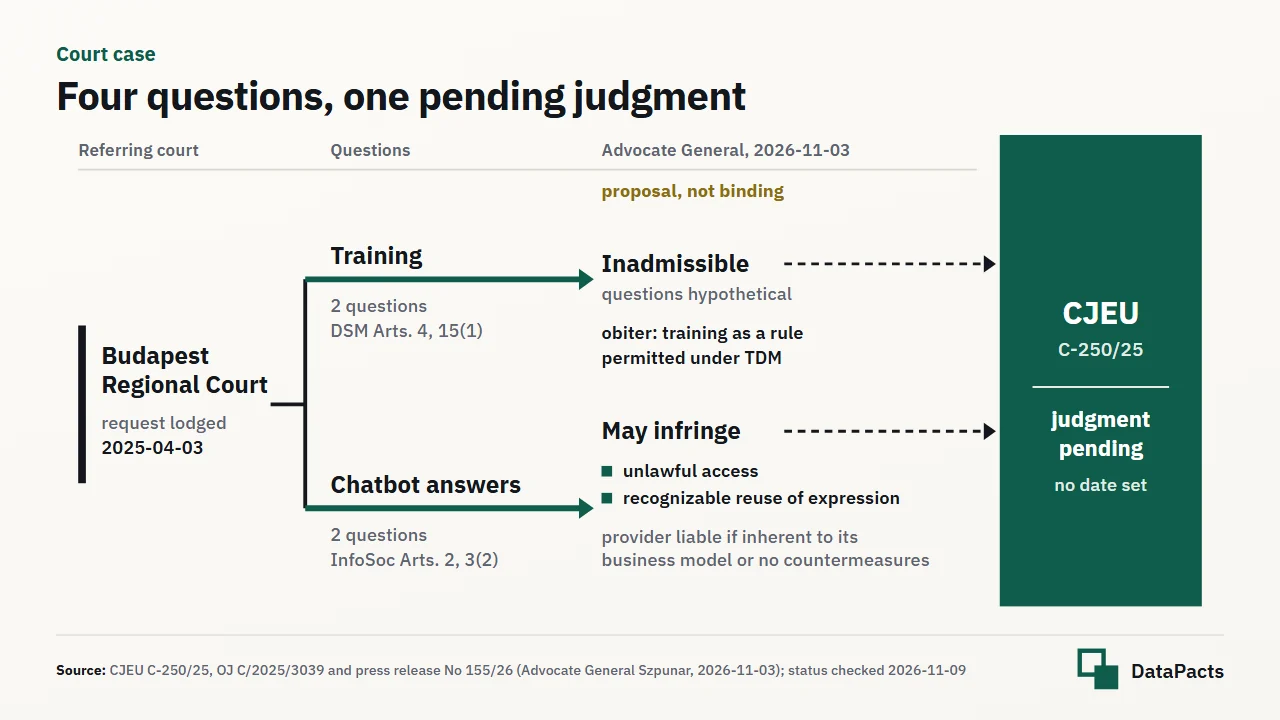
As of November 9, 2026, no judgment exists and no judgment date is set. The opinion proposes that the two training questions are inadmissible and that chatbot answers built on press articles may infringe in certain circumstances, but it is not binding.
This page is part of the independent reference on AI training data licensing, is not legal advice, and DataPacts is not affiliated with either party.
The facts here come from the Court's press release No 155/26 and the Official Journal notice, and the Google statement is dated; how figures are sourced and dated is set out on the methodology page.
Like Company v. Google at a Glance: Court, Docket, Parties and Status
The case is a pending preliminary reference, C-250/25, lodged on April 3, 2025, in which the Advocate General's opinion of November 3, 2026 is the latest step. The table lists the case facts as of 2026-11-09 with the source of each.
| Field | Value | Source |
|---|---|---|
| Case | Like Company v Google Ireland Limited, C-250/25 | OJ C/2025/3039; press release 155/26 |
| Court | Court of Justice of the European Union (preliminary reference) | press release 155/26 |
| Referring court | Budapest Környéki Törvényszék (Budapest Regional Court), Hungary | OJ C/2025/3039; press release 155/26 |
| Request lodged | 2025-04-03 | OJ C/2025/3039 |
| Claimant | Like Company, Hungarian operator of web portals | press release 155/26 |
| Defendant | Google Ireland Ltd., Alphabet group member providing Gemini | press release 155/26 |
| Provisions | DSM Directive Arts. 4 and 15(1); InfoSoc Directive Arts. 2 and 3(2) | OJ C/2025/3039 |
| Advocate General | Maciej Szpunar; opinion 2026-11-03 | press release 155/26 |
| Status | judgment pending; no date set | press release 155/26; case status 2026-11-09 |
What Like Company Claims About Gemini and Its Press Articles
Like Company, a Hungarian operator of web portals, claims the press publishers' right in Article 15(1) of the DSM Directive over its articles and says Google used them to train Gemini models and reproduced and made them available through the Gemini chatbot between June 13, 2023 and May 31, 2024. That period is Like Company's claim as the Court summarizes it, not a finding.
The referring court, the Budapest Környéki Törvényszék (the Court renders it "Budapest Regional Court"), referred four questions. Two ask whether training a large language model (LLM) on press publications falls under the publisher's reproduction right or the text and data mining exception in Article 4 of the DSM Directive.
Two ask whether chatbot answers fall under the reproduction right or the right of making available, citing Articles 2 and 3(2) of the InfoSoc Directive (Directive 2001/29/EC).
The defendant is Google Ireland Ltd., the Alphabet group member that provides Gemini. The press release gives no registry number or legal form for Like Company, and none is stated here.
The provisions come from Directive (EU) 2019/790 (OJ L 130, 17.5.2019, p. 92), in force since June 6, 2019, with a transposition deadline of June 7, 2021.
Articles 4 and 15 of that directive are under interpretation in this case. No court has found that Like Company's articles were used for training or answers. The table sets the four questions beside the Advocate General's proposals.
| Question | Subject | Provisions | Advocate General's proposal | Source |
|---|---|---|---|---|
| Training 1 | whether using press publications to train an LLM falls under the publisher's reproduction right or the text and data mining exception | DSM Arts. 15(1) and 4 | inadmissible as hypothetical; obiter: training as a rule permitted under the exception | press release 155/26 |
| Training 2 | same subject, second question | DSM Arts. 15(1) and 4 | inadmissible as hypothetical; obiter: training as a rule permitted under the exception | press release 155/26 |
| Answers 1 | whether chatbot answers fall under the reproduction right | DSM Art. 15(1); InfoSoc Art. 2 | may infringe in certain circumstances (unlawful access; recognizable reuse of expression); provider liable where inherent to its business model or without credible, effective countermeasures | press release 155/26 |
| Answers 2 | whether chatbot answers fall under the right of making available | DSM Art. 15(1); InfoSoc Art. 3(2) | may infringe in certain circumstances; provider liability as in Answers 1 | press release 155/26 |
Table as of 2026-11-03: proposals of an Advocate General, not a judgment.
Advocate General Szpunar's Opinion of November 3, 2026
Advocate General Maciej Szpunar delivered his opinion on November 3, 2026 (press release No 155/26), proposing that the Court set aside the two training questions and answer the two questions about chatbot answers.
An Advocate General proposes a legal answer to the Court, which is not bound by it. The opinion is not binding on the Court, and this page states it as summarized in the Court's press release, so the reasoning behind each proposal is not reproduced here.
The Two Training Questions: Proposed Inadmissible, With an Obiter on Training
The Advocate General advised the Court to declare the two questions on LLM training inadmissible because they are hypothetical. If the Court follows that proposal, it would not answer them, and the question of how Article 4 applies to LLM training would stay without a ruling in this case.
For the sake of completeness, he suggested that using protected works to train an LLM is, as a rule, freely permitted under the text and data mining exception. That passage is an obiter, not binding and not a ruling.
The Article 4(3) condition, that the use has not been expressly reserved in an appropriate manner, such as machine-readable means for content made publicly available online, is set out in full on the page on the EU text and data mining exception and the opt-out.
Chatbot Answers and the Press Publishers' Right: Access and Recognisable Expression
On the two questions about chatbot answers, the Advocate General suggested that when an LLM-driven chatbot retrieves a press publication, reuses it to generate an answer and gives that answer to the user, the press publisher's right may be infringed in certain circumstances. For the reproduction right, the press release names two factors:
- whether the chatbot accessed the publication unlawfully;
- whether the answer reuses the publication's form of expression in a recognisable way, to such an extent that the user can dispense with the original.
This part concerns real-time retrieval, that is, a chatbot fetching articles when it answers, and not training. The press release links the possible infringement to these two factors and gives no further test, so this page adds none. It is a proposal to the Court and not law.
When the Chatbot Provider Would Be Liable
The Advocate General proposed that the chatbot provider is liable for such uses of press publications where they are inherent to its business model or where it has not put in place appropriate measures to counter them credibly and effectively.
This is a proposal to the Court, not a finding against Google, and no court has found infringement in the case.
Status and Next Steps in C-250/25
As of November 9, 2026 the Court of Justice has not given judgment in C-250/25, and no judgment date is set. The opinion of 2026-11-03 is the latest step, and the Court gives its judgment at a later date.
The Court interprets EU law through preliminary references such as this one. The Hungarian court's own proceedings are not described on this page beyond the four questions it referred.
| Date | Step | Source |
|---|---|---|
| 2023-06-13 to 2024-05-31 | period of use claimed by Like Company (as summarized by the Court) | press release 155/26 |
| 2025-04-03 | request for a preliminary ruling lodged | OJ C/2025/3039 |
| 2026-11-03 | Advocate General Szpunar's opinion; press release No 155/26 | curia.europa.eu |
| not set | judgment | press release 155/26 ("at a later date") |
Timeline as of 2026-11-09: no judgment exists, and the opinion is not binding.
Between the opinion and the judgment, the case record holds nothing further that this page states. The triggers for a re-check are a judgment date on the Court's calendar and the judgment itself.
This page is updated then, together with the C-250/25 rows on the case tracker and the EU law pages. The page keeps opinion and judgment apart in every row, so a reader can see which step each statement comes from. No outcome is predicted here.
What the Opinion Signals for Press Publishers Whose Articles Chatbots Retrieve
For a press publisher, the opinion separates two uses of its articles: training, which it treats as, as a rule, permitted text and data mining, and chatbot answers built on retrieved articles, which it says may infringe the press publishers' right in certain circumstances.
The control Google offers is covered on the page about Google-Extended and opting out of Gemini training: Google states that the Google-Extended robots.txt token covers training future Gemini models and grounding, and does not affect Search inclusion or ranking (Google's statement, checked 2026-11-09). The press release does not mention that token.
Both points are an Advocate General's proposal, not law, until the Court gives judgment. A publisher that reads the opinion should therefore treat the training passage as an obiter and the chatbot passage as a proposal with two conditions, neither of which is a settled rule.
A publisher can also license its articles instead of relying on a reservation or a claim, or do neither. These are separate choices with different costs and different evidence needs, and none is required by the opinion.
The comparison of licensing, its downsides and not licensing sits on the page for news publishers licensing content to AI companies. This section is information, not legal advice.
Tracker updates by email
Where C-250/25 Sits Among Other Training-Data Cases
C-250/25 is the only training-data copyright case in the tracker before the EU Court of Justice, and the national courts in Germany and the United States are deciding related questions under their own law.
The case tracker of AI copyright lawsuits over training data lists every tracked case with docket and status. The table compares the cases that share a question with C-250/25, as of 2026-11-09.
| Case | Court and docket | Question shared with C-250/25 | Status | Source |
|---|---|---|---|---|
| Kneschke v. LAION | LG Hamburg 310 O 227/23; OLG Hamburg 5 U 104/24; BGH I ZR 281/25 | reproduction for an AI training dataset under the German exceptions | pronouncement scheduled 2026-12-17, 08:45 | BGH case notice |
| GEMA v. OpenAI | Landgericht München I, 42 O 14139/24 | § 44b UrhG and copies in a model | judgment 2025-11-11, not final | Munich court press page |
| News Publishers v. Perplexity (New York Times row) | S.D.N.Y. 1:25-cv-10106-LAP | news content used by an AI answer engine | pending | New York Times SEC filing |
| In re Google Generative AI Copyright Litigation | N.D. Cal. 5:23-cv-03440 | training Google models on books and images | pending | govinfo court record |
Google's own data-buying profile records the case among its litigation, see Google's licensing, programs and litigation. The rows differ in law and jurisdiction, so a result in one does not decide another.
More About Like Company v. Google
Opinion Versus Judgment: What Is Settled and What Is Still Open
Nothing in C-250/25 binds anyone yet: the record holds a request, four questions and a non-binding opinion.
| Settled | Still open |
|---|---|
| request lodged 2025-04-03 (OJ C/2025/3039) | whether the Court rules on the training questions at all |
| four questions referred | how the Court answers the chatbot-answer questions |
| opinion delivered 2026-11-03 | whether Like Company's articles were used for training (the record does not establish it) |
Frequently Asked Questions About C-250/25
Has the Court of Justice ruled in Like Company v. Google?
No. The Advocate General delivered his opinion on November 3, 2026, and the judgment is pending with no date set as of November 9, 2026.
Did the Advocate General say AI training is legal?
No, he proposed that the training questions be declared inadmissible. He added, as an obiter, that training is as a rule permitted under the text and data mining exception; this is not binding.
Which court referred the case?
The Budapest Környéki Törvényszék in Hungary referred the case. The Court renders its name as "Budapest Regional Court". For national rules, see Hungarian law for data licensing.
Who are the parties?
Like Company, a Hungarian web-portal operator, and Google Ireland Ltd. Google Ireland is the Alphabet group member that provides Gemini.
Does the case decide whether Like Company's articles were used for training?
No court has found that. The training questions may not be answered at all. This page is information, not legal advice.